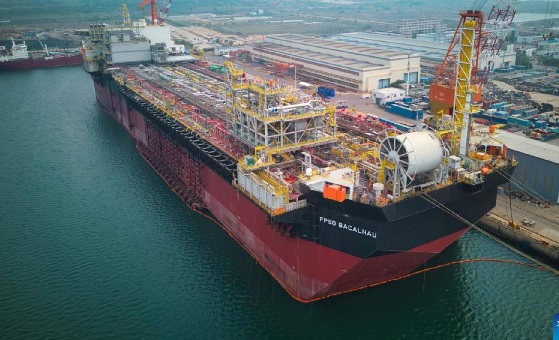
DALIAN, May 29 (Xinhua) — A large-scale offshore oil production base, which can process 220,000 barrels of crude oil per day, was delivered to the coastal city of Dalian in northeast China’s Liaoning Province on Friday.
Named Bacalhau, the M350 floating, production, storage, and offloading (FPSO) hull was jointly developed by Dalian Shipbuilding Industry Co., Ltd. (DSIC) and Mitsui Ocean Development & Engineering Company.
The FPSO is a high-end large-scale offshore engineering base designed to exploit deep-sea oilfields. It can undertake preliminary processing such as sediment filtration, oil-gas separation, oily sewage treatment and storage, and loading and unloading crude oil.
“The daily production capacity of Bacalhau delivered today is equivalent to an oil and gas processing plant covering an area of 10 square kilometers on land,” said Han Yu, project manager at the offshore project management team of DSIC.
The Bacalhau has a total length of 364 meters, a beam of 64 meters, a depth of 33 meters, and a displacement of more than 460,000 tonnes.
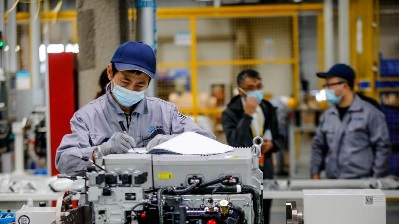
BEIJING, May 29 (Xinhua) — Profits of China’s major industrial firms fell 20.6 percent year on year in the first four months of the year, data from the National Bureau of Statistics showed Saturday.
Industrial firms with annual main business revenue of at least 20 million yuan (about 2.83 million U.S. dollars) saw their combined profits at about 2.03 trillion yuan in the period.
NANCHANG, May 29 (Xinhua) — More German business people are seeking opportunities in east China’s Jiangxi Province, taking advantage of the regional industrial opportunities to make their businesses high-end, intelligent, and environment-friendly.
From Tuesday to Friday, the “Xplore China-Jiangxi” exchange conference was held in the provincial capital Nanchang. With more than 60 German business representatives present, the conference focused on the complementary industries of Jiangxi and Germany, such as the digital economy, new energy, automobile, equipment manufacturing, and environmental protection.
“Nanchang is my second hometown,” said Sascha Rensen, global business development manager (Asia Pacific) of Nefab Packaging. He first came to Nanchang in 2015 and has witnessed its rapid development.
Being adjacent to the Yangtze River Delta region and the Greater Bay Area, Jiangxi’s industrial and supply chains have improved after years of development, with electronic information, equipment manufacturing, biopharmaceutical, and new energy being the leading industries in the province.
Germany has become an important investment and trading partner of Jiangxi. In 2022, the import and export trade volume between Jiangxi and Germany reached over 1.66 billion U.S. dollars.
A total of 13 projects were inked at the conference, with a total investment contract value of 222 million U.S. dollars. In the meantime, the provincial department of commerce and the German Chamber of Commerce in China signed a memorandum of understanding on strategic cooperation.
After visiting several electronic information and equipment manufacturing enterprises in Jiangxi, Maximilian Butek, executive director and board member of German Chamber of Commerce in China, said that China is forging ahead on industrial modernization, which brings many opportunities. “We can participate in carbon reduction and other industries related to the common goals of China and Germany.”
“We hope that Chinese and German enterprises can strengthen communication and explore how to utilize business opportunities in Jiangxi and establish a long-term partnership,” said Butek.
A group of leading German enterprises has already invested in Jiangxi, including Giesecke & Devrient (China) Technologies Co., Ltd., and Fresenius Kabi (Nanchang) Co., Ltd. German companies have established a total of 61 companies in the province with a total investment of 462 million U.S. dollars. “These enterprises have not only developed themselves but also brought advanced technology, management experience, and marketing concepts to Jiangxi, which is a win-win for both sides,” said Rao Zhixin, deputy director of the provincial department of commerce.
Rao said Germany has a leading global electronic and electrical industry and hoped that Jiangxi and Germany could expand and strengthen cooperation in multiple fields such as semiconductors, electronic equipment, electronic components, and specialized raw materials.
Jiangxi will strive to create a first-class business environment and is planning to build a Sino-Germany industrial park for German enterprises to settle down, making the park a key destination for foreign investment, according to Rao.
“We also set up a company in Nanchang in February, focusing on the Internet of Things, hardware services, and Internet security businesses. This is our strategic decision after long-term consideration because Nanchang has great opportunities and market potential,” said Rensen. “In the future, we hope our investment plan will go well in a good business environment with the policy support of the government.”
BEIJING, May 29 (Xinhua) — China’s tablet shipments jumped 38 percent year on year to 6.5 million units in the first quarter of 2023, according to a report by the technology market research firm Canalys.
Apple Inc. led the tablet market, with shipments more than doubling to 2.5 million units. Chinese tech giant Huawei ranked second, with shipments rising 23 percent to 1.1 million units.
Economic activity has picked up in recent months, but business and consumer spending on computers remained conservative, the report said.
Personal computer shipments fell 24 percent year on year to 8.9 million units from January to March.
Lenovo, the top vendor of personal computers, saw its shipments down 24 percent year on year to 3.3 million units during the period.
BEIJING, May 29 (Xinhua) — From delivering food at the doorstep to picking tea, China has witnessed a remarkable expansion in the utilization of robots across diverse settings, transforming industries and people’s daily life.
At the seventh World Intelligence Congress held from May 18 to 21 in the northern Chinese city of Tianjin, a robot shaped like a mantis climbing up and down caught the attention of visitors.
It’s the first intelligent tower robot to be rolled out by the State Grid Tianjin Electric Power Company.
Guided by a skilled staff member, the tower robot adeptly maneuvers its eight claws. Even when faced with obstacles like nails or tilted timber, the robot effortlessly traverses them. Upon reaching its assigned position, it deftly secures the bolts and nuts, showcasing its exceptional precision and agility.
Powered by a built-in lithium battery, the robot can work for more than 10 hours. “The assembly of transmission tower is risky. The robot integrates bionic climbing, intelligent perception, human-computer interaction, and other technologies, which can effectively reduce the risk for on-site workers,” said Ma Jun, who works at the State Grid Tianjin Electric Power Company.
Today, the use of robots in China has expanded across various sectors, including agriculture, logistics, education and healthcare.
An impressive example of this technological advancement was seen in Hangzhou’s West Lake scenic spot, located in east China’s Zhejiang Province. Here, a tea-picking robot equipped with a sun hat made of solar panels maneuvers through rows of renowned Longjing tea bushes using its agile mechanical arms and caterpillar wheels.
The introduction of the 550-kg robot tea picker has been a boon for local tea planters, who have been facing a significant shortage of labor lately.
In southwest China’s Guizhou Province, robots are used to conduct routine inspections at power substations in remote mountainous areas.
So far, 13 robots have been deployed at 10 power substations in the city of Tongren, where they can conduct automatic inspection patrols, according to the Guizhou branch of the China Southern Power Grid.
Equipped with high-precision sensors and high-definition cameras, the robots can complete a routine patrol in 50 minutes, compared with 12 hours by humans, who must also spend another 40 minutes traveling to the substation, said Zhou Jingyu, head of the Taiping Power Substation in Tongren.
Earlier this year, China said it will strive to double its manufacturing robot density by 2025 compared with that of 2020, according to an action plan issued by the Ministry of Industry and Information Technology and 16 other government departments.
The use of service and special robots will be significantly increased by 2025, with the capability of the country’s robotics industry to promote high-quality economic and social development markedly improved, the plan stated.
As for the future application of robots, Hu Yuchen, co-founder of Shanghai Dajie Robot Co., Ltd., said that flexible manufacturing has not been realized in many factories at this stage.
“We hope that industrial robots have eyes and also a brain with flexible control to help some heavy and high-polluting industries facilitate machines replacing humans,” Hu said.
BEIJING, May 29 (Xinhua) — The Agricultural Development Bank of China, a rural policy bank, has issued financial bonds worth 23 billion yuan (about 3.25 billion U.S. dollars) to shore up rural development.
The bonds include those designated for supporting the supply and price stability of grain and other important farm produce, according to the bank.
It has issued more than 15 trillion yuan of financial bonds in China since 2004.
As China’s only agricultural policy bank, it has offered credit support to agriculture and rural areas, with a focus on key fields, weak links, and areas that have shaken off poverty, and facilitated the allocation of resources to rural areas.
In the next stage, the bank will offer more distinctive and diversified bond products in domestic and overseas capital markets to attract more investment in rural revitalization.
BEIJING, May 29 (Xinhua) — Stocks on the Shanghai bourse saw their key indices up at the end of April compared with the end of March this year, according to the People’s Bank of China, the country’s central bank.
At the end of April, the Shanghai Stock Exchange Composite Index closed at 3,323.3, up 50.4 points, or 1.5 percent, month on month.
The Shenzhen Stock Exchange Component Index closed at 11,338.7 points at the end of last month, down 387.7 points, or 3.3 percent, from the end of March.
In April, the daily average turnover was 494.42 billion yuan (about 69.87 billion U.S. dollars) on the Shanghai bourse, up 23.9 percent month on month, and 646.88 billion yuan on the Shenzhen bourse, up 21.8 percent month on month.
LANZHOU, May 29 (Xinhua) — China has started digitalization work of a Buddhist temple in northwest China’s Gansu Province dating back more than 900 years ago.
Giant Buddha Temple, also known as the Dafo Temple in Zhangye City, was built in 1098 during the Western Xia Dynasty (1038-1227) and is an important ancient temple on the Silk Road.
This time, digital information from the Grand Buddha Hall, the Library of Buddhism, and a pagoda, including about 30 figures in the hall, frescos of more than 530 square meters as well as carvings on the bricks, is to be collected.
When the work is completed, visitors will be able to see the temple’s layout in different dynasties, the construction process of the large reclining Buddha, as well as Buddhist legends on the frescoes in the new digital gallery, according to Wang Kang, head of the cultural relics institute of Zhangye Giant Buddha Temple.
He noted that the temple had gone through several renovations and reconstructions in the Ming and Qing Dynasties (1368-1911), and digital technology made it possible for people to see its original appearance.
For the sake of protection, the second floor of the Grand Buddha Hall is normally closed to the public. “In the future, people will be able to see all parts of the hall in the digital world,” Wang added.
Digitalization work will be extended to other items and buildings in the temple complex in the next step.
DETROIT, the United States, May 26 (Xinhua) — Chinese Commerce Minister Wang Wentao met here Friday with South Korea’s Trade Minister Ahn Duk-geun, with both sides vowing to intensify bilateral trade and economic cooperation.
Meeting on the sidelines of the two-day 2023 APEC Ministers Responsible for Trade Meeting, the two ministers exchanged views mainly on maintaining stability of industrial and supply chains and strengthening bilateral, regional and multilateral cooperation.
Noting that China-South Korea economic and trade relations have been continuously deepening under the strategic guidance of the two countries’ heads of state, Wang said China’s efforts in promoting high-standard opening-up will create new opportunities for countries worldwide including South Korea.
China is ready to work with South Korea to deepen bilateral trade and investment cooperation, maintain the stability of the industrial chain and supply chain, and jointly push bilateral, regional and multilateral economic and trade cooperation to a new level, Wang said.
Ahn said that the importance of South Korea-China economic and trade relations has been increasing in recent years, and the close cooperative relationship between the two countries has played an important role in ensuring the stability and unimpeded flow of the global supply chain.
South Korea is willing to further deepen bilateral economic and trade cooperation and expand the areas for bilateral cooperation under regional and multilateral frameworks, he said.
Both sides agreed to strengthen dialogue and cooperation in the field of semiconductor industrial chain and supply chain.


 DALIAN, May 29 (Xinhua) — A large-scale offshore oil production base, which can process 220,000 barrels of crude oil per day, was delivered to the coastal city of Dalian in northeast China’s Liaoning Province on Friday.

 BEIJING, May 29 (Xinhua) — Profits of China’s major industrial firms fell 20.6 percent year on year in the first four months of the year, data from the National Bureau of Statistics showed Saturday.


