The following are the central parity rates of the Chinese currency renminbi, or the yuan, against 24 major currencies announced on Friday by the China Foreign Exchange Trade System:
Currency Unit Central parity rate in yuan
U.S. dollar 100 687.17
Euro 100 749.45
Japanese yen 100 5.1693
Hong Kong dollar 100 87.541
British pound 100 851.27
Australian dollar 100 461.31
New Zealand dollar 100 430.69
Singapore dollar 100 517.60
Swiss franc 100 752.37
Canadian dollar 100 508.24
Malaysian ringgit 64.262 100
Ruble 1,124.62 100
Rand 259.36 100
Korean won 18,884 100
UAE dirham 53.443 100
Saudi riyal 54.622 100
Hungarian forint 5,068.48 100
Polish zloty 62.369 100
Danish krone 99.39 100
Swedish krona 150.71 100
Norwegian krone 151.23 100
Turkish lira 279.042 100
Mexican peso 263.31 100
Thai baht 496.86 100
The central parity rate of the yuan against the U.S. dollar is based on a weighted average of prices offered by market makers before the opening of the interbank market each business day.
The central parity rate of the yuan against the Hong Kong dollar is based on the central parity rate of the yuan against the U.S. dollar and the exchange rate of the Hong Kong dollar against the U.S. dollar at 9 a.m. in international foreign exchange markets on the same business day.
The central parity rates of the yuan against the other 22 currencies are based on the average prices offered by market makers before the opening of the interbank foreign exchange market.
The purchasing managers’ index (PMI) for China’s non-manufacturing sector came in at 58.2 in March, up from 56.3 in February, the National Bureau of Statistics said Friday.
A reading above 50 indicates expansion, while a reading below it reflects contraction.
The central parity rate of the Chinese currency renminbi, or the yuan, strengthened 169 pips to 6.8717 against the U.S. dollar Friday, according to the China Foreign Exchange Trade System.
In China’s spot foreign exchange market, the yuan is allowed to rise or fall by 2 percent from the central parity rate each trading day.
The central parity rate of the yuan against the U.S. dollar is based on a weighted average of prices offered by market makers before the opening of the interbank market each business day.
Chinese internet company Meitu on Thursday said it generated over 2.08 billion yuan (about 302 million U.S. dollars) in revenue in 2022, up 25.2 percent year on year.
Meitu recorded an adjusted net profit of 111 million yuan last year, up 29.9 percent year on year.
Meitu’s VIP subscription service saw strong growth last year amid surging demand for AI-generated content, achieving a revenue of 782 million yuan, up 57.4 percent, according to the company’s annual report.
Its revenue from the image software as a service (SaaS) business totaled 463 million yuan, and the revenue from online advertising hit 596 million yuan.
Founded in October 2008, Meitu is an AI-driven technology company that aims to “beautify” users with its image products and beauty management services.
China imported macadamia nuts worth 5.18 million U.S. dollars from Zimbabwe in 2022, the Chinese Embassy in Zimbabwe said Thursday.
“Hope to see a good harvest of macadamia nuts and greater export earnings for Zimbabwe this year,” the embassy said in a tweet.
China imported agricultural products worth 657 million U.S. dollars from Zimbabwe in 2022, up 22.64 percent year-on-year, underlying China as a big market for Zimbabwean agricultural products.
China ranked as the third largest importer of Zimbabwean goods last year, according to data from the country’s trade promotion body ZimTrade and statistics office, the Zimbabwe National Statistics Agency.
Zimbabwe’s agricultural exports to China are set to grow further after the two countries last year signed a citrus trade protocol that could expand citrus exports to China, one of the world’s biggest consumers of citrus products.
Zimbabwe’s first shipment of citrus products to China is set for April this year, ZimTrade has confirmed.
Five foreign leaders on Thursday called on all countries to stick to solidarity and cooperation to jointly meet global challenges and promote world economic growth, while delivering speeches at the opening ceremony of the Boao Forum for Asia Annual Conference 2023.
The following are the highlights of their remarks.
Singapore’s Prime Minister Lee Hsien Loong:
China is one of the biggest economies in the world. Its consumer market is huge and expanding. Its technology is advancing rapidly. Its work force is increasingly skilled.
We welcome China’s commitment to continue opening up its economy, and to continue supporting multilateralism and regional cooperation, and we look forward to all parties contributing more actively to regional and global development and prosperity, to benefit Asia and the world.
Spain’s Prime Minister Pedro Sanchez:
We all believe in a strong transparent and rule-based multilateral system as a framework for discussing global challenges. No global problem can be solved unilaterally.
Europe and Asia must join forces to tackle global challenges and promote economic development worldwide. We have to take every opportunity to promote dialogue and cooperation for our own sake and for the wellbeing of our future generations. China and Asia are known for their can-do spirit and there’s so much we can do together.
Malaysia’s Prime Minister Datuk Seri Anwar Ibrahim:
In the light of this, we should work closely together in a spirit of cooperation and solidarity, striving towards reducing inequality, promoting social justice and enhancing standards of living for all.
Translating of the ideas of the practical reality, solidarity and cooperation is best exemplified in the realization of the Belt and Road Initiative. With a pandemic behind us, we should try to gain or regain its momentum.
Prime Minister of Cote d’Ivoire Patrick Achi:
This forum is therefore more important today than ever not only for Asia, but also for Africa, a continent of the dawn of humanity. Africa aspires for prosperity and modernity. However, current challenges are enormous.
I want to seize this opportunity to address these challenges because I believe that resolutions reached through cooperation and solidarity between nations are closely linked with the future of Africa and even all humanity.
Managing Director of the International Monetary Fund (IMF) Kristalina Georgieva:
Cooperation has already transformed the global economy by deepening trade integration — which has boosted incomes and living standards across the world.
Over the past 40 years, the world economy has tripled in size, with emerging and developing countries quadrupling in size — making them the biggest beneficiaries.
Likewise, for countries all across Asia, trade integration has been a key ingredient of strong GDP growth for many decades.
How can policymakers navigate this time of uncertainty?
This year’s Boao Forum offers an answer: through cooperation and solidarity, the twin beacons of light we can rely on to guide us through the challenges that lay ahead.
Despite all the forces of fragmentation, we know we are stronger together.
Together, we spread a guiding light far and wide. Together, we can navigate the rough waters to reach a safe harbor. Together, we are wealthier and more secure.
OpenLab 3.0 Asia-Pacific, Huawei’s latest regional center for joint innovation and solution R&D, has been officially inaugurated here on Friday.
Aiming to accelerate the digital transformation, the 20-million-U.S. dollar project will upgrade the OpenLab in Singapore and radiate its capabilities across the Asia-Pacific (APAC) and beyond.
“OpenLab 3.0 is a global technology platform for local partners, customers, and institutions of higher learning in the APAC. It explores joint solutions based on the demands of various industries and continuously contributes to building the digital APAC,” Nicholas Ma, president of Huawei APAC Enterprise Business Group, said.
“OpenLab 3.0, a platform for innovation, experience, and know-how sharing, exemplifies our talent-centric commitment, and is set to emerge as a pivotal hub for talent cultivation across the region,” said Zhang Zhengjun, vice president of Huawei APAC Public Affairs and Communications.
The launching ceremony of OpenLab 3.0 Asia-Pacific, witnessed by Goh Pei Sheng, vice president of the Singapore Economic Development Board’s Digital Industry Singapore, saw the attendance of over 60 participants from the technology and public sector, industry associations, and universities.
Huawei has established OpenLabs worldwide which serve as open innovation platforms where the Chinese company joins forces with local partners to develop industry solutions for the region. Its OpenLab in Singapore was officially launched in 2016.
China’s non-manufacturing activity this month registered the fastest expansion in more than a decade thanks to rapidly recovering services and a vibrant construction industry, official data showed Friday.
The purchasing managers’ index (PMI) for the non-manufacturing sector went up for a third straight month to 58.2 in March, the highest since May 2011, according to the National Bureau of Statistics (NBS). The figure was 56.3 in February and 54.4 in January.
A reading above 50 indicates expansion, while a reading below it reflects contraction.
Senior NBS statistician Zhao Qinghe said the recovery of the service sector gained momentum with effective pro-consumption measures and the construction industry also reported quicker expansion as building projects across the country picked up pace amid the warming weather.
The sub-index for the service sector was 56.9 in March, higher than 55.6 last month and 46.7 a year ago. In particular, business activities of retail and transport stood well above 60, indicating improving consumption and travel sentiment of residents.
Meanwhile, the construction sector’s sub-index was 65.6 this month, up from 60.2 in February. The labor demand of building companies has increased for three consecutive months, and the optimism about the sector’s prospects has remained high for four months in a row.
The carbon emission intensity of major agricultural products in China is on a downward trend, according to a report released by the Chinese Academy of Agricultural Sciences (CAAS) on Friday.
“China has achieved a low carbon emission intensity in agriculture, making a positive contribution to addressing global climate change,” said Mei Xurong, vice president of the CAAS.
According to the report, China’s gross agricultural product accounts for 9.5 percent of the total gross domestic product (GDP), while the total carbon emissions from agricultural production account for only 6.7 percent of China’s total carbon emissions.
China has ensured food security and the effective supply of important agricultural products, while achieving a low carbon emission intensity in agriculture, the report said.
The report also highlighted the important role of science and technology in low carbon agriculture.
It said that China invests around 100 billion yuan (about 14.6 billion U.S. dollars) each year to support the construction of high-standard farmland. Adopting new technologies enables an increase in food production while reducing carbon emissions.
In recent years, China has made use of renewable energy technology to treat more than 500 million tonnes of organic waste from agriculture and rural areas each year, effectively reducing environmental pollution and carbon emissions, the report added.
The ChiNext Index, tracking China’s Nasdaq-style board of growth enterprises, gained 0.69 percent to close at 2,399.5 points Friday.
The ChiNext Index, together with the Shenzhen Component Index and other indices, reflects the performance of stocks listed on the Shenzhen Stock Exchange.


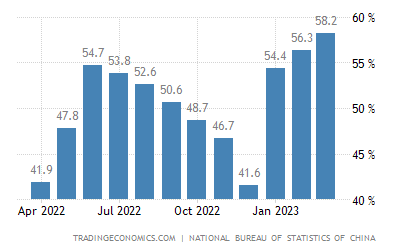
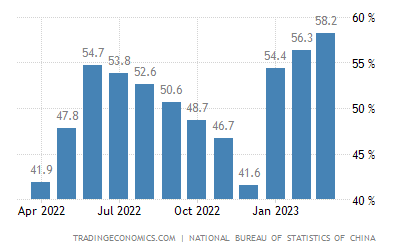 The purchasing managers’ index (PMI) for China’s non-manufacturing sector came in at 58.2 in March, up from 56.3 in February, the National Bureau of Statistics said Friday.


