China’s consumer price index (CPI), a main gauge of inflation, rose 1 percent year on year in February, the National Bureau of Statistics said Thursday.
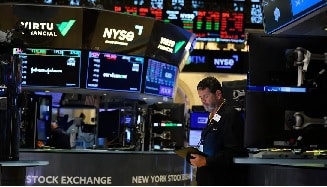
U.S.-listed Chinese companies traded lower on Tuesday, with all the top 10 stocks by weight in the S&P U.S. Listed China 50 index ending the day on a downbeat note.
Shares of Li Auto and Baidu sank 5.64 percent and 4.6 percent, respectively, leading the slide in the top 10 stocks.
Shares of NIO and NetEase dropped 3.65 percent and 3.08 percent, respectively, also among the worst performers in the top 10 stocks.
Wall Street's major averages tumbled on Tuesday as Federal Reserve Chair Jerome Powell's tough talk on interest rates spooked investors.
A bright future lies ahead for Sino-Greek cooperation in shipping, Chinese and Greek speakers told an event at Greece’s Piraeus port on Tuesday.
“Cooperation between China and Greece came initially from the sea, and its future lies in the sea,” said the president of the Association of Banking and Financial Executives of Hellenic Shipping at the event.
George Xiradakis said that Sino-Greek ties in maritime affairs are “strong and long-lasting,” and have benefited the whole world.
Almost 50 percent of energy resources, and 20 percent of other products and goods imported in China are transported by Greek-owned ships. Many Greek shipowners also build their ships in China, Xiradakis told the event.
Chinese Ambassador to Greece Xiao Junzheng said in his speech that in 2022, China’s shipbuilding completions, new orders and pending orders accounted for 47.3 percent, 55.2 percent, and 49 percent respectively of the global total in terms of deadweight tons. The potential of Sino-Greek shipping cooperation should be tapped even further, he added.
Speakers at the event agreed that China’s COSCO Shipping’s investment has transformed Piraeus port since 2008.
Piraeus today is an integrated international maritime center, and a vital driving force in global supply chains, Xiradakis stressed.
COSCO’s investment has boosted Piraeus to the 5th port in Europe, and 9th internationally in the Xinhua-Baltic Shipping Centers Index (ISCD), said Piraeus’ Vassilis Korkidis.
The president of the company’s Chamber of Commerce and Industry, which co-organized the event, said: “We haven’t forgotten that when we were between the three austerity measures of the EU memoranda, under capital controls with an uncertain future (during the Greek debt crisis in the period 2009-2018), China trusted Greece (…), respected our history and friendship and invested in our country.”
Both Chinese and Greek investors are committed to continuing the sustainable development of the port as a global shipping center, Korkidis added.
Chinese investment in Piraeus has so far created 3,000 direct jobs, and 10,000 indirect jobs. It has also contributed over one billion euros (1.06 billion U.S. dollars) to the local economy, Xiao told the event.
“China and Greece are important partners in the joint construction of the Belt and Road Initiative. The two ancient civilizations are learning from each other (…) and there has historically been goodwill between the two countries,” the ambassador said. (1 euro= 1.06 U.S. dollar)
China's foreign exchange reserves came in at 3.1332 trillion U.S. dollars at the end of February, according to the State Administration of Foreign Exchange on Tuesday.
The U.S. dollar index increased and the prices of global financial assets generally fell last month, affected by global macroeconomic data and monetary policy expectations of major economies. China's foreign exchange reserves fell last month due to the combined effects of currency translation and asset price changes, according to the foreign exchange regulator.
China's foreign exchange reserves are expected to maintain generally stable thanks to the country's efforts to promote steady economic recovery and high-quality development, and the great potential and impetus for the development of the Chinese economy, it added.
The central parity rate of the Chinese currency renminbi, or the yuan, weakened 369 pips to 6.9525 against the U.S. dollar Wednesday, according to the China Foreign Exchange Trade System.
In China's spot foreign exchange market, the yuan is allowed to rise or fall by 2 percent from the central parity rate each trading day.
The central parity rate of the yuan against the U.S. dollar is based on a weighted average of prices offered by market makers before the opening of the interbank market each business day.
Early in the morning at a Chinese rail port, a massive crane was hoisting cargo containers and loading them onto a waiting train.
The containers carried China’s homemade FAW-Hongqi cars. After rolling off the production line in Changchun, northeast China’s Jilin Province, the cars were loaded in the land port and transported to Europe via the China-Europe freight train service.
Over the past few years, the China-Europe freight train service has witnessed rapid expansion in Jilin Province, and the old industrial base has also accelerated its auto exports to the European market through the service.
In the first two months of this year, Changchun Xinglong Customs handled a total of 826 passenger cars exported via the China-Europe freight trains. The figure exceeded the whole of last year, according to Wang Yongjia, deputy director of the Changchun Xinglong customs.
In addition to the export of complete cars, some industrial machinery such as auto parts are also shipped from Changchun to European countries via the service, Wang added.
“The vehicles transported via China-Europe freight trains can reach the European market faster (than sea routes), which not only saves the cash flow but also offers a flexible option for shipment according to overseas sales plans,” said Dai Wei, general manager of Changchun International Land Port Development Co., Ltd.
Cooperation between Chinese automakers such as FAW and overseas enterprises has also accelerated, in a push to make cars more adaptable to the overseas market. FAW has set up overseas R&D institutions such as a design center in Munich and an R&D company in Austria for Jiefang, FAW’s truck brand.
Dai noted that auto glass, carbon, and aluminum products manufactured in Changchun have also been shipped to European countries.
In 2022, Jilin Province launched China-Europe freight trains designated for transporting automobiles and clean energy products for the first time. Since 2023, the province has sent out 11 China-Europe freight trains, carrying 605 twenty-foot equivalent units, according to local authorities.
The ChiNext Index, tracking China's Nasdaq-style board of growth enterprises, was down 0.33 percent to open at 2,375.87 points Wednesday.
The ChiNext Index, together with the Shenzhen Component Index and other indices, reflects the performance of stocks listed on the Shenzhen Stock Exchange.
The following are the central parity rates of the Chinese currency renminbi, or the yuan, against 24 major currencies announced on Wednesday by the China Foreign Exchange Trade System:
Currency Unit Central parity rate in yuan
U.S. dollar 100 695.25
Euro 100 733.63
Japanese yen 100 5.0652
Hong Kong dollar 100 88.569
British pound 100 822.32
Australian dollar 100 458.16
New Zealand dollar 100 425.19
Singapore dollar 100 513.31
Swiss franc 100 737.90
Canadian dollar 100 505.45
Malaysian ringgit 64.363 100
Ruble 1,086.85 100
Rand 267.72 100
Korean won 18,845 100
UAE dirham 52.838 100
Saudi riyal 53.999 100
Hungarian forint 5,168.51 100
Polish zloty 63.963 100
Danish krone 101.49 100
Swedish krona 154.30 100
Norwegian krone 153.84 100
Turkish lira 272.158 100
Mexican peso 260.42 100
Thai baht 503.95 100
The central parity rate of the yuan against the U.S. dollar is based on a weighted average of prices offered by market makers before the opening of the interbank market each business day.
The central parity rate of the yuan against the Hong Kong dollar is based on the central parity rate of the yuan against the U.S. dollar and the exchange rate of the Hong Kong dollar against the U.S. dollar at 9 a.m. in international foreign exchange markets on the same business day.
The central parity rates of the yuan against the other 22 currencies are based on the average prices offered by market makers before the opening of the interbank foreign exchange market.
China's benchmark prices for spot interbank gold transactions were mixed Wednesday, according to the China Foreign Exchange Trade System.
The benchmark price for gold that is 99.95 percent pure or above stood at 419.74 yuan (about 60.37 U.S. dollars) per gram, up 0.35 yuan from the previous trading day, while the price for gold that is 99.99 percent pure or above went down 0.5 yuan to 419.76 yuan per gram.
Spot transaction prices on the interbank price inquiry market are allowed to rise or fall within 15 percent from the benchmark prices each trading day.
The interbank gold price inquiry business was introduced in 2012 to enhance market liquidity and enrich trading models.