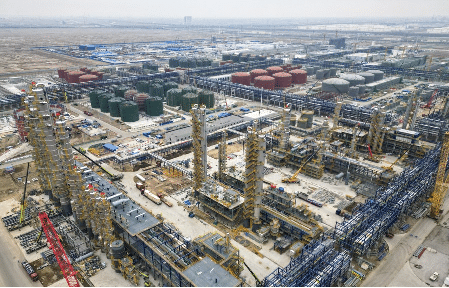
A total of 36 manufacturing projects with an investment of 66.8 billion yuan (around 9.8 billion U.S. dollars) were signed on Tuesday in north China's Tianjin Municipality, local authorities said.
The signed projects include five new energy projects, nine information technology projects, and six high-end equipment projects, with an investment of 19.5 billion yuan, 17.4 billion yuan, and 8.3 billion yuan, respectively, said Yin Jihui, director of the Tianjin industry and information technology bureau.
Since the beginning of 2023, Tianjin has attracted 160 projects with a total investment of 80.5 billion yuan, injecting new momentum into the high-quality development of Tianjin’s manufacturing industry, said Yin
China's central bank plans to issue 25 billion yuan (about 3.67 billion U.S. dollars) worth of bills in Hong Kong next Tuesday.
The central bank bills will be issued in two batches. One is worth 10 billion yuan with a maturity of three months, or 91 days. The other is worth 15 billion yuan with a maturity of one year, the People's Bank of China said in a statement.
The move aims to enrich yuan-investment products with high credit ratings in Hong Kong and improve the yield curve of yuan in the region, the central bank said.
Since November 2018, the bank has established a standard mechanism for issuing central bank bills in Hong Kong.
Hong Kong's stock market ended lower on Wednesday with the benchmark Hang Seng Index down 1.43 percent to close at 20,812.17 points.
The Hang Seng China Enterprises Index fell 1.30 percent to end at 7,018.14 points, and the Hang Seng Tech Index lost 0.97 percent to close at 4,288.75 points.
In a science and technology park in north China’s Tianjin municipality, dozens of mechanical arms moved along a production line, while busy robots carrying components weaved around.
Each day more than 2,000 sets of power batteries were turned out, which would be used for nearly 200 electric vehicles.
The scene is a sharp contrast to three years ago when production of the line was suspended from time to time in the Tianjin Lishen Battery Joint-Stock Co., Ltd. due to an order shortage.
Lishen started providing power batteries for the Dongfeng Motor Corporation four years ago, delivering about 53,000 sets by last year. In 2023 alone, however, it is estimated that 45,000 sets will be supplied.
“We didn’t stop working even during the Spring Festival holiday,” said Zhao Xiaojun, deputy head of Lishen’s power battery manufacturing department.
“Now that we are no longer worried about order shortage, we fear that we couldn’t complete the orders on time.”
Lishen is just one of the examples to show the resilience of the Chinese economy after the country relaxed its COVID-19 restrictions late last year.
According to statistics by the China Association of Automobile Manufacturers (CAAM), in 2022, output and sales of new energy vehicles in China were 7.06 million and 6.89 million, up 96.9 percent and 93.4 percent, respectively.
The International Monetary Fund (IMF) has lifted its forecast for China’s economic growth this year to 5.2 percent from a previous prediction of 4.4 percent.
Behind economic resilience is the ability of risk resistance.
Suppliers for Lishen are mostly domestic companies. Last May when the consignments were hindered by the COVID-19 pandemic, local authorities in Tianjin helped to arrange for closed-loop delivery so as to ensure production in Lishen.
“If we stop our production, the loss per day would be as much as 30 million yuan (about 4.4 million U.S. dollars),” said Zhao.
In 2022, in spite of the pandemic, the revenue of power batteries in Lishen soared by 76 percent.
The high-tech industry is an important driver of economic growth.
According to China’s State Council Information Office, last year’s investment in high-tech industries witnessed rapid growth, up 18.9 percent from the previous year. The growth rate for high-tech manufacturing was 22.2 percent, and the rate for high-tech services was 12.1 percent.
Another Tianjin-based company, TCL Zhonghuan Semiconductor Co., Ltd., is working on its new project, producing a solar ultra-thin single wafer of 25 GW used for the transformation of light into electricity. Zhang Xuenan, deputy chief engineer of the company, told Xinhua that once in full operation, the project could generate a revenue of billions of yuan, creating jobs for thousands.
“This project is another example of China’s economic growth potential,” said Bo Wenguang, vice president of the Binhai Development Research Institute of Nankai University. “The potential is gradually expanded and unleashed.”
Two new projects are under construction in Lishen, with investment for each topping ten billion yuan. A third one is being discussed. Once in operation, their combined production capacity could be at least ten times the company’s current capacity.
“I’m sure that constant innovation, research, and development could keep injecting impetus into our company,” said Lishen’s general manager, Zhang Qiang.
Chinese stocks closed lower on Wednesday, with the benchmark Shanghai Composite Index down 0.39 percent to 3,280.49 points.
The Shenzhen Component Index closed 0.25 percent lower at 12,064.38 points.
The combined turnover of stocks covered by the two indices stood at 937.3 billion yuan (about 137.5 billion U.S. dollars), up from 914 billion yuan on the previous trading day.
Shares related to electronic information, media, and entertainment led the gains, while the hotel and tourism sectors suffered losses.
The ChiNext Index, tracking China's Nasdaq-style board of growth enterprises, lost 0.7 percent to close at 2,547.2 points Wednesday.
With unbridled excitement, Ulantuya, who hails from Mongolia, indulged in a shopping spree at a bustling mall in Erenhot, a major city on the China-Mongolia border.
“There is a great variety of products here. I will surely take many of them home,” said Ulantuya, surrounded by a swarm of Mongolian merchants and customers.
Border cities like Erenhot have seen booming business and greater people-to-people exchanges since cross-border travel resumed between China and its neighbors on Jan. 8, as part of the country’s optimized COVID-19 response.
Zhang Yuan, who has been running a leather goods shop at the mall for 12 years, was delighted to have Mongolian merchants back. “As I reconnected with old friends, warm greetings were exchanged, and our handshakes lingered just a tad longer than usual,” Zhang said.
Statistics from the commerce department of China’s Inner Mongolia Autonomous Region showed the Erenhot highway port has recorded a daily average of about 600 passenger trips since Jan. 8. The port also handled 1.42 million tonnes of cargo in January, up 98.2 percent year on year.
Ceke Port, located in Alxa League in Inner Mongolia, is an important cross-border channel for mineral products transportation.
At a worksite in Ceke, Mongolian containers brimming with coal were hoisted onto waiting trucks before being shipped to various corners of China.
According to the regional department of commerce, inbound and outbound cargo volume at Ceke Port increased by 105,000 tonnes in January compared with December.
In Ganqmod Port, the largest highway port on the China-Mongolia border, trucks loaded with copper powder, coal and other mineral products were seen lining up to enter China.
With an impressive five-fold surge in the volume of goods handled since the start of 2023, cross-border trade is off to a roaring start at the bustling port, said Hecheltu, deputy director of the management committee of the Ganqmod Port.
Boldoo, a truck driver from Ulaanbaatar, Mongolia, has transported mineral products between China and Mongolia for eight years, mainly via Ganqmod Port.
“The port has seen an increasing number of trucks coming from Mongolia over the past month,” said Boldoo. “I now earn 6,000 yuan (about 876.6 U.S. dollars) a month by making two trips every week. My family’s life has greatly improved since I began this job.”
Multiple engineering experiments are currently underway, or poised to begin, at a cabinet on China's space station which is in a near-Earth orbit. These experiments aim to acquire know-how that can support more experimental possibilities and human survival in outer space.
The Space Basic Experiment Cabinet mounted on the country's space lab module Mengtian is carrying its first group of five experiments on space technology, figuring out how to resist microbes that may eat away spacecraft metals, produce oxygen from algae in space, and convert heat energy into electricity.
MICROBES AND ALGAE
One of the drawers installed onto the cabinet is the microbial resistance facility. Microbes tend to have significant corrosive influence on materials in a confined space module, which makes effective in-orbit management of them crucial for any long-term space presence.
The facility in a detachable box is projected to complete the first high-throughput microbial resistance experiment in the world, in which the microbial growth will be actively controlled in microgravity before implementing PCR testing and subsequent quarantine and disinfection.
The first microbe being tested is fungus Aspergillus niger, a type of mildew that may corrode the copper and aluminum all
The box will be used as a key biological safety platform for scientific research and technical identification in the space station, according to the
China Academy of Space Technology (CAST).
Aside from potential hazards, the biological chemistry in space can also be utilized to produce fundamental elements for human survival. An algae cultivation test in the cabinet is designed to examine how efficiently the water plant can generate oxygen and how to cook it on site.
Microalgae is a primary producer on Earth that makes the planet oxygen-rich and it is believed to be highly tolerant to zero-gravity and cosmic radiation. Also, some kinds of it are capable of synthesizing protein, fatty acid, and sugar-like nutrients to offer safe food supplements for astronauts.
In Mengtian, the algae will be cultivated in both solid and liquid cultures and then the liquid-supported algae will be heated in a “microwave oven.”
This is a significant attempt that may lay a foundation for extended space travel and long-term human habitation in the future, said the CAST.
POWER AND METALS
A pilot engine called Stirling thermoelectric converter has also been put on the experimental rack. The heat-to-electricity conversion tech involves two pistons in a cylinder moving at high frequency, which can convert thermal energy to electricity with relatively high efficiency and power density.
Chinese engineers are trying to verify the feasibility and stability of it in orbit, so as to provide clues for developing advanced power technology in space that can be used in future deep-space exploration.
Another experiment in the cabinet may tell material scientists how to utilize the liquid metal in space.
The alloyed metals like gallium-based and bismuth-based ones can flow at normal temperatures or slightly higher than that. They exhibit several desirable properties including good conductivity, high boiling points, and good capacity for heat transmission.
Such an experiment on Mengtian will verify the liquid metal’s performance in rapid melting, electromagnetic drive, sealing, and inflation protection, which may help give birth to emerging and disruptive technologies, according to the CAST.
The last of the five experiments is set to evaluate the hazards of chippings produced by a device based on friction between electric brushes and slip rings. The device is used for power and signal transfer in solar array drive assembly and spacecraft altitude control gyroscope.
However, it’s still unknown how those rubbing fragments floating in the capsule will affect space work — how those granules move or whether they will cluster in microgravity.
The test is designed to take pictures of their real motions to lay a foundation for an optimized device that can ensure long-duration operation of spacecraft, according to the CAST.
China's central bank on Wednesday added liquidity to the banking system via operations of medium-term lending facility (MLF) and reverse repos.
The People's Bank of China (PBOC) injected 499 billion yuan (about 73.19 billion U.S. dollars) into the market through one-year MLF with an interest rate of 2.75 percent.
The central bank also conducted 203 billion yuan of seven-day reverse repos at an interest rate of 2 percent.
The move aims to maintain reasonable and sufficient liquidity in the banking system, the central bank said.
A reverse repo is a process in which the central bank purchases securities from commercial banks through bidding, with an agreement to sell them back in the future.
The sales revenue of China's gaming industry totaled 265.8 billion yuan (about 39 billion U.S. dollars) in 2022, according to an industry report released on Tuesday.
The 2022 China gaming industry report was released by the China Audio-Video and Digital Publishing Association at the annual conference of China's gaming industry in the southern Chinese city of Guangzhou.
There were 664 million gamers in China in 2022, according to the report.
In recent years, the technological achievements of China's game industry have been applied deeply in sectors such as medical treatment and sports, and contributed to scientific and technological innovation, the report said.




 Hong Kong's stock market ended lower on Wednesday with the benchmark Hang Seng Index down 1.43 percent to close at 20,812.17 points.


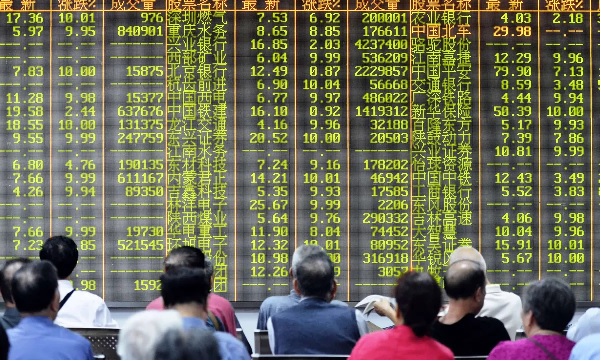 Chinese stocks closed lower on Wednesday, with the benchmark Shanghai Composite Index down 0.39 percent to 3,280.49 points.


