Wednesday, November 25, 2026

Home Blog Page 1222

Economic Watch: China’s Rosy Prospects In Economy Boost Global Growth Confidence

0

16753204171090 China’s economy is expected to recover faster thanks to good fundamentals, effective macro-policy response, and optimized pandemic prevention and control policies, which will boost global growth expectations, observers said.


The International Monetary Fund (IMF) on Monday projected China’s economy will grow by 5.2 percent in 2023, 0.8 percentage point higher than October 2022 forecast.


 “Growth in China is projected to rise to 5.2 percent in 2023, reflecting rapidly improving mobility,” the IMF said in the newly released update to its World Economic Outlook report, adding that “growth is expected to pick up in China with the full reopening in 2023.”


 ROBUST REBOUND


 Following a new round of policy shifts concerning COVID-19 prevention and control, a rebound in travel and consumption in January illustrates the resilience of the Chinese economy and supports forecasts of a further recovery.


 During the three-day New Year holiday, the country recorded roughly 52.7 million domestic tourist visits, up 0.44 percent year on year. Tourism revenue generated over the holiday reached over 26.5 billion yuan (3.9 billion dollars), up 4 percent from the same period last year.


 The following weeklong Spring Festival holiday has been even more encouraging. Official statistics showed about 308 million domestic trips were made in China during the holiday, up 23.1 percent year on year. The holiday box office sold more than 187.6 million tickets as of noon (1600 GMT) Friday, generating a whopping revenue of 6.76 billion yuan (about 988 million dollars).


 Zhu Haibin, chief China economist at J.P. Morgan, is also optimistic. “We see both production and consumption activities on track to recover further. It is likely that the economic recovery could be front-loaded compared to our baseline forecast,” wrote Zhu.


Noting that hundreds of U.S. companies across multiple industries are eager to expand their businesses in the Chinese market, Craig Allen, president of the U.S.-China Business Council, expects the Chinese economy to register a higher growth rate in the first half of this year than the latter half of last year, as a result of so much domestic demand during the Spring Festival holiday season.


GLOBAL CONFIDENCE


Such numbers and the assurance that China will pursue economic stability and expand domestic demand have given foreign investors and observers much confidence in the Chinese economy.


Besides the IMF, multiple international investment banks and financial institutions, including Morgan Stanley and Goldman Sachs, have upwardly revised their forecast for China’s economic growth in 2023.


In a research note released in January, Morgan Stanley raised its outlook for China’s GDP growth in 2023 from 5.4 percent to 5.7 percent, predicting that a rebound in activity will come earlier and be sharper than expected.


The rapid rebound in mobility and the alignment of COVID-19 management, economic and regulatory policy to promote growth are two major reasons for the upward revision of the forecast, said Chetan Ahya, chief Asia economist at Morgan Stanley.


Goldman Sachs has raised its targets for the MSCI China Index twice in January, offering more upside in 2023 for investors to savor when trading resumes after Lunar New Year holiday, South China Morning Post has reported.


 “We are very confident in the Chinese economy and the strength of the leadership and the government and the people of China,” said Haitham Al Ghais, secretary general of the Organization of Petroleum Exporting Countries.


 China is a major actor in global value chains, chairman of the China-Belgium Chamber of Commerce Bernard Dewit said, and therefore has a significant impact on manufacturing, shipping and global logistics.


China will continue to provide important support for global industries and supply chains to return to normal operations, and this is extremely important in order to stabilize the global economy, he noted.


GROWTH ENGINE


According to the IMF, the rise in central bank rates to fight inflation and the Russia-Ukraine conflict continue to weigh on economic activity.


Although the update also said the balance of risks remains tilted to the downside, financial institutions and observers expressed confidence in China’s role in global growth in the coming year, saying that China has played a meaningful role as a global growth engine.


 In 2023, China “can play a very important role in stimulating” global growth, said Hamid Rashid, chief of the Global Economic Monitoring Branch, Economic Analysis and Policy Division, UN Department of Economic and Social Affairs.


 In recent decades, China has evolved into a global economic leader in consumption, trade and investment, according to a recent UBS report.


 “As a result, the country has played a meaningful role as a global growth engine — not only benefiting Chinese companies and its people, but many other developing and developed markets,” it added.


 “All fundamentals are in place” in China for continued economic growth over the next 20 years, BHP Group CEO Mike Henry said in late November, adding that “obviously, China is going to provide a bit of stability to global growth over the next year.”


 With the advantages of first class infrastructure, high quality workers and huge market, China has become “indispensable” in the world, said Khairy Tourk, professor of economics with the Stuart School of Business at the Illinois Institute of Technology in Chicago.


He also praised China’s COVID-19 policies for not only saving millions of lives, but also a major factor behind the revival of the Chinese economy.

   When advanced countries might suffer from deep recession, “only China is the country that will continue to be a major engine of global growth,” the scholar said.

Article inline ad

China’s Soes Log Revenue Growth In 2022

0
 

16752347537684

China's state-owned enterprises (SOEs) posted increased revenues last year, according to official data released Monday.
   
The SOEs raked in 82.6 trillion yuan (about 12.2 trillion U.S. dollars) in operating revenues in 2022, up 8.3 percent from a year ago, data from the Ministry of Finance shows.
  
 The combined profits of SOEs decreased 5.1 percent year on year to 4.31 trillion yuan last year, the ministry said.
   
The SOEs saw their debt-to-asset ratio reach 64.4 percent as of the end of 2022, up 0.4 percentage points from the previous year, according to the ministry.
   
The net profits of centrally-administered SOEs climbed 5 percent year on year to 1.9 trillion yuan in 2022, according to data from the State-owned Assets Supervision and Administration Commission of the State Council.  
Article inline ad

Economic Watch: Chinese Economy Gets Off To A Good Start In 2023

0

16752345598218 With long queues outside restaurants, crowded subway cars, and active machines in factories and on building sites, the Chinese economy is shaking off its COVID shadow and has gotten off to a good start in 2023.


 ROBUST CONSUMPTION


During the weeklong Spring Festival holiday, which ended last Friday, cinemas, restaurants, and tourist attractions were swamped with people eager to meet their pent-up consumption desires.


 Cinemas nationwide sold 129 million tickets, generating 6.76 billion yuan (nearly 1 billion U.S. dollars) in revenue in the period, up 11.89 percent year on year. Some 308 million domestic trips were made, with tourism revenues hitting a total of 375.8 billion yuan, up 30 percent.


Better-than-expected holiday spending improved confidence in a services consumption recovery, CITIC Securities said in a report, noting that the catering sector is about to see a stable and sustainable rebound and that tourism will strengthen gradually during peak seasons.


Expanding consumption has become a policy priority.


A State Council meeting on Saturday stressed the need for timely measures to promote an early recovery of consumption as the main economic driving force. Local governments have since January been rolling out favorable policies to improve consumer sentiment.


Shanghai, a mega city in east China, on Sunday unveiled an action plan including purchase tax exemptions for new-energy vehicles and vouchers for sectors such as cultural tourism and catering. Hainan, an island province in south China, has actively promoted duty-free shopping, reporting 5.19 billion yuan in sales from Jan. 1 to 28.


A consumption rebound is a key theme for 2023, UBS economist Wang Tao said, predicting that full-year nominal retail sales will grow 9 percent year on year.


FACTORIES IN FULL SWING


Post-holiday production is also picking up across the country, with factories in full swing.


On Saturday, the first business day after the Spring Festival holiday, construction on 136 key projects broke ground in Xi’an, capital of northwest China’s Shaanxi Province.


These projects, covering everything from advanced manufacturing to modern services, are expected to have an annual output of over 150 billion yuan and create more than 110,000 jobs.


 In the southwestern municipality of Chongqing, more than 60 rotary drilling rigs were in simultaneous operation at a construction site for Changan Auto’s new factory in January. “With an investment of 6.3 billion yuan, the project will have an annual capacity of 280,000 new energy vehicles,” according to project director Wu Kezhi.


Chongqing is planning to launch 1,123 major projects this year, with total investment up 18.5 percent from a year earlier.


The same vigor can be seen nationwide, as local authorities are making solid efforts to resume production, bringing fresh and sustainable momentum to the economy.


Major economic powerhouses — Guangdong, Zhejiang, Shandong and Sichuan provinces — have set their 2023 growth targets at above 5 percent. New measures for this year have been unveiled in local government work reports, and they are expected to boost the high-quality growth of China’s economy.


BRIGHTENED OUTLOOK


The reemerging hustle and bustle across the country has painted an encouraging picture of China’s economy after a difficult 2022.


Saturday’s State Council meeting urged efforts to promote a steady economic rebound for the beginning of the year.


 The meeting underscored the need to facilitate a speedy resumption of business and production after the holiday. Timely measures will be taken to promote an early recovery, advance opening-up in a steadfast manner, and stabilize and upgrade foreign trade and investment.


Global investors and institutions have remained confident in the Chinese economy, and multiple investment banks have upwardly revised their forecasts for China’s growth rate in 2023.


Liu Linan, head of China macro strategy at Deutsche Bank, has predicted that the Chinese economy will expand about 6 percent this year and that growth will become even more steady in 2024 as China emerges from the impacts of the three-year epidemic.


After returning to normalcy, and when financial risks tame and pro-growth reforms take effect, China’s resilience will also strengthen in the medium-to-long term, Liu said, expressing optimism about the prospects of Chinese assets.


The country’s economy has passed its most difficult moment and is expected to achieve an overall recovery and improve this year, with more market vitality unleashed and an accelerated rebound in activity, analysts have said.  

Article inline ad

1st LD: China’s Manufacturing PMI Up In January

0


16752342117873

The purchasing managers' index (PMI) for China's manufacturing sector came in at 50.1 in January, up from 47 in last December, data from the National Bureau of Statistics showed Tuesday.
   
A reading above 50 indicates expansion, while a reading below reflects contraction.
   
The sub-index for large enterprises stood at 52.3 in January, up 4 percentage points from the previous month.
  
Demand in the manufacturing market also rebounded, with the sub-index for new orders gaining 7 percentage points from a month earlier to 50.9.

   
The sub-index for production stood at 49.8, up 5.2 percentage points from last December, the data showed.  

Article inline ad

China’s Industrial Profits Down 4 Pct In 2022

0


16752340012574

 Profits of China's major industrial firms declined 4 percent year on year in 2022, data from the National Bureau of Statistics (NBS) showed Tuesday.

   
Industrial firms with annual main business revenue of at least 20 million yuan (about 2.96 million U.S. dollars) saw their combined profits reach about 8.4 trillion yuan in the period, the NBS said. 

Article inline ad

China’s Manufacturing PMI Up In January

0
 

16752338663767

The purchasing managers' index (PMI) for China's non-manufacturing sector came in at 54.4 in January, up from 41.6 in December, the National Bureau of Statistics said Tuesday.
   
A reading above 50 indicates expansion, while a reading below it reflects contraction. 
Article inline ad

China Conducts Central Bank Bills Swap

0


16752334956344

The People's Bank of China, or the central bank, conducted a central bank bills swap (CBS) operation on Tuesday to improve the liquidity of perpetual bonds.
   
The CBS, valued at 5 billion yuan (about 739.6 million U.S. dollars), is open to primary dealers for bidding at a fixed rate of 0.1 percent, the central bank said in a statement.
  
 The swap will be due on April 30, 2023, according to the statement.
  
 The CBS scheme allows dealers to swap the perpetual bonds they hold for central bank bills, which will boost market demand for perpetual bonds but have a neutral impact on liquidity in the banking system.
   
Perpetual bonds are fixed-income securities with no maturity date and are not redeemable but pay a steady stream of interest in perpetuity. 
Article inline ad

China’s Central Bank Continues To Add Liquidity Via Reverse Repos

0
16752332004908China's central bank continued to inject funds into the financial system through open market operations on Tuesday.
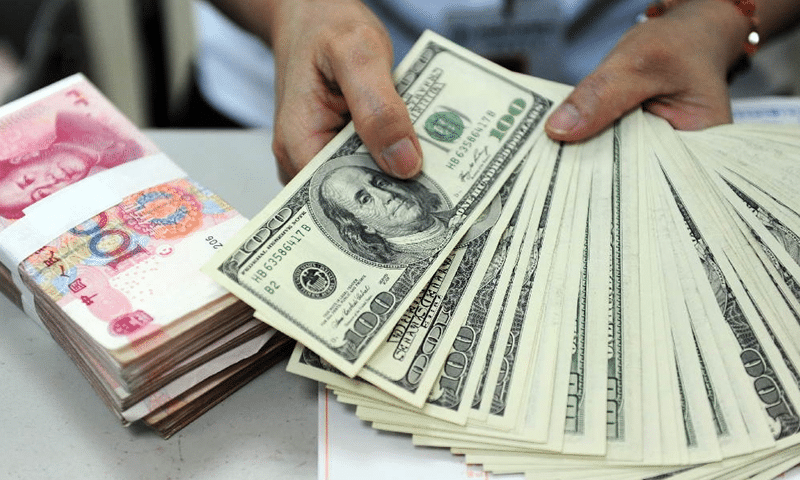
  
 The People's Bank of China said on its website that it has conducted 471 billion yuan (about 69.67 billion U.S. dollars) of seven-day reverse repos at an interest rate of 2 percent.
   
The move is aimed at keeping liquidity stable at the end of the month, according to the central bank.
   
A reverse repo is a process in which the central bank purchases securities from commercial banks through bidding, with an agreement to sell them back in the future.  
Article inline ad

Chinese Yuan Strengthens To 6.7604 Against USD Tuesday

0
16752330285485The central parity rate of the Chinese currency renminbi, or the yuan, strengthened 22 pips to 6.7604 against the U.S. dollar Tuesday, according to the China Foreign Exchange Trade System.

   
In China's spot foreign exchange market, the yuan is allowed to rise or fall by 2 percent from the central parity rate each trading day.
   
The central parity rate of the yuan against the U.S. dollar is based on a weighted average of prices offered by market makers before the opening of the interbank market each business day. 
Article inline ad

China’s Benchmark Interbank Gold Prices Higher Tuesday

0


16752328713585

China's benchmark prices for spot interbank gold transactions were higher Tuesday, according to the China Foreign Exchange Trade System.
   
The benchmark price for gold that is 99.95 percent pure or above stood at 421.94 yuan (about 62.41 U.S. dollars) per gram, up 0.78 yuan from the previous trading day, while the price for gold that is 99.99 percent pure or above went up 0.22 yuan to 422.67 yuan per gram.
   
Spot transaction prices on the interbank price inquiry market are allowed to rise or fall within 15 percent from the benchmark prices each trading day.
   
The interbank gold price inquiry business was introduced in 2012 to enhance market liquidity and enrich trading models. 
Article inline ad