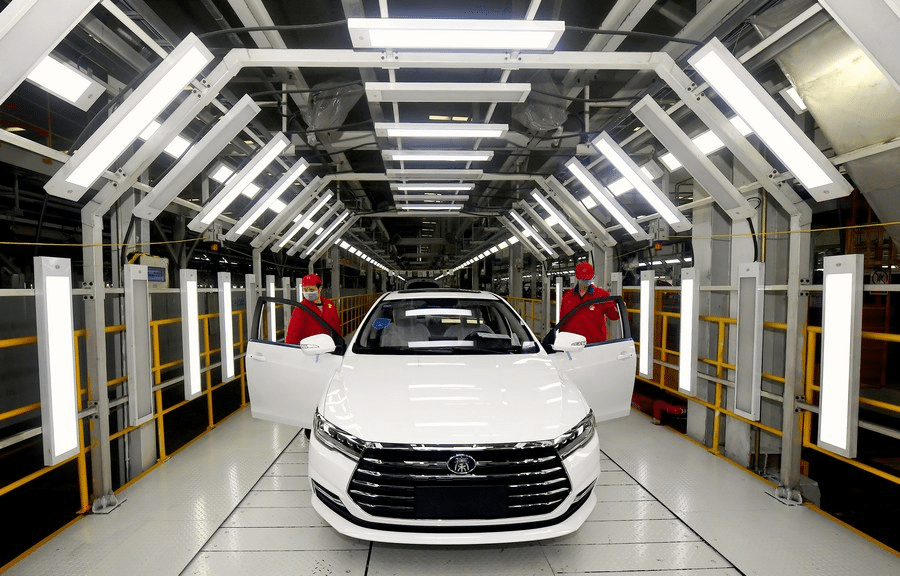
Sales of Chinese-brand passenger vehicles jumped 22.8 percent in 2022 amid domestic automobile manufacturers' bid to upgrade products, industry data showed.
Last year, about 11.77 million domestic-brand passenger vehicles were sold, according to the China Association of Automobile Manufacturers. The market share of these cars reached 49.9 percent, up 5.4 percentage points year on year.
Aiming at opportunities in the fields of new-energy vehicles and intelligent networks, Chinese automakers have promoted electrification and intelligent upgrading of vehicles and optimized the structure of products in recent years to attract more consumers, said the association.
The international development of Chinese auto companies has also constantly enhanced the influence of domestic brands, it added.
With continuously optimized anti-virus response, China’s economy is shaking off the shadow of COVID-19, backed by huge potential and supportive policies.
Fresh positive signs have shown that sectors ranging from tourism to services and catering are returning to their pre-pandemic levels, indicating that an economy with 1.4 billion people is headed for a fast recovery.
China is confident of achieving an overall recovery and improvement in its economic performance in 2023, with a better foundation and more advantages shoring up growth, said Zhao Chenxin, deputy director of the National Development and Reform Commission.
REGAINED VITALITY
Service-related consumption, which had once suffered heavy losses due to the pandemic, is among the first batch of sectors to see a revival. In Beijing, the hi-tech hub of Shenzhen and many other cities, hordes of people now crowd outside restaurants, waiting for seats during peak hours. Moviegoers swarm cinemas to watch movies on the big screen, while road and subway lines are flooded with commuters again.
An index tracking shopper foot traffic in 83 cities across the nation came in at 96.6 on Dec. 31, 2022 — climbing 28.7 points from the lowest level in the same month — data from the State Information Center showed. On Jan. 1, 2023, a total of 10,640 cinemas opened for business nationwide, the highest number in nearly 10 months.
Meanwhile, easier travel rekindled Chinese people’s zeal for tourism. During the three-day New Year holiday, the popular travel destination of Hainan in the south of China welcomed more than 1 million tourists and achieved a total tourism revenue of 1.5 billion yuan (about 223 million U.S. dollars). Zhangjiakou in the cold north, where snow and ice sports flourish, also welcomed an influx of tourists during the holiday, with many hotels fully booked.
This rising trend of enthusiasm for travel is likely to extend into the upcoming Spring Festival holiday. In the Jan. 1-Jan. 8 period, the inquiry volume for domestic travel services during the Spring Festival holiday soared nearly twenty-fold compared with one year before, data from the online travel services provider Tongcheng Travel showed.
Aside from the booming consumer market, headway has been made in accelerating the resumption of work and production. Major projects nationwide are kicking off construction intensively, while most factories are running at full throttle as orders pour in.
As of late December 2022, 99.5 percent of major projects in Chongqing had started construction again and factories in Hunan had set new output records since November, with confidence restored.
At a machinery company located in Jiashan County, east China’s Zhejiang Province, the production lines are humming and machines are running, gearing up to satisfy increasing overseas orders.
“The year of 2023 will see recovery and a surge in orders for foreign trade companies like us,” said Wang Shengshuang, chairman of the company — expecting to reach an ambitious target of 50 percent year-on-year growth in overseas sales.
POLICY-BACKED MOMENTUM
Despite the COVID-19 disruptions, China’s economic momentum continues unabated, thanks to strong policy support that helps foster vitality in investment, consumption and trade.
China has sustained an average annual economic growth rate of about 4.5 percent over the past three years — significantly higher than the world average.
One propeller that has driven momentum is the utilization of special-purpose bonds, which are crucial in expanding effective investment. By the end of November 2022, local governments in China had issued 4 trillion yuan worth of new special-purpose bonds, offering support to nearly 30,000 key projects. In 2023, the country will appropriately expand the areas in which these bonds can be invested and used.
Early investment at the start of the year by local governments can lay a good foundation for achieving steady economic growth in the first quarter (Q1) and throughout the year, according to Zhang Yiqun, an expert from the Society of Public Finance of China.
The country will also strengthen support for consumption related to retail, catering, tourism and new energy vehicles, while expanding consumption scenarios with the help of new technologies and applications.
Local governments are on the move to encourage as much consumer spending as possible. Shenyang in northeastern China vowed to issue vouchers worth a total of 100 million yuan in Q1, covering sectors such as automobiles, home appliances, shopping malls, supermarkets and catering.
A slew of policies rolled out to stimulate consumption have evidently helped to revive the growth of the auto market. In 2022, auto sales rose 2.1 percent year on year to 26.86 million units. Sales of new energy vehicles (NEVs) almost doubled from a year earlier to about 6.89 million units.
China announced in September last year that the purchase tax exemption for NEVs would be extended to the end of 2023, which is expected to waive 100 billion yuan worth of taxes. Thanks to this, the China Association of Automobile Manufacturers has forecast that China’s NEV sales for 2023 will grow 35 percent year on year to 9 million units.
Foreign trade remains a driving force for economic growth. Despite the pandemic-depressed global demand, China’s foreign trade hit a record high again in 2022, exceeding the 40-trillion-yuan mark for the first time, official data showed.
To further boost this sector, Chinese authorities canceled registration requirements for businesses engaged in foreign trade activities from Dec. 30, 2022, onwards.
Fiscal and monetary policies will continue to play a major role in cementing an overall improvement in economic operation. Wen Bin, chief economist with China Minsheng Bank, said the country will step up its fiscal policy in order to achieve greater effectiveness, while also making its prudent monetary policy more targeted and effective, possibly bringing its deficit-to-GDP ratio up to 3 percent and special bond issuance up to about 3.8 trillion yuan in 2023.
POTENTIAL-DRIVEN OUTLOOK
Though COVID-19 flare-ups and geopolitical conflicts have complicated the country’s growth trajectory, the Chinese economy retains its huge potential and sound long-term fundamentals.
A report from Standard Chartered Bank indicated that it expected China to grow at 5.8 percent in 2023, and be an important driver of the expected global recovery.
Analysts noted that China’s economy has enormous potential in areas such as industrial upgrading, new infrastructure, scientific and technological innovation, urbanization, and higher-standard opening-up, making it a strong magnet for global investors.
Though China’s optimized epidemic response may disrupt economic activity in the short term, it is set to shore up growth for the year as a whole, said Han Wenxiu, executive deputy director of the office of the Central Committee for Financial and Economic Affairs, adding that the recovery will pick up pace especially in Q2, when more factories crank up production and businesses reopen.
China’s growth potential was further unleashed by an orderly easing of mobility restrictions, followed by a strong release of pent-up demand for consumption and services, according to a report recently issued by the World Bank. “A quicker-than-expected recovery in the country’s real estate sector is another upside possibility.”
In the next 15 years, the world’s most populous country will see its middle-income population increase to more than 800 million. The strong consumption power of this middle-income population constitutes a super-large market, creating enormous opportunities for foreign businesses.
In late 2022, Swiss tech giant ABB opened a state-of-the-art robotics mega factory in Shanghai, with their investment amounting to 150 million USD. Market opportunities have been seen in emerging sectors in China, such as electronics, e-commerce logistics, healthcare, pharmaceuticals and service robotics, said Marc Segura, president of ABB Robotics.
The China Council for the Promotion of International Trade revealed that over 99 percent of surveyed foreign firms are confident about China’s economic outlook in 2023 — and 98.7 percent said they would maintain and expand their investment in China.
“All fundamentals are in place” in China for continued economic growth over the next 20 years, BHP Group CEO Mike Henry said, adding that China is obviously going to provide stability for global growth this year.
East China's economic powerhouse Jiangsu Province handled 1,973 China-Europe freight train journeys in 2022, an increase of 9.6 percent year on year and hitting a record high, local authorities have said.
Five cities in Jiangsu, including Nanjing and Lianyungang, are now operating 23 routes, reaching nearly 80 cities in Europe, Central Asia and Southeast Asia.
Due to global headwinds and the COVID-19 pandemic, international logistics and transportation have been hindered in recent years, so the China-Europe freight train service has effectively filled the gap between supply and demand in these fields, said Wang Jianjun, general manager of an international freight train company in Nanjing.
The freight train service has also boosted friendly exchanges at the regional level, according to Jiangsu’s foreign affairs department. The province has inked 354 international sister-city partnerships with 64 countries.
China's Guizhou Province registered robust growth in the digital economy in 2022, with its growth rate ranking top in the country for seven consecutive years, local authorities said Friday.
In 2022, Guizhou accelerated the development of the big-data industry and the province's added value of the electronic information manufacturing industry rose by more than 60 percent, according to a government work report delivered by Li Bingjun, governor of the province.
The income from Guizhou's software and information technology service industries surged by 99.7 percent in the year, Li noted.
In 2023, Guizhou's GDP is expected to grow by around 6 percent to reach 2.2 trillion yuan (around 327 billion U.S. dollars), with the digital economy accounting for around 40 percent of its GDP, according to the report.
The province will also vigorously develop the cloud service industry to further boost income and speed up the development of data circulation services.
North China's coal-rich province of Shanxi has set the gross domestic product (GDP) growth target at about 6 percent for 2023, according to the ongoing annual session of the provincial people's congress.
Shanxi's GDP was estimated at over 2.5 trillion yuan (about 371.5 billion U.S. dollars) in 2022. Over the past five years, Shanxi has seen an average annual GDP growth of over 6 percent, according to the government work report released at the session.
As an important energy base in China, Shanxi's coal production reached 1.3 billion tonnes last year, ranking first in the country, of which the advanced coal production capacity increased to 80 percent in proportion.
China launched an energy revolution pilot program in Shanxi in 2019, promoting the coal-rich province to explore energy transition.
As of 2022, the installed capacity of new energy and clean energy in Shanxi had reached 49 million kilowatts, accounting for 40.25 percent of the province's total, and the energy consumption intensity for power generation in 2022 dropped by 16 percent compared to five years ago.
China’s southernmost island province of Hainan has set a GDP growth target of 9.5 percent for 2023, Feng Fei, governor of Hainan, said on Friday.
Hainan will leverage a tourism revival to boost consumption, Feng said as he delivered a government work report at the annual session of Hainan’s provincial people’s congress.
The province will this year strive to increase its number of tourists and tourist revenues by 20 percent and 25 percent, respectively, he said.
China in June 2020 released a master plan to build the island province into a globally influential and high-level free trade port by the middle of the century. It aims to build Hainan into an international tourism and consumption center by 2025, and a globally influential tourism and consumption destination by 2035.
Official data shows that during the three-day New Year holiday, Hainan welcomed more than 1 million tourists and achieved a total tourism revenue of 1.5 billion yuan (223 million U.S. dollars), and its duty-free sales hit 422 million yuan.
According to the government work report, Hainan will continue to hold the China International Consumer Products Expo, and it will upgrade the competitiveness and attractiveness of its tourism to build the island into an international tourism and consumption center.
In the past month, Hainan has seen a tourism recovery, with tourist numbers and tourism revenues growing rapidly. It is estimated that sales during the upcoming Spring Festival will increase by 45 percent year on year, up 10 percent from the 2019 figure, said Li Gang, vice general manager of the China Tourism Group.
“We are inspired by the report’s development plan and feel confident about the consumption target,” Li said, adding that Hainan still needs to improve the quality of its tourism products to make the island more attractive to tourists.
Hainan’s tourism and consumption were impacted by COVID-19 last year. As China continues to optimize its COVID-19 policies, tourism and consumption in Hainan have been boosted, said Li Weiming, a professor at the Management School of Hainan University.
“With more convenient logistics and transportation, we are confident that the government’s economic targets will be achieved,” Li said.
Most of the capital goods in China posted lower prices in early January of 2023 compared with late December of 2022, official data showed Saturday.
Of the 50 goods monitored by the government, which include seamless steel tubes, gasoline, coal, fertilizer and some agricultural products mainly used for processing, 27 posted lower prices, and 21 saw prices rise, according to the National Bureau of Statistics.
Hog prices dropped 10.7 percent in early January to 15 yuan (about 2.23 U.S. dollars) per kg, data from the bureau showed.
The figures, released every 10 days, are based on a survey of nearly 2,000 wholesalers and distributors in 31 provincial-level regions across the country.
A fleet of luxury electric vehicles (EV) from Chinese manufacturers were showcased for the first time this week at the 100th Brussels Motor Show, which opened its doors to industry professionals and media on Friday.
Boosted by the European Union's green transformation policy, sales of EVs in Europe have been increasing in recent years. And Chinese EVs have proved popular among European buyers due to their competitive prices and high quality.
Build Your Dreams (BYD), the Chinese electric car manufacturer and inventor of the 3.0 blade battery, revealed three new models at the show.
"With our design, technology, services and dealer partners, BYD will try to stand out and provide the best possible experience for European consumers," said Mike Belinfante, spokesperson for BYD Europe.
The new X55 from Beijing Automobile (BAIC) was also officially unveiled at the show, and will be launched in Europe in February. Belgian car dealer OneAutomotive has introduced multiple models from BAIC Motor and DFSK (Dongfeng Sokon) to the markets in Belgium and Luxembourg over the last two years.
A OneAutomotive employee said: "In the past two years, the import volume of these two brands of cars has grown steadily.
China's annual foreign trade value hit record high again in 2022, as the country works to better coordinate epidemic response with economic and social development amid complex and severe domestic and international situations, official data showed Friday.
Total goods trade reached 42.07 trillion yuan, up 7.7 percent year on year, topping the world for six consecutive years, according to the General Administration of Customs (GAC). The figure exceeded 40 trillion yuan for the first time, said the GAC.
In U.S. dollar terms, the trade value increased 4.4 percent over the previous year to 6.31 trillion dollars, GAC data showed.
Exports rose 10.5 percent to 23.97 trillion yuan, and imports went up 4.3 percent to 18.1 trillion yuan.
China's foreign trade delivered breakthroughs in scale, quality, and efficiency last year, which is a hard-won feat considering headwinds in demand, supply, and expectations, GAC spokesperson Lyu Daliang said.
In 2022, China rolled out policies dynamically to bolster growth, including that of foreign trade.
The package of policies and their follow-up measures to shore up economic recovery have paid off, unleashing the vitality of trade entities, said Lyu.
China has released a document to support the development of micro, small and medium-sized enterprises (MSMEs), detailing specific measures to promote the high-quality development of these firms, according to the Ministry of Industry and Information Technology.
The document, issued by the State Council, contained 15 measures that aim at stabilizing the growth and improving the competitive edge of the MSMEs in the country.
Seven of these measures seek to help MSMEs tide over difficulties through policy support, easier financing and demand expansion, among others.
In particular, large enterprises and platform institutions are encouraged to release procurement lists targeting MSMEs and carry out cross-border matchmaking activities, in order to create more business opportunities for these enterprises.
The document also outlined eight measures to help build up the core competitiveness of smaller businesses.
Efforts should be made to enhance talent cultivation, step up direct financing support for quality MSMEs and strengthen the application and protection of intellectual property rights of these firms, the document said.