S


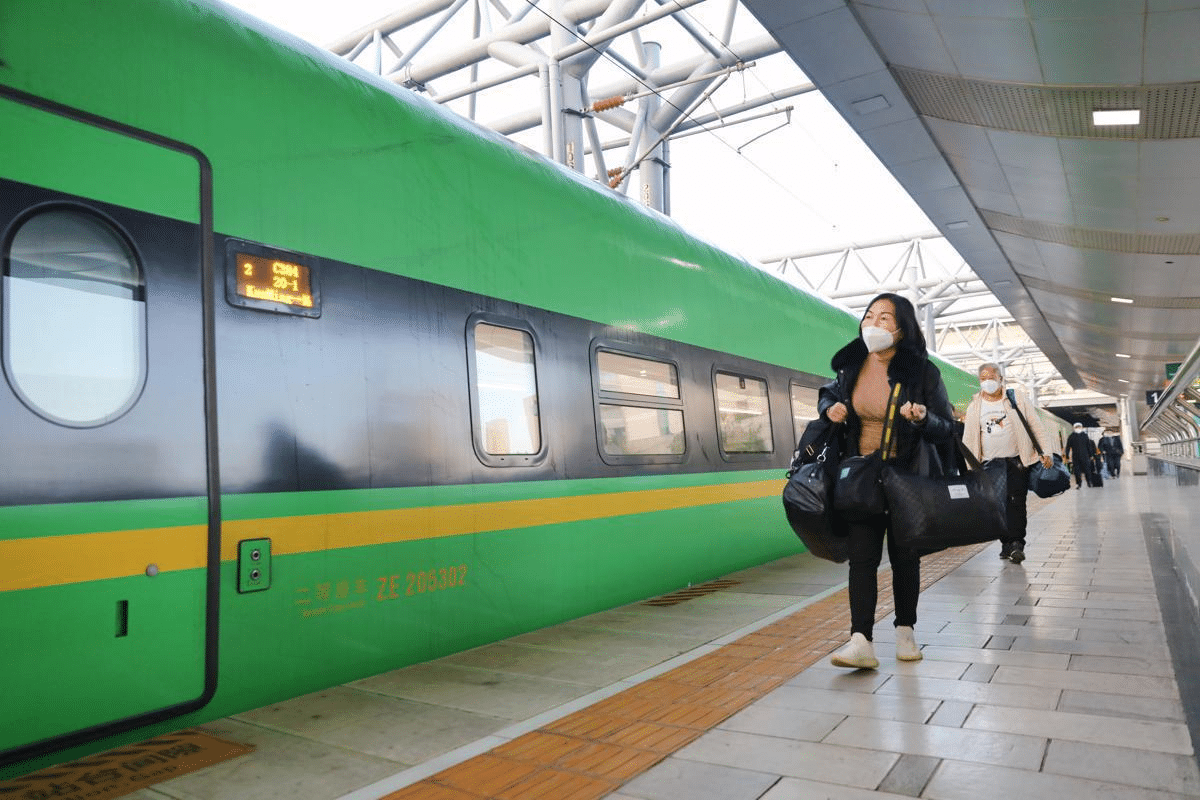
ince its launch in December 2021, the China-Laos Railway has handled over 9 million passenger trips and 12 million tonnes of cargo, according to official figures.
Since the beginning of 2023, the railway has seen a growing momentum in its passenger volume, with the average number of passengers dispatched daily reaching 29,000, almost double that of the same period in 2022, according to the ongoing annual session of southwest China's Yunnan provincial people's congress.
As a landmark project of high-quality Belt and Road cooperation, the 1,035-km China-Laos Railway connects Kunming, capital of Yunnan, with the Laotian capital Vientiane.
The railway is expected to handle more than 10 million passenger trips and 13 million tonnes of cargo in 2023, said the annual session.
The first battery-powered locomotive manufactured by China Railway Rolling Stock Corporation (CRRC) Dalian Co. Ltd was launched here on Wednesday to aid Thailand's efforts to improve its railway service while cutting carbon emissions.
Testing of the locomotive was conducted successfully by the State Railway of Thailand at the Bang Sue Grand Station in Bangkok.
Speaking at the testing ceremony, Thai Transport Minister Saksayam Chidchob said that Thailand is encouraging the use of renewable energy, which is environmentally friendly, to replace the use of fuel in the country's transportation system, as part of the efforts to achieve Thailand's commitment to reduce annual greenhouse gas emissions by 20 to 25 percent by 2030.
Saksayam also spoke highly of the cooperation between Thailand and China on railways.
"Thailand and China have been cooperating in various aspects of railway development," he said, "Thailand hopes to develop railway technology cooperation with countries around the world including China, and the success of this test marks significant progress in the battery-powered locomotive project."
Nirut Maneephan, governor of the State Railways of Thailand,
China will provide financial support for the Angolan national broadband network project under a concessional loan framework agreement signed here on Wednesday.
Under the agreement, the Export-Import Bank of China will provide funding to the tune of about 249 million U.S. dollars to build a 2,000-kilometer terrestrial optical cable in Angola as well as a submarine line connecting the enclave of Cabinda, and upgrade the country's telecommunications network.
The agreement was signed by the Chinese Ambassador to Angola, Gong Tao, and Angolan Minister of Finance Vera Daves de Sousa in Luanda, the capital of Angola.
The national broadband project will bring high-speed network services to Angola's remote areas, lower access costs, and boost the country's digital economy.
The Angolan finance minister said that the framework agreement will further develop the friendly relations between Angola and China and promote economic and technical cooperation between the two countries.
China maintained its grain purchase level and ensured a stable domestic grain market in 2022, against the backdrop of sharply fluctuating international grain prices.
Enterprises across the country are expected to have purchased 400 million tonnes of grains in 2022, basically on par with the levels seen in past years, data from the National Food and Strategic Reserves Administration shows.
The country ensured that the domestic grain market maintained overall stability last year, with an enhanced reserve capacity, amid a global grain price swing, administration head Cong Liang said at a meeting on Wednesday.
Noting that grain and oil consumption has entered its peak season as the Spring Festival holiday approaches, Cong urged all localities to ramp up their supply of green and high-quality products.
Related departments began auctioning wheat on Jan. 11, releasing 140,000 tonnes from the country’s reserves weekly. The auction system is expected to be help meet the enterprise demand for grain, Cong said.
A China-developed space-borne solar camera studying the solar transition region released its first group of scientific data on Wednesday.
The 46.5-nanometer extreme-ultraviolet imager or Solar Upper Transition Region Imager (SUTRI), mounted on SATech-01 satellite, was launched into space on July 27, 2022, from the Jiuquan Satellite Launch Center in northwest China by a Lijian-1 carrier rocket.
SUTRI is the first solar imager in the world to work at a wavelength of 40 to 110 nanometers based on a multilayer narrow-band filtering technique, according to the National Astronomical Observatories of China under the Chinese Academy of Sciences.
The device is capable of taking full-disk dynamic pictures of solar regions between the solar chromosphere and corona, thus building a key bridge for solar scientists for the lower atmosphere and higher one on the sun.
Starting operation on Aug. 30, 2022, SUTRI obtained over 200,000 pictures within four months. The data released in its first group were acquired between September 5 to November 5 last year.
Now, the device in orbit is in good working order and is expected to produce more data.
Chinese Ambassador to Australia Xiao Qian said the bilateral relationship is at a critical stage of turnaround currently, and he believed an improved relationship would give more confidence for bilateral cooperation in various fields.
While addressing the New Year’s Press Gathering held by the Chinese embassy on Tuesday, Xiao said 2022 was an “extraordinary year” for the China-Australia relations, which have tided over difficulties and regained positive momentum thanks to the efforts from both sides.
“Both sides need to renew our commitment to the relationship, bring it back on the right track, and earnestly implement the important consensus between our leaders and the China-Australia Foreign and Strategic Dialogue Joint Outcomes Statement,” he said.
The Chinese ambassador urged Australia to look at China in a more objective way, and formulate its defense policy relating to China on the basis of facts and rationality.
“If you think the other side is an enemy, how could you have a sincere, real and good relationship in real sense.”
“It is simply not true that China is and could be a potential threat to Australia. There’s no reason for us to believe. That’s not the case,” he stressed.
Xiao also dismissed Australia’s security pact with Britain and the U.S. as not constructive nor helpful, and Canberra’s nuclear submarine deal under this mechanism goes against the international non-proliferation efforts and Australia’s own interest.
“China is not seeking to be an enemy of the United States, Britain nor Australia, so there’s no reason for the three countries to stand together to work on something that is targeting China as a potential threat,” he said.
“We have certainly different views, but there’s no reason for us to be confrontational in nature.”
As Australian businesses and universities are expecting more Chinese travellers and students after China further optimized its COVID-19 prevention and control measures, the ambassador believed that a further improved relationship would give more impetus for the bilateral cooperation.
He said the two countries experienced some difficulties under the previous Australian government, and those difficulties have affected relationship in other fields.
“I personally believe that while we have a consistent improvement of relationship, that will give people more confidence that they can be assured to continue doing their normal business.”
He said he hoped China and Australia will continue to rise above differences, respect each other and work together for mutual benefit in the new year, so that the relationship can get back on the right track and move forward in a sustainable manner.
China is expected to overtake the United States as the world's biggest market for British luxury automobile maker Rolls-Royce, the company's chief executive officer (CEO) told Xinhua in an exclusive interview.
Torsten Muller-Otvos hailed the potential of his company as he presented its sales figures for 2022.
Last year, Rolls-Royce Motor Cars sold 6,021 of its luxury cars to customers in around 50 countries, a sales record in the company's 118-year history. Thirty-five percent of the sales were realized in the U.S., 25 percent in China (around 1,500 vehicles), 20 percent in Europe, and 10 percent in the Middle East.
Calling the 2022 sales figures "a fabulous record," Muller-Otvos said the brand is well-positioned and has seen stunning results in basically all markets worldwide. Looking at 2023 and further, the CEO said he was "cautiously optimistic."
"It's fair to mention that in China we have done the second best every year in our history," Muller-Otvos said. "I'm very proud about what we have achieved in China this year."
Asked about the future, Muller-Otvos said that the company is very strongly engaged in China and that he would not be surprised to see sales in China surpass those in the United States one day.
Guo Zi handed over the keys to a Wuling Air EV car to the buyer on Thursday, closing her first sale of a new energy vehicle (NEV) in 2023.
“I sold more than 380 NEVs in 2022,” said Guo, a top sales representative at a retail dealer of SAIC-GM-Wuling (SGMW), a major Chinese automobile manufacturer, in the city of Liuzhou, south China’s Guangxi Zhuang Autonomous Region.
“The purchase tax exemption for NEVs really reduces consumers’ costs, which, in addition to high gasoline prices, has been an important factor drawing customers to NEVs,” she said, adding the dealer saw people flocking in for inquiry during the New Year holiday.
China announced in September last year that the purchase tax exemption for NEVs would be extended to the end of 2023. The third extension since the country first implemented the policy in 2014, was expected to waive 100 billion yuan (about 14.8 billion U.S. dollars) worth of taxes.
As of Nov. 10, a total of 68.62 billion yuan worth of taxes had been exempted in 2022, up 101.2 percent year on year, according to the State Taxation Administration.
After a government subsidy program for NEVs terminated on Dec. 31, 2022, which was first put in place in 2010 to stimulate the popularity of NEVs, “auto companies may adjust NEVs’ selling prices based on assessments of the market, but the extension of the tax exemption remains bullish news for the sales of NEVs,” said Wang Weisen, deputy general manager of the sales company of SGMW.
Boosted by incentive policies, China has seen a continued positive trend in domestic sales of NEVs, Wang noted.
From January to November 2022, NEVs sales of SGMW rose 32.5 percent year on year to reach 519,327 units.
BYD, China’s largest NEV manufacturer, said its NEV sales jumped 208.64 percent year on year to over 1.86 million units in 2022.
For startup carmakers like Li Auto and NIO, 2022 was also a fruitful year. Li Auto delivered 133,246 NEVs last year, up 47.2 percent from the 2021 level. NIO delivered 122,486 units in the same period, an annual increase of 34 percent.
In the first 11 months of 2022, the country’s NEV sales exceeded 6.06 million units, with the market share of such vehicles hitting 25 percent, according to the China Association of Automobile Manufacturers (CAAM).
A slew of policies rolled out by the authorities to stimulate consumption have evidently helped to revive the growth of the auto market, said Chen Shihua, deputy secretary-general of the CAAM.
A strong growth momentum has been sustained in the production and sales of NEVs, Chen said. “Judging from the sales volume of NEVs, the purchase tax exemption has been recognized by the market.”
The CAAM has forecast that China’s NEV sales for 2023 would grow 35 percent year on year to 9 million units, compared to an estimated 6.7 million units for 2022.
The NEV subsidy program had made significant contributions to the rapid development of China’s passenger vehicle industry, said Cui Dongshu, secretary-general of the China Passenger Car Association.
Despite the end of the subsidies, the country’s NEV sector will continue to develop in a sound environment, Cui added.
“The extension of purchase tax exemption will continue to drive the growth of NEVs sales. In the future, China’s NEV sector will maintain high growth,” Cui said.
National Hydrogen Power Quality Inspection and Testing Center, an organization dedicated to boosting the development of China’s hydrogen fuel-cell vehicle industry, started operation Monday in Chongqing Municipality.
With a total investment of 500 million yuan (73.9 million U.S. dollars), the center covers an area of 190 mu (around 12.67 hectares) with labs for hydrogen-powered vehicles, hydrogen fuel cells, and power assembly.
It can provide testing services for the whole industrial chain, including hydrogen fuel cell vehicles, critical auto parts, and hydrogen quality.
The center, the first of its kind in China, was established by China Automotive Engineering Research Institute Co., Ltd.
In recent years, Chongqing in southwest China has ramped up efforts to promote the development of the hydrogen fuel-cell vehicle industry, with a number of automakers rolling out various car models and key supporting enterprises taking root there.
It has cooperated with neighboring Sichuan Province to build a “hydrogen corridor,” under which around 1,000 hydrogen fuel-cell logistics vehicles are expected to go into service by 2025.
Chinese automaker Geely Automobile Holdings Limited reported an eight-percent sales growth year on year in 2022 after selling more than 1.43 million vehicles.
Last year, Geely focused not only on expanding its electric product line but also on improving the intelligence of its products, the company said.
Geely said its transformation in the new energy vehicle (NEV) sector achieved notable results, with annual sales of NEVs hitting 328,727 units in 2022.
The company also exported more than 198,000 vehicles in 2022, an increase of 72.4 percent, year on year.
In 2023, Geely set an annual sales target of 1.65 million vehicles.