Tuesday, November 24, 2026

Home Blog Page 1245

Chinese Scientists Develop New Method Of Plastic Recycling

0

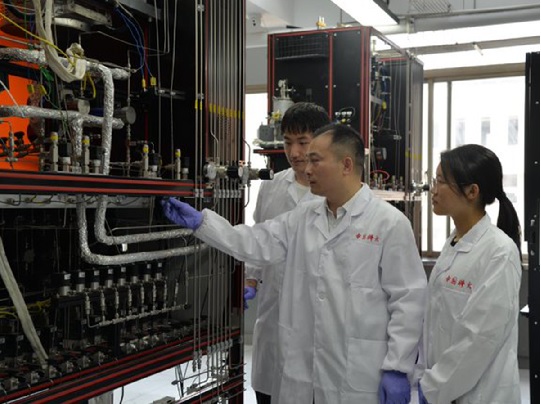
16885509365596BEIJING, July 4 (Xinhua) — A Chinese research team has developed a new method of recycling polyethylene plastic waste that could cut costs while producing a range of useful petroleum-based materials, according to a paper published recently in the journal Nature Nanotechnology.

   Polyethylene plastic, which is one of the five main types of plastic, is highly stable and does not biodegrade easily. However, the research team from the University of Science and Technology of China has discovered a new recycling process that employs existing technology while producing useful by-products.

   Considering the similarities between polyethylene and oil, in terms of both chemical structure and composition, the team borrowed technology from the oil industry to devise its new method.

   The team devised a “hydrogen breathing” strategy, using catalysts to break down the chemical structure of waste plastic and reorganize it, forming high-value ring-shaped hydrocarbons. These can then be used as raw materials for the synthesis of drugs, dyes, resins and fibers.

   Han Buxing, an academician of the Chinese Academy of Sciences, said that the research uses environmental pollutants such as abandoned polyethylene plastics to prepare petroleum-based chemical products, providing a new method for the “artificial carbon cycle” of waste plastics. 

Article inline ad

China Science, Technology News Summary — July 5

0

16886325197466 BEIJING, July 6 (Xinhua) — The following is a summary of published science and technology news of China.

   CORAL MONOGRAPH

   Chinese researchers have recently published a monograph on hermatypic corals in the Zhongsha Islands in the South China Sea, providing valuable first-hand information for studying their diversity and distribution pattern.

   From 2019 to 2021, the South China Sea Institute of Oceanology under the Chinese Academy of Sciences organized a series of comprehensive scientific expedition voyages to the Zhongsha Islands. In the process, experts identified and recorded a total of 200 hermatypic coral species belonging to 16 families and 58 genera.

   GREEN AVIATION

   Low-carbon technologies are playing more roles in sustaining Chinese airports’ green transformation, facilitating the civil aviation sector to move toward the country’s “dual carbon” goal.

   The civil aviation sector will promote safe and efficient SAF (sustainable aviation fuels) substitution, promote airport electrification and clean energy application, and strengthen energy conservation and intensive utilization, according to the Civil Aviation Administration of China.

   WORLD ROBOT CONFERENCE

   The World Robot Conference 2023 (WRC 2023) will be held in Beijing from August 16 to 22, at which cutting-edge achievements and the latest robot industry exhibits will be unveiled, the China Association for Science and Technology (CAST) said Tuesday at a press conference.

   Consisting of three sections, including forum, exhibition, and competition, the WRC 2023 will focus on the frontier trends of robot technology and industry, show the application scenarios of robot innovation in various sectors, and hold high-level brain-computer interface and man-machine cooperation competitions, said Xu Guanghong, an official of the CAST. 

Article inline ad

China Advances Research On South China Sea’s Deep Structure

0

16886326444464 BEIJING, July 6 (Xinhua) — Researchers from a Chinese university have made breakthroughs in the study of the deep structure of the South China Sea.

   Over the past 100 million years, a large number of Earth plates have subducted to the deep part of the South China Sea. However, due to the limitations on seabed observation, the deep structure of the South China Sea has been poorly understood, according to researchers from the Shenzhen-based Southern University of Science and Technology.

   The research team from the university used the data from a passive seismic experiment using ocean bottom seismometers, together with the land stations, to determine the high-resolution, three-dimensional seismic structure of the southwest sub-basin of the South China Sea.

   The researchers discovered that there is an anomaly area at a depth of 40 to 80 km in the south of the basin with an obvious low seismic shear velocity, and the anomaly is most apparent at a depth of about 50 km, according to a research article published in the journal Nature Communications.

   After deep thermodynamic and rock geochemical analysis, they obtained the geophysical evidence that the upper mantle in the southern South China Sea is relatively rich in water, and revealed the north-south asymmetry of the seismic wave velocity structure in the deep South China Sea.

   The study is of great significance in revealing the deep structure of subducting plates, the genesis of many volcanoes and reefs in the South China Sea, and the water cycle in the earth subduction zone, according to the researchers.   

Article inline ad

China Science, Technology News Summary — July 6

0

16886377799776 BEIJING, July 6 (Xinhua) — The following is a summary of published science and technology news of China.

   SOUTH CHINA SEA’S DEEP STRUCTURE

   Researchers from a Chinese university have made breakthroughs in the study of the deep structure of the South China Sea.

   Over the past 100 million years, a large number of Earth plates have subducted to the deep part of the South China Sea. However, due to the limitations on seabed observation, the deep structure of the South China Sea has been poorly understood, according to researchers from the Shenzhen-based Southern University of Science and Technology.

   The research team from the university used the data from a passive seismic experiment using ocean bottom seismometers, together with the land stations, to determine the high-resolution, three-dimensional seismic structure of the southwest sub-basin of the South China Sea.

   CHINA’S BDS

   China’s BeiDou Navigation Satellite System (BDS) has served more than 200 countries and regions to date, according to a commendation ceremony for the construction of BDS-3 held in Beijing on Wednesday.

   China successfully launched 30 BDS-3 satellites in two and a half years, completing BDS-3 six months ahead of schedule in 2020.

   BDS-3 is a giant, complex space system with the largest scale, widest coverage, highest service performance requirements and closest connection with daily life that China has built so far, according to the ceremony.

   INTRAVITAL IMAGING

   Imagine tens of millions of table tennis balls spinning, bouncing, and even colliding with each other in a gigantic gymnasium. It is almost impossible to track every movement with human eyes.

   A similar challenge had once shrouded the imaging of large-scale intercellular behaviors, but Chinese scientist Wu Jiamin and his colleagues, under the leadership of Prof. Dai Qionghai, addressed the problem by devising a series of computational mesoscale fluorescence microscopes.

   In a laboratory at Tsinghua University, there lies the one-and-only microscope in the world that can realize 3D imaging of brain-wide subcellular dynamics in mice.   

Article inline ad

China Launches New Satellite To Test Satellite Internet Technologies

0


16890649805360

JIUQUAN, July 10 (Xinhua) -- China on Sunday sent a new test satellite into space from the Jiuquan Satellite Launch Center in northwest China.
   The satellite was launched by a Long March-2C carrier rocket at 7:00 p.m. (Beijing Time) and entered the planned orbit.
   It will carry out test missions for satellite internet technologies.
   The launch was the 478th flight mission of the Long March carrier rocket series.
Article inline ad

China Witnesses Increasing Academic Influence With Over 5,000 Sci-Tech Journals

0


16890671318704

BEIJING, July 10 (Xinhua) -- China has published a total of 5,071 sci-tech journals covering various fields and seen greater academic influence globally, according to a report released by the China Association for Science and Technology.
   The report showed that by the end of 2021, China had 4,482 Chinese-language sci-tech journals, 420 sci-tech journals published in English and 169 sci-tech journals using a combination of Chinese and English.
   There were 1,570 journals in the field of basic science, 2,271 in technical science and 1,152 in medical science, according to the report.
   The report also highlighted that Chinese-language sci-tech journals had an increasing academic influence with the international citation ratio rising to 7.6 percent in 2020 from 4.44 percent in 2016.
   In addition, China's English-language sci-tech journals secured inclusion on a number of globally prestigious databases, thereby promoting international academic exchanges. 
Article inline ad

China Becomes New Zealand’s Fastest Growing Int’l Science Partner: Report

0

16890695689305 WELLINGTON, July 7 (Xinhua) — China is New Zealand’s fastest-growing major international partner in co-producing scientific publications, according to a new report released on Friday.

    The report, commissioned by the New Zealand China Council (NZCC), shows the share of New Zealand research co-authored with China increased from 7.7 percent to 11.6 percent between 2017 and 2022.

    Among New Zealand’s major research partners, this share is lower than Australia, where 16.7 percent of all publications included Chinese co-authors in 2022, and similar to Britain where 11.8 percent of research was co-authored with Chinese researchers last year, according to the report.

    The report also shows that China now ranks fourth as an international research partner for New Zealand, behind Australia, the United States and Britain, and ahead of Germany.

    China has become one of New Zealand’s leading research partners across multiple disciplines, said NZCC Chair John McKinnon.

   “Scientific and wider academic research collaboration and partnership between New Zealand and China deserves more recognition for the value it generates,” McKinnon said.

    Benefits to New Zealand include accelerated access to medical breakthroughs, biosecurity preparedness against invasive pests, a better understanding of the ocean environment, fruit species improvement and sustainable development of New Zealand’s tourism sector, he said.

    The report also identifies challenges and barriers to science and research collaboration with China, including limited funding opportunities and the need to manage risks associated with projects involving overseas partners.  

Article inline ad

Sino-European Joint Space Mission Enters Flight Model Phase

0

16890744382577 BEIJING, July 10 (Xinhua) — A China-Europe joint space mission, Solar Wind Magnetosphere Ionosphere Link Explorer (SMILE), has entered the flight model phase in an all-around way, according to the National Space Science Center (NSSC) under the Chinese Academy of Sciences (CAS).

    After a four-day discussion and consultation, the review experts unanimously agreed that SMILE has successfully passed the critical design review, marking an important milestone in the development stage of SMILE, the NSSC said.

    The review experts believe that SMILE has completed the development of prototypes as required. After testing and experimental verification, the functions and performance indexes of each prototype product meet the task requirements, and the quality and technical status of the prototype development process are under control, according to the experts.

    They also noted that the satellite and payloads have been designed as required with clear interfaces and technical status and feasible designs. The functions and performance indexes also meet the task requirements.

    SMILE is a collaborative science mission between the CAS and the European Space Agency to build a deeper understanding of the Sun-Earth link by observing the dynamic interaction between the solar wind and Earth’s magnetosphere.

    The satellite is scheduled to be launched from a space launch center in Kourou in French Guiana in the first half of 2025.  

Article inline ad

China Grants Access To Its Space Station For Space Science Projects

0


1960 16902727375845

BEIJING, July 24 (Xinhua) -- The application system for space science projects in China's space station is now open to scientists and engineers, according to the China Manned Space Agency (CMSA).
   The CMSA will solicit projects covering space science and human research, physics in microgravity, space astronomy and Earth science, as well as new space technologies and applications.
   According to the CMSA, China's space station is also a national space laboratory. It is equipped with scientific experiment cabinets, technological test cabinets and supporting systems inside its modules.
   The space station also has exposure experiment platforms, standard payload interfaces and large payload hanging points outside the modules to support scientific research, technological experiments and applications in various fields.
   The application details are available at www.cmse.gov.cn.  
Article inline ad

Chinese researchers find new potential anti-diabetic drug target

0

16914899355605 BEIJING, Aug. 8 (Xinhua) — Researchers from China’s Peking University have found a new potential drug target for improving the effectiveness of diabetes treatment.

   Bacteroides spp. microbial dipeptidyl peptidase 4 (DPP4) from the gut microbiota is believed to be an important therapeutic target for the management of type 2 diabetes, according to the researchers.

   DPP4 can degrade the host’s glucagon and contribute to compromising glucose homeostasis, as indicated in the joint study by Peking University Health Science Center, Peking University Third Hospital, and the College of Chemistry and Molecular Engineering of Peking University.

   The researchers also found that the enrichment of the peptidase in the host’s body will significantly reduce the clinical efficacy of Sitagliptin, a commonly used diabetes treatment medication, as Sitagliptin cannot inhibit the activity of DPP4 effectively.

   Efforts are underway to seek methods to inhibit the enzyme activity of DPP4, which holds the potential to enhance the efficacy of existing medications and even discover new treatment approaches.

   The discovery is expected to have significant implications for further understanding the pathogenesis of diabetes and for enhancing the efficacy of related drug treatments, according to the study.

   The research was published in Science on Aug. 4.  

Article inline ad