By Wang Keju | chinadaily.com.cn | Updated: 2025-07-03
China will take countermeasures to safeguard its interests and firmly oppose any attempt to reach a trade deal that harms China’s interests, the Ministry of Commerce said on Thursday.
He Yongqian, a spokeswoman for the ministry, made the remarks at a news conference, responding to questions about the trade deal the United States reached with Vietnam.
Under the trade agreement between the US and Vietnam, the US will impose a 20 percent tariff on Vietnamese exports to the US, and a 40 percent tariff on goods transshipped through Vietnam.
The ministry said that China has noted the trade deal and is conducting an assessment.
“China is pleased to see any parties resolve their trade differences with the US through equal consultations, but China firmly opposes any attempt to reach a deal at the expense of China’s interests,” said He.
“If such a situation were to occur, China would resolutely take countermeasures to safeguard its own interests,” she added.
Are you frustrated with manual and often chaotic processes in your manufacturing business?
Take control of manufacturing with real time scheduling, full production floor visibility and ERP integration. Aspect Productivity Technology has been helping manufacturers improve productivity and build business growth with a proven MES since 2009.
Product
Live Production Scheduling
Data Insights
Visibility and Monitoring
QA and Traceability
Integrations
Roadmap
https://www.aspectpt.com/product/
Phone: +64 9 837 7303
During NZ business hours (8:30 am to 5 pm NZT)
Email: sales@aspectpt.com
Emergencies or in out of office hours Bob Dedekind at +64 21 304 343
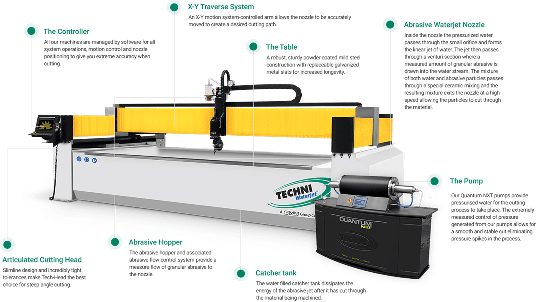
TECHNI Waterjet® is your trusted waterjet cutter manufacturer when it comes to giving your business a competitive advantage using finest abrasive Waterjet machines and cutting technology. Our team of water jet machine engineers has been developing and innovating new complete high-pressure abrasive waterjet cutting solutions for over 35 years.
MISSION & VALUES STATEMENT
TECHNI’s Mission is to be a manufacturer of reliable, innovative waterjet products and service, of such quality that our customers will receive superior value, while our employees and business partners will share in our success.
We are a proud and passionate team of motivated and reliable employees, with a high level of integrity and creativeness.
We work as a professional team that is committed to our process and increasing our knowledge in order to achieve our goals. We are quality focused, taking pride in everything we do.
TECHNI’s success will be determined via our daily actions and through the core values we represent.
A leading high-tech engineering company specialising in electronics, electrical, education and additive manufacturing equipment. Also, Emona TIMS Pty Ltd proudly designs and manufactures in Australia, and exports world-wide our Emona TIMS telecommunications training systems.
Emona TIMS Pty Ltd manufactures and exports worldwide a range of university & college level laboratory equipment & software for Telecommunications known as ‘TIMS’.
TIMS provides hands-on experience in modeling telecoms theory to enhance understanding in the lab and uses a unique block diagram approach for building experiments.
About The Emona Group
The Emona Group of companies was established in 1979 by Mr Alfred (Fred) Brežnik AM. From our start as a single person office importing and distributing electronic test instruments, the Emona Group has diversified and grown to cover imports, manufacturing and exports, with sales offices around Australia. Emona also has a representative office outside of Dallas, TX, USA.
Our range covers electronic and electrical test and measuring instruments for the Australian market, engineering teaching equipment and additive manufacturing systems for Australia and New Zealand, and worldwide exports of the TIMS Telecommunications Training System.
With our QA certification to AS/NZS ISO9001 and use of NATA traceable calibration equipment, the Emona Group is established as one of Australia’s leading instrumentation, additive manufacturing systems and teaching equipment suppliers to industry, education, defence and government customers.
Emona has also been recognised in numerous industry and government awards. Emona has received awards in recognition of outstanding performance from industry partners such as Rigol Technologies Inc, Tektronix Inc, Seaward Ltd, Metrel and Markforged. In 2007 Emona was awarded a prestigious Commonwealth Government “Secrets of Australian ICT Innovation Competition” award for our TIMS Telecommunications Training System.
With over 40 years experience in the latest technology, Emona continues to expand with diversification into 3D printing and additive manufacturing systems in composites and metals, as well as PCB and electronics printing.
We thank our Australian and worldwide customers for supporting Emona and we will continue to work to provide the best possible products, backed by professional technical support, repair and calibration services.
About Emona Instruments
A leading high-tech engineering company specialising in electronics, electrical, education and additive manufacturing equipment. Also, Emona TIMS Pty Ltd proudly designs and manufactures in Australia, and exports world-wide our Emona TIMS telecommunications training systems.
About Emona TIMS
Emona TIMS Pty Ltd manufactures and exports worldwide a range of university & college level laboratory equipment & software for Telecommunications known as ‘TIMS’.
TIMS provides hands-on experience in modeling telecoms theory to enhance understanding in the lab and uses a unique block diagram approach for building experiments.
PRODUCTS
Electronic Test & Measurement
Electrical & Industrial Instruments
Engineering Teaching & Research Equipment
High Performance 3D Printers
Print 3D parts in under 2 hours with quality that rivals injection molding. Formlabs, represented in Australia by Emona Instruments, is proud to announce the new Form 4, a new resin printer that prints at blazing speeds with incredible precision and unmatched accuracy. Leverage the reliability and ease of use of the Formlabs ecosystem to print most parts in under two hours, or print quick models in just minutes.
Form 4 and its biocompatible version, Form 4B, represent the next evolution in stereolithography (SLA) 3D printing technology, built upon years of groundbreaking hardware, software, and materials science innovations. The Form 4 features up to four times faster print speeds than previous Form Series printers and a 30% larger build volume.
Form 4’s speed is driven by the new Low Force Display™ print engine, a powerful combination of high-power LEDs and masking lenses that cure each layer of resin instantly — regardless of part size or quantity. Print speeds are no longer affected by how much of the build platform is covered, so multiple parts can print at once without extending your print time.
Form 4 combines the new print engine with updates to the Formlabs materials library — 23 unique resins on Form 4 and 37 on Form 4B available at launch — as well as new accessories and post-processing solutions, and an improved user experience. These updates reaffirm that Formlabs’ resin 3D printing ecosystem is the most powerful tool available for any professional to turn their ideas into reality.
Are you looking for a place where you can immerse yourself in nature and simply enjoy the sound of silence, where the air is clean and fresh, the skies are tall and there is plenty of space to enjoy a Sunday afternoon drink in a unique Australian setting?
Would you like to step back in time and smell the wine being made as you walk into the winery, or just soak up that sense of wine history that surrounds you as you taste an exquisite range of award-winning wines in an historic cellar door?
Book a Seated Tasting Experience to explore the large range of premium wines produced by father and daughter winemaking team, Chris and Jen Pfeiffer.
Enjoy 15 award-winning Pfeiffer fortified wines that have been carefully handcrafted from aged stocks using time-honoured traditions and skills that have been passed down through the generations with a World Class Fortified Wine Tasting Experience.
Carefully craft your own blend and become a Muscat Master Blender along the way or even picnic on the ‘pfamous’ Sunday Creek bridge with a pre-booked Picnic Hamper…and if the season is right, you can even feed some turtles.
Pfeiffer Wines is located at 167 Distillery Road, Wahgunyah, Victoria. We are 6km from Corowa NSW and 6km from Rutherglen Victoria.
Directions and Map
Pfeiffer Wines is located on the large sweeping bend in Distillery Road, Wahgunyah, Victoria. We are 45km from Albury, 300 km from Melbourne and 600km from Sydney.
Daily commercial flights operate between Albury – Sydney and Albury – Melbourne.
All major car rental firms operate from Albury Airport.
Pfeiffer Wines is open 7 days a week, from 9am until 5pm Monday – Saturday and from 10am – 5pm on Sunday, including all Public Holidays, except Christmas Day, Boxing Day, Good Friday and Anzac Day morning.
We are 45km from Albury, 300 km from Melbourne and 600km from Sydney. Daily commercial flights operate between Albury – Sydney and Albury – Melbourne. All major car rental firms operate from Albury Airport.
Continuing our family philosophy, we produce exceptional wines that reflect the regional characters from where the grapes are sourced.
Richard Buller represents the third generation of Buller family wine makers, with his father Richard (Dick) Buller, handing him the reigns in 1974. From his first vintage as a wine maker, Richard was awarded five
gold medals. Since then, he’s fostered a passion for crafting wines in a boutique style that exhibit the unique characters and complexities of their variety and the regions from which the fruit is sourced.
The Richard Buller Wines head office is based in the Rutherglen Wine Growing Area of Victoria, Australia and that family commitment and passion continues to grow. Their wines are recognised and sold in Australia, Singapore, Hong Kong, China,
the UK and Denmark.
Along with his wife Susan, and daughter Kate, Richard continues to drive that vision to deliver wines with quality and integrity. Kate’s three young children, Rippon, Ivy and Archer, who make up the fifth generation of Buller’s, delight in spending time in the family vineyards, while their grandfather tends the vines.
Richard Buller Wines are fine Australian wines of distinction: made from premium parcels of fruit grown in specially selected vineyards across Victoria. They are proud to present this extensive collection of wines, suitable for every day enjoyment, ranging to wines with style and flavour to satisfy the palate of the most discerning wine consumer.
Showing 1–12 of 13 results
Default sorting
Caldwell Tawny
Caldwell Tawny
Cally 2012 Cabernet Merlot Petit Verdot
Cally 2012 Cabernet Merlot Petit Verdot
Cally 2014 Shiraz
Cally 2014 Shiraz
Classic 2016 Cabernet Sauvignon *SOLD OUT*
Classic 2016 Cabernet Sauvignon *SOLD OUT*
Classic 2017 Merlot
Classic 2017 Merlot
Classic 2018 Shiraz
Classic 2018 Shiraz
Clio 2015 Riesling
Clio 2015 Riesling
Clio 2015 Shiraz
Clio 2015 Shiraz
Hearts 2018 Cabernet Merlot
Hearts 2018 Cabernet Merlot
Reginald 2012 Merlot
Reginald 2012 Merlot
Reginald 2015 Cabernet Sauvignon
Reginald 2015 Cabernet Sauvignon
Our Vineyard
In 1997 Richard and Susan Buller bought 50 acres of soft sloping, granite-rich land just outside Rutherglen, with the dream of starting their own vineyard.
Following two years of planning and preparation, in the Winter of 1999 the first Shiraz vines were planted by the family. Twenty years on, 12 acres of land are planted under Shiraz with more vines planned for future planting.
Although not organic, the vineyard is run in the greenest way possible. Grass is kept down the centre rows, which helps with bug control – insects eat the weeds and grasses, rather than the vines and grapes. Pesticides are not used on or in the vineyard. During winter, sheep graze between the vine rows, keeping the weeds at bay, and providing a natural fertiliser. The vines are irrigated using underground bore water pumped directly from under the property.
Healthy Ecosystem
The family have a small dam on the vineyard, teaming with wildlife, including frogs, fish, yabbies, turtles and ducks, while kangaroos, echidnas and many other types of birds come for a drink or swim to keep cool in Summer.
Future Vineyard Development
Future plantings of different varieties are planned, we are looking at Durif, more Shiraz and grapes for fortified wines.
The fifth generation of Bullers, Richard’s grandchildren, are now old enough to help with the Summer pruning, and they enjoy helping Grampy in the vineyard.
Companion farming involves having animals among the vines to help with control of weeds and pests. The animals also turn the ground over and help to fertilise the soil.
China will ratchet up efforts to accelerate technological innovation, share its original technologies and innovative scenarios, and promote the digital transformation of urban areas, as part of a broader push to foster new quality productive forces, officials and experts said.
Zhuang Rongwen, head of the Cyberspace Administration of China, highlighted the significance of strengthening the deep integration of sci-tech innovation with industrial innovation, developing new quality productive forces in accordance with local conditions, and leveraging new technologies such as artificial intelligence to promote the innovation in urban management.
Zhuang made the remarks at the opening ceremony of the Global Digital Economy Conference 2025, which kicked off on Wednesday in Beijing. Themed “Building a Digital-Friendly City”, the event has attracted over 300 international guests from more than 50 countries and important international organizations.
Zhuang called for efforts to boost the in-depth integration of digital technologies with public services, accelerate the interconnectivity and sharing of information and data, promote exchanges and cooperation in the digital economy domain among different cities, and carry out international cooperation in fields such as AI.
More work is needed to promote urban digital transformation, build an intensive and unified digital foundation and data platform, and bolster cross-field and cross-department data sharing, said Liu Liehong, head of the National Data Administration.
Liu stressed the need to give full play to the important role of data elements and digital technologies in urban emergency and safety management, as well as deepen the reforms related to the circulation and utilization of data resources and the market-oriented allocation of data elements, to facilitate the innovative development of the digital economy.
The added value of core industries of China’s digital economy accounted for about 10 percent of GDP in 2024, while the total data output reached 41.06 zettabytes, marking a robust 25 percent year-on-year increase, according to the “Digital China Development Report 2024” released by the NDA.
The country has unveiled a guideline on promoting the development of smart cities and urban digital transformation to make urban management smarter. By 2027, China expects to see significant progress in the digital transformation of urban areas and to have built a number of livable, resilient and smart cities, according to the document released by the NDA and several other government departments.
“Digital technologies are reshaping how we live, we work and we connect. They have the potential to be strategic accelerators for sustainable development,” said Beate Trankmann, the United Nations Development Programme’s resident representative in China.
Trankmann said that given China’s position as a global pioneer in emerging technologies and innovation, “China’s knowledge, experience and commitment to efficient governance and regulation of digital tech will be critical to inform how we as an international community move forward.”
Jiang Xiaojuan, a professor at the University of Chinese Academy of Social Sciences, said that data has permeated all aspects of society, and has an impact on the allocation of social resources and the logic of economic and social operations, adding digital technologies represented by the internet, big data and AI have significantly enhanced the capabilities of data generation, transmission and processing.
Citing that China, as the world’s largest data producer, has unique advantages in facilitating the development of its digital economy, Jiang called for efforts to give full play to the multiplier effects of data elements, create more abundant applications in a wider range of sectors, and promote the sharing, development and utilization of public data.
Wu Jianping, an academician at the Chinese Academy of Engineering, said the emergence of state-of-the-art digital technologies has laid a solid foundation for unleashing the value of massive data elements, which underscores the significance of safeguarding data security, a prerequisite to ensuring the orderly development of the data industry.
ACWA Power, a Riyadh, Saudi Arabia-based energy and water desalination giant, remains deeply committed to investing in China and is set to strengthen its foothold in China’s rapidly growing renewable energy sector, said its top executive.
ACWA Power’s founder and chairman, Mohammad A. Abunayyan, expressed strong optimism in the country’s renewable energy market and long-term economic prospects, and plans to further expand its presence to meet growing demand in the country.
“China, now the world’s largest renewable energy market, represents a key opportunity for ACWA Power to scale its expertise in green energy solutions,” Abunayyan said on the sidelines of the Summer Davos meeting held recently in Tianjin.
The China market will play a key role in ACWA Power’s energy-sustainable development strategy. By 2030, ACWA Power plans to expand its global asset base to approximately $250 billion, with investment in the China market expected to reach $30 billion to $75 billion.
He highlighted China’s increasing importance to the company’s global strategy, positioning it as the second most important market globally, only after Saudi Arabia.
“As the world’s largest renewable energy market, China, a strategically vital market with immense long-term potential driven by robust demand and a commitment to renewable energy and advanced technologies, for us is extremely important, leading the way in clean energy,” Abunayyan said.
“China’s commitment to innovation, massive market size and opening-up policies represent key drivers for continued investment and growth in the sector.”
Following years of collaboration with Chinese firms in third-party markets, the Middle East energy conglomerate formally entered China’s renewable energy landscape this year, securing agreements for over 1 gigawatt of renewable energy projects across several provinces in the country, eyeing a multidecade investment strategy focused on solar, wind, desalination and green hydrogen.
Earlier this year, the company secured partnerships with two of China’s major renewable power producers — Sungrow and Mingyang Smart Energy — to jointly develop and invest in solar and wind projects that will contribute to China’s ambitious decarbonization targets.
The company is also exploring prospects in offshore wind, water desalination and green hydrogen, eyeing to invest heavily in research and development in China in the years to come.
Industry experts believe that due to the resilient demand growth, China has become the focus of multinational corporations.
Propelled by ambitious carbon neutrality goals and significant renewable energy investments, China presents a highly attractive market for global companies, said Lin Boqiang, head of the China Institute for Studies in Energy Policy at Xiamen University.
Engaging in this dynamic market provides access to the world’s largest energy consumer base, enables diversification from fossil fuels and secures a strategic foothold in the global energy transformation, he said.
Abunayyan expressed strong confidence in China’s economic trajectory, particularly its long-term potential and the quality of its growth, pointing to the huge demand within China, driven by its large population, growing middle-income group and the increasing energy needs from technological advancements like artificial intelligence.
This demand underpins ACWA Power’s confidence in the market’s long-term viability, he said.
A key focus area for its investment in China is desalination, which Abunayyan identified as the company’s top priority sector in the market.
The company, the world’s largest desalination player, said it is working to localize the components and supply chain for desalination within China, not only for domestic projects but also for use in its global ventures.
Abunayyan praised the Chinese government’s efforts to improve the foreign investment environment in recent years, citing increased transparency and openness toward MNCs.
While acknowledging that the current global environment is “not easy” due to geopolitical tensions and potential short-term supply chain issues, Abunayyan maintained a resolutely optimistic stance on China’s long-term outlook.
“I am very confident about the long term and ACWA Power will continue leveraging its strong existing partnerships with Chinese companies, including State-owned enterprises as well as private firms.”
BEIJING — China’s State Administration for Market Regulation on Wednesday said that it has released a series of national standards for emerging industries such as artificial intelligence (AI).
Seven national standards have been released — covering AI, information technology and the internet of things — to provide technical support for the expansion of digital services and applications, the administration said.
Another five national standards cover data centers, cybersecurity technologies, and systems and software engineering, supporting deeper integration and interconnection throughout the digital economy.
The administration has released national standards on the safety of electric earthmoving machinery and the general requirements for battery-swap systems, improving the standards system for the electrification of traditional construction equipment and supporting the green transformation and upgrading of traditional industries, the administration said.
It has also released a range of national standards covering such areas as elderly care and child care, transportation and energy, agriculture and rural development, and green and low-carbon development.
Sector’s carbon emissions intensity down by over 60% in 2005-22 period
By ZHU WENQIAN | China Daily | Updated: 2025-07-03
China’s textile and apparel producers are making more efforts to cut carbon emissions, and technologies such as intelligent manufacturing, biomanufacturing and 3D printing are helping them to further accelerate the sector’s green transformation.
As a core hub for global textile and clothing production and consumption, China’s processing of textile fibers accounts for over 50 percent of the global total, said the China Textile Information Center (CTIC).
The country’s textile sector’s carbon emission intensity, which is measured by a company’s carbon emissions volume divided by its sales revenue, declined by over 60 percent during the 2005-22 period. In the past two years, the carbon emissions intensity of leading domestic enterprises further dropped by 14 percent, said the China National Textile and Apparel Council.
“China’s textile sector is accelerating the formation of new quality productive forces around the new positioning of technology, fashion, green and health,” said Sun Ruizhe, president of the council.
“We should give full play to leading textile enterprises’ role in carbon emissions reduction, and strengthen technological innovation in key areas such as using green fibers, promoting waterless or reduced-water printing and dyeing, as well as the recycling of waste textiles.”
Sun said China should further integrate itself into global green development, strengthen cooperation with markets involved in the Belt and Road Initiative by sharing green technologies and jointly building green standards, and promoting mutual recognition of key indicators.
Globally, carbon emissions from the textile sector account for 0.6 percent of total carbon emissions, said the International Energy Agency.
“Accurate climate prediction is crucial for the design, production, sales and other aspects of the apparel sector. Quantitative prediction can help enterprises make adjustments in advance based on their previous business experiences,” said Chao Qingchen, director of the National Climate Center.
As China aims to peak carbon dioxide emissions before 2030 and achieve carbon neutrality before 2060, Bosideng Group, a major domestic down jacket firm, said the dual-carbon goals provide historical opportunities for the textile industry to further upgrade, and consumers have indicated a growing demand for sustainable fashion products.
The company has continuously optimized the efficiency of its energy usage, expanded the application rate of renewable electricity, and supported public ecological projects. It also requires suppliers to reduce the use of harmful substances.
“Bosideng deeply feels the responsibility and always integrates the concept of sustainable development throughout the entire process of our operation. Sustainable growth has become a widely recognized global consensus,” said Gao Dekang, chairman and CEO of Bosideng.
Meanwhile, the ratio of China’s small and medium-sized enterprises engaged in the textile sector is significantly higher than in the overall manufacturing sector. Currently, there are 690 specialized, innovative and “little giant” textile enterprises in China. “Little giant” companies refer to specialized SMEs that produce unique goods and services.
In a strategic move to accelerate the textile sector’s digital transparency, the 2025 digital product passport whitepaper for China’s textile sector was launched in late June by the CTIC, and GS1 China — an affiliate of the State Administration for Market Regulation.
The whitepaper established China’s first integrated digital product passport framework, and positioned digital transparency as the cornerstone of sustainable transformation across the lifecycle of a product.