Thursday, November 26, 2026

Home Blog Page 218

5 Cities Rise As Intl Centers For Consumption

0

Policies including instant tax refunds, visa-free transit offer significant boost

By Zhu Wenqian | China Daily | Updated: 2025-06-23 

China is accelerating the building of five major cities — Shanghai, Beijing, Guangzhou in Guangdong province, Tianjin and Chongqing — into international consumption centers on a par with global metropolises such as New York, Paris and Tokyo, as part of the country’s broader efforts to boost domestic spending.

 From the perspective of global standards, international consumption cities are often regarded as “shopping paradises” with advanced commercial facilities and strong purchasing power of consumers, industry insiders said.

 Consumption’s key role as a driver of economic development has long been a key focus of China’s top leadership.

 In November 2021, President Xi Jinping said in a speech delivered via video link at the opening ceremony of the fourth China International Import Expo in Shanghai that China will firmly share market opportunities with the world, including promoting the integration of domestic and foreign trade and accelerating the building of international consumption cities.

 About four years ago, with the approval of the State Council, China’s Cabinet, the decision was made that the five cities would take the lead in being developed as international consumption centers.

 Zhang Xiaoying, a researcher at the Guangzhou Academy of Social Sciences, said, “Given the profound changes in the global economic landscape, building international consumption cities is of great significance for China in boosting the consumption market, promoting industrial upgrading, driving high-quality development and further expanding opening-up to the outside world.”

 In the past few years, the five selected cities have continued to innovate diversified consumption scenarios, and high-quality global resources are accelerating their presence in those cities.

 Inbound travel has emerged as a bright spot in these cities. China unveiled a set of measures in April to further optimize its departure tax refund policy for eligible overseas visitors and instant tax refund services have been implemented nationwide.

 Marco, a traveler from the Netherlands who didn’t disclose his surname, visited Beijing for the first time in June with a friend. He shopped in the bustling Guomao area, the capital’s central business district, and received an instant tax refund for the products he bought.

 “Being able to buy tax-free goods is always good, just like in many other countries. We assumed there would be something like this here, and we learned the policy at the entry of the shopping mall,” Marco said.

 In 2024, the number of inbound foreign visitors to the five cities doubled year-on-year, and the number of tax refund stores in those cities accounted for about 60 percent of the country’s total. This year, China will increase the number of tax refund stores to about 10,000 nationwide, almost tripling the current number, the Commerce Ministry said.

 “The number of such stores in China is far from enough,” said Sheng Qiuping, vice-minister of commerce.

 Sheng noted that Japan has more than 60,000 stores available for tax refunds for overseas visitors. South Korea has some 20,000 such stores, while France, Germany and Italy have over 10,000 each.

 Andrea Yue, partner of indirect tax services at professional services firm EY, said the instant tax refund service has helped stimulate consumption in China. Combined with the country’s 240-hour visa-free transit policy, it is expected to further promote the growth of inbound tourism and tourist spending.

 Against the backdrop of mounting economic challenges at home and abroad, China’s policymakers have swiftly responded with coordinated measures to boost consumption, while prioritizing consumption as the nation’s top economic initiative this year.

 Shanghai, which is among Chinese cities with a high concentration of foreign tourists, has been striving to build itself into a major global tourist destination. The city is now home to theme parks such as Shanghai Disney Resort, Shanghai Haichang Ocean Park and Shanghai Legoland Resort.

 The city has also been holding various top international events such as the Formula 1 Chinese Grand Prix.

 Furthermore, China will encourage the development of cruise tourism and the low-altitude economy to boost the building of international consumption centers, according to the Commerce Ministry.

 Chongqing, a mountainous city in Southwest China, has vigorously developed its low-altitude sector, which centers around activities, businesses and services conducted at altitudes below 1,000 meters above ground level.

 The megacity aims to build a low-altitude logistics network that links its urban and rural areas, as well as connects with Chengdu, Sichuan province, and other parts of the country, according to a document released by the local government in early June.

 Late last year, a new low-altitude flight was launched at Chongqing Wushan Airport, allowing tourists to experience the magnificent scenery overlooking the Three Gorges of the Yangtze River.

 China’s coastal cities such as Shanghai and Tianjin are embracing a wave of international cruise tourism, as more domestic and foreign cruise lines are introducing various types of voyages.

 China is also building its second domestically made large cruise ship, the Adora Flora City, in Shanghai, and the vessel is scheduled for delivery in 2026. The first domestically built cruise ship, the Adora Magic City, has completed more than 100 voyages, providing more than 350,000 passenger trips, according to China State Shipbuilding Corp.

 zhuwenqian@chinadaily.com.cn


Article inline ad

‘Digital Bridge’ Connects Global Business Amid Geopolitical Headwinds

0

By Zhu Shenshen

2025-06-20      

Building an Innovation Hub

MagHub

News in Brief

 “Digital Bridge” continues to facilitate international business connections, covering multinational companies in China and Chinese firms expanding globally, despite geopolitical uncertainties including ongoing tariff disputes, China Biz Buzz learned during the ongoing Mobile World Congress (MWC) Shanghai.

 The MWC’s Glocal Tech Forum, co-hosted by China Mobile International, Nokia Shanghai Bell and GSMA convened to explore how technology can drive more connected, resilient and inclusive global growth.

 ‘Digital Bridge’ connects global business amid geopolitical headwinds

Markus Borchert, CEO of Nokia Shanghai Bell, gives a speech during a MWC Shanghai forum.

 Markus Borchert, chief executive officer of Nokia Shanghai Bell, highlighted his company’s pivotal role as a “Digital Bridge,” supporting both multinational firms establishing a presence in China and Chinese companies venturing overseas. While acknowledging the “vast, but also complex” opportunities, Borchert emphasized the booming demand for digital connectivity among multinationals in China, such as campus wireless networks connecting with their international operations. He cited a major European chemical company building a large facility in South China, relying on Nokia Shanghai Bell’s solutions for its network infrastructure.

 These companies, he noted, recognize and value the strengths of the Chinese market, its robust local supply chains and excellent infrastructure, fostering a “In China, For China” localization approach.

 Separately, China Mobile unveiled its international strategy and the latest development results for GTI, a global industry association it co-founded in 2011 with SoftBank, Bharti Airtel, Vodafone and Sprint (now T-Mobile US).

 GTI, which currently boasts 147 carrier members and 272 partner organizations, also presented insights into the evolution of 5G Advanced and 6G trends at MWC Shanghai, anticipating a boost to scientific innovation and the digital economy. Discussions at the GTI conference also delved into the deep integration between 5G, robotics and artificial intelligence.

 For global expansion, Nokia Shanghai Bell has built optical data center interconnect (DCI) infrastructure for two of China’s leading Internet companies, Tencent and Baidu, supporting their overseas market endeavors.


Article inline ad

Unitree Robotics Shares Vision For China’s Robot Revolution

0

Xinhua

 2025-06-22      

From robots dancing the Yangko, a traditional folk dance, during China’s 2025 Spring Festival Gala, to bone-crushing combat mechs in the arena and all-terrain robotic dogs that carry humans, the creations of Chinese firm Unitree Robotics never fail to astonish with their boundary-pushing features.

 “Within the next year or two, robots will acquire generalized capabilities for both commercial and household applications, such as tidying rooms and delivering items,” said Wang Xingxing, founder and CEO of Unitree Robotics, in a recent exclusive interview with Xinhua.

 Founded in east China’s tech hub Hangzhou in 2016, this world-renowned consumer robotics company has been consistently enhancing the operational capabilities of robots to perform practical tasks for humans.

 “Over the past year, we’ve upgraded the manipulation capabilities of our robots’ arms, enabling tasks like component assembly and door opening — all to free humans from strenuous labor,” the CEO revealed.

 Unitree Robotics, notably, is the first company in the world to start public retail of high-performance quadruped robots, and leads the global market in terms of robot sales volume.

 While humanoid robots often demonstrate their technical prowess through performative acts like dancing and combat, such displays have sparked debates about practical utility, viable commercialization pathways and potential industry bubbles.

 In response, Wang said that before achieving the “ultimate goal” of integrating humanoids into daily work and life, these performances serve dual purposes — showcasing genuine technological progress while generating interim commercial value.

 “In robot combat tournaments, our latest-generation control technology enables robots to perform complex combos, from precision punches to spinning kicks, with seamless transitions and exceptional stability,” Wang explained. He predicted such competitions could evolve into a globally popular sport rivaling football and basketball.

 Unitree Robotics launched its humanoid robot project in 2023. Leveraging years of technological accumulation in quadruped robotics, the company developed its first bipedal robot prototype in just six months.

 Powered by AI advancements, the humanoid robots launched by Unitree Robotics in 2024 exhibited superhuman flexibility, making them capable of executing highly dynamic maneuvers. This year, through data capture and reinforcement learning technologies, the robots have mastered martial arts maneuvers, including aerial cartwheels and kip-ups, garnering widespread attention.

 Led by pioneers like Unitree Robotics, China’s technological prowess is making its mark in the global humanoid robotics arena. A recent Morgan Stanley report forecasts China’s humanoid robot market will grow to 6 trillion yuan (about 836.88 billion US dollars) by 2050 — with the total number of humanoid robots reaching 59 million.

 According to data from China’s State Administration for Market Regulation, as of December 2024, the country had 451,700 enterprises in the intelligent robotics industry, with total registered capital topping 6.44 trillion yuan. The number of enterprises represents a 206.73-percent surge since 2020 and 19.39-percent growth from 2023, demonstrating sustained robust expansion.

 In March 2025, China deployed humanoid robots in 5G-enabled smart factories, thereby achieving multi-unit, multi-scenario collaborative training across diverse tasks.

 “Currently, large-scale, batch deployment of robots still requires breakthroughs in both hardware and software,” said Wang, who thinks the greater challenge lies in AI foundation models.

 “The ‘ChatGPT moment’ for humanoid robots, when they will truly enter workplaces and homes, still requires some time,” Wang said, adding that global robotics firms and research institutions are exploring diverse approaches and are now on the cusp of breakthroughs.

 Wang believes humanoid robots will first gain traction in industrial and commercial applications. He asserts that AI and general-purpose robotics will drive a new “industrial revolution,” potentially restructuring production relationships and human-machine ethics. It is necessary to think in advance about issues including legal framework refinement, human-robot collaboration safety protocols, and workforce skills transformation, Wang noted.

 “Since childhood, I’ve dreamed of changing the world through technology. Just like our company name ‘Unitree’ implies, this isn’t merely a business — I aim to cultivate a thriving ‘science and technology tree’ that branches across the cosmos,” he said.

 Source: Xinhua   Editor: Zhang Long


Article inline ad

I And 5G Drive Digital Transformation At MWC Shanghai 2025

0

By Zhu Shenshen

  2025-06-18      

Artificial intelligence (AI) and 5G services are rapidly integrating into diverse industries and sectors, boosting economic growth and digital transformation, as observed at the Mobile World Congress (MWC) Shanghai 2025.

 The regional extension of the world’s leading telecommunications exhibition opened on Wednesday at the Shanghai New International Expo Center. Thousands of visitors, including key officials from industry giants such as China Mobile, Huawei, Lenovo and ZTE, are attending the three-day show. Onsite demonstrations are showcasing the latest advancements in 5G-Advanced (5G-A) technology, cutting-edge robotics and autonomous driving.

 China currently leads globally in 5G adoption, boasting over 1 billion 5G connections. The GSMA, the global mobile industry association, projected at the opening session of MWC Shanghai that China’s 5G penetration rate will reach 124 percent by 2030, surpassing the United States’ projected 117 percent and Europe’s 101 percent. This high figure implies that, on average, individuals possess two or more 5G-enabled devices, ranging from smartphones and wearable devices to robots and smart cars.

 A recent GSMA report further indicated that mobile technologies and digital transformation are set to contribute an estimated US$2 trillion to China’s economy by 2030, accounting for 8.3 percent of the nation’s GDP.

 AI and 5G drive digital transformation at MWC Shanghai 2025Ti Gong

Yang Jie, chairman of China Mobile, said “Silicon Lives” will be a feature of future society.

 “Silicon Lives” intergrate into future society.

 Yang Jie, chairman of China Mobile, expressed his expectation for the emergence of diverse AI devices, such as robots and intelligent cars. These devices will assist humans in decision-making and service tasks, facilitating the integration of “Silicon Lives” into future society. China Mobile is committed to developing 5G/6G, AI and quantum computing technologies to enhance the country’s information infrastructure.

Eric Xu, of Huawei, highlighted high-quality video streaming and intelligent cars as new business demands.

 At an MWC Shanghai forum, Eric Xu, Huawei’s rotating chairman, highlighted high-quality video streaming and intelligent cars as new business demands driving the telecommunications industry, simultaneously fueling economic development and improving daily life. Xu further predicted that 5G-connected vehicles would account for 30 percent of all cars sold in China this year, surging to 95 percent by 2030. He emphasized that intelligent cars are becoming a crucial growth engine for 5G development in China.

 AI and 5G drive digital transformation at MWC Shanghai 2025SHINE

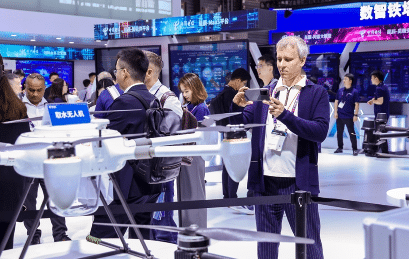
Visitors gather around drones at the China Telecom booth.

 Robots and drones shine

 Robots and drones also caught visitors’ attention, taking center stage in the exhibition halls.

 China Telecom’s booth showcased several, representing the carrier’s one-stop services for the booming low-altitude economy, encompassing software, system control and advanced networks. These drones are widely utilized in surveillance monitoring, Urban Air Mobility (UAM), logistics and emergency rescue services. It’s forming part of China Telecom’s strategy to integrate 5G and AI services into 100 general industries.

 Robots continue to be a major highlight of the show. Shanghai-based AgiBot exhibited its range of interactive robots that can move and engage with visitors, and are already serving as guiding roles in some telecom carrier outlets. The MWC Shanghai event, which also features a robot competition and autonomous driving demonstrations, ends on Friday.

 AI and 5G drive digital transformation at MWC Shanghai 2025Zhu Shenshen / SHINE


Article inline ad

Nation Spearheads 5G-A Network Across 300 Cities

0

By MA SI | CHINA DAILY | Updated: 2025-06-21 07:09

As a global pioneer in commercializing 5G-advanced, or 5G-A, technology which plays a key role in bridging 5G to 6G, China has already deployed such networks in over 300 cities, according to the Ministry of Industry and Information Technology.

 The progress showcases China’s first-mover advantage in defining the next-generation network, which is of crucial importance to the nation’s industrial upgrade, experts said.

 He Biao, general manager of China Mobile, said, the company “will trial 6G technologies on its 5G-A infrastructure, and promote the integrated research and development of the two”.

 As an important upgrade of 5G, 5G-A networks theoretically deliver tenfold improvements in peak data rates and connection density compared to 5G. It will also unlock a market connecting 100 billion internet of things devices, according to China Mobile.

 More importantly, 5G-A base stations have integrated sensing and communication capabilities. They not only handle voice and data transmission, but can also function as distributed radar systems, enabling real-time detection of airborne objects within their coverage zones, China Mobile said, adding that it is testing such a system to facilitate the development of the low-altitude economy, such as drone delivery in Shenzhen, Guangdong province.

 Data from the ministry shows that more than 30 provincial-level regions in China have launched 5G-A service packages, with subscribers surpassing 10 million.

 Meanwhile, telecom operators in China, the Middle East and other regions are also introducing new initiatives to explore applications combining 5G-A and artificial intelligence.

 According to Huawei Technologies Co, the convergence of 5G-A and AI is driving transformation.

 In the industrial sector, 5G-A’s ultra-low latency and high bandwidth are enabling precise perception and decision-making for robots. Real-time data processing via 5G-A supports closed-loop “sense-decide-act” operations, reducing high-risk work hazards while boosting efficiency and safety.

 For robots to truly integrate into industrial production and everyday applications, low latency is the basic requirement, and collaborative decision-making is the key to commercial application, said Chang Lin, CEO of Leju Robot.

 The synergy between 5G-A’s wide coverage and AI route optimization is also enhancing efficiency and cutting costs. For instance, drone deliveries leveraging 5G-A achieve smarter path planning, significantly improving speed and reducing operational expenses, according to Huawei.

 Wang Tao, executive director of Huawei, said commercially, experience-driven monetization is key to 5G-A’s success. By translating network capabilities into premium user experiences — such as cloud gaming and multi-angle sports streaming — 5G-A enables innovative payment models. This “pay-for-experience” trend is reshaping consumption and unlocking new value.

 But challenges still exist. Wu Hequan, an academician of the Chinese Academy of Engineering, said that in recent years, emerging applications such as augmented reality and the low-altitude economy have created growing demand for high uplink bandwidth. However, current 5G networks face shortcomings in insufficient uplink speeds.

 Downlink speed refers to the data transfer rate from network servers to local devices, while uplink speed measures data transmission from local devices to servers.

 According to Wu, while China’s mobile networks have achieved remarkable progress in downlink speeds — with 5G being seven times faster than 4G and 5G-A 10 times faster than 5G — the uplink speeds still significantly lag behind downlink performance.

 Vivek Badrinath, director-general of GSMA, an industry group representing the world’s largest mobile phone operators, said the past year has seen major strides in 5G and AI worldwide. Moving forward, GSMA will deepen collaboration with Chinese telecom carriers to seize 5G-A’s opportunities in enhanced performance and system efficiency to scale AI in manufacturing, ports and beyond.

 masi@chinadaily.com.cn


Article inline ad

Expo To Lift Partnerships With S. Asian Countries

0

By ZHU WENQIAN in Beijing and LI YINGQING in Kunming | CHINA DAILY | Updated: 2025-06-21    

China is willing to integrate its growth more closely with the development of South Asian countries while continuing to strengthen cooperation between those involved, said Wang Dongming, vice-chairman of the Standing Committee of the 14th National People’s Congress, at the ninth China-South Asia Expo.

 The event opened in Kunming, Yunnan province, on Thursday and will run until Tuesday.

 In the past few years, China and South Asian countries have strengthened practical cooperation in multiple sectors. Economic and trade exchanges have maintained a good development momentum and the achievements have benefited people all over the world, Wang said.

 He added that China is willing to continuously enhance strategic mutual trust with South Asian countries, firmly defend multilateralism and actively engage in mutual learning.

 The bilateral trade value between China and South Asian countries has continued to grow and reached nearly $200 billion last year, doubling over the past decade with an average annual growth rate of about 6.3 percent, said the Ministry of Commerce.

 This year’s expo features 16 exhibition halls that are being used to comprehensively showcase industries that boast great potential for economic and trade cooperation between China and South Asian countries. Those sectors include green energy, modern agriculture, medical and healthcare, and cultural tourism, according to the local government.

 Domestic and international exhibitors are showcasing their latest achievements and products at the event.

 For instance, China Southern Power Grid Lancang-Mekong International Co Ltd is showcasing its achievements over the past 20 years about promoting cross-border power interconnection and common technical standards in the region.

 Meanwhile, Ryan Chen, an exhibitor from Vietnam, is attending the expo for the third time this year. He mainly sells eaglewood, also known as agarwood, and its derivatives. Last year, his company set up four booths at the expo and sales reached about 300,000 yuan ($41,764). The company has set up eight booths this year.

 Thirasha, an exhibitor from Sri Lanka, said she is attending the expo for the first time this year. As a marketing director of her company Ahmad Tea, she said the company mainly sells black tea, flower tea, fruit tea and herbal tea. Many consumers have indicated an interest in buying tea at the expo.

 “Tea is a specialty product of both China and Sri Lanka, and many Chinese consumers love tea. It’s possible to find some Chinese buyers and I will come back next year,” she said.

 Contact the writers at zhuwenqian@chinadaily.com.cn

Article inline ad

China-EU Green Ties Set To Expand

0

Nation offers manufacturing expertise, while Europe provides market access

By ZHONG NAN | CHINA DAILY | Updated: 2025-06-21

With Chinese exports of environment-friendly products to Europe booming and European firms scaling up investments in clean energy and smart manufacturing across the nation, green cooperation between China and the European Union is expected to thrive, said business leaders and observers.

 They said such cooperation is increasingly driven by shared climate goals and complementary strengths, with China offering manufacturing expertise and clean tech solutions, while Europe provides market access, strong demand, innovation ecosystems and regulatory frameworks conducive to green growth.

 Pinnacle Sports Products (Suzhou) Co Ltd, an electric scooter manufacturer in Suzhou, Jiangsu province, shipped 4,537 electric scooters to the Netherlands earlier this month, according to Nanjing Customs.

 Europe’s growing demand for green mobility solutions has created broad market opportunities for electric scooters that are lightweight, smart and cost-effective, said Yuan Di, the company’s president, adding that his firm has exported more than 80,000 electric scooters, mainly to France, Sweden and the Netherlands, in the first five months of this year.

 Chinese companies are not only exporting photovoltaic panels, energy storage systems and electric buses to European countries, but are also expanding investments in Europe, said Wang Zhimin, a researcher at the Academy of China Open Economy Studies, which is part of the University of International Business and Economics in Beijing.

 In European countries such as Hungary, Serbia, Portugal and Germany, Chinese companies, including electric car manufacturer BYD, battery producer Contemporary Amperex Technology Co and home appliance manufacturer Hisense Group, have all built advanced battery plants, electric vehicle factories and next-generation eco-friendly home appliance manufacturing bases, said the Ministry of Commerce.

 Wang said that these projects reflect China’s commitment to supporting Europe’s green transition and promoting sustainable development.

 With many European consumers choosing EVs to cut both carbon emissions and fuel costs, Minth Group, a Jiaxing, Zhejiang province-headquartered manufacturer of exterior and structural automotive parts with more than 22,300 employees globally, has built 16 plants in Serbia since 2019, and focused on the production and manufacturing of new energy vehicle components, such as lightweight car bodies, battery housings and chassis structural parts.

 “Serbia is not only a manufacturing base for us, but also a testing ground for China-EU collaborative innovation in green technologies,” said Yu Ke, head of the foreign trade unit at Ningbo Minth Automotive Parts Research and Development Co, a subsidiary of Minth Group in Ningbo, Zhejiang province.

 Ningbo Minth Automotive’s auto parts exports to Central and Eastern European countries have surged to 210 million yuan ($29.23 million) between January and May, jumping 400 percent year-on-year, data from Ningbo Customs showed.

 Beyond lowering household energy costs, Chinese investments are creating jobs and strengthening the integration of upstream and downstream industrial chains in host countries, said Lin Meng, director of the modern supply chain research institute at the Beijing-based Chinese Academy of International Trade and Economic Cooperation.

 Lin said they have fostered deeper industrial and technological collaboration between Chinese and European companies.

 Buoyed by optimism about the Chinese market, many European companies are going deeper into the green economy as China accelerates efforts toward its dual carbon goals.

 One such company is the French industrial conglomerate Schneider Electric.

 “We have been supporting key consumer industries such as food and beverage, bio-pharmaceuticals, and electronics with our digital solutions and services,” said Yin Zheng, executive vice-president, China and East Asia operations, Schneider Electric.

 This enables businesses to save energy, enhance efficiency, and improve the traceability, intelligence and safety of their products, said Yin.

 zhongnan@chinadaily.com.cn

Article inline ad

China Tower Dials Up On Innovation

0

By MA SI | CHINA DAILY | Updated: 2025-06-21 07:33   

China Tower Corp, a mobile communication infrastructure company that runs almost all of the country’s telecom towers, is beefing up innovation application of its digital infrastructure after the company played a pivotal role in helping the nation build the world’s largest and highest-quality mobile broadband network.

 Zhang Zhiyong, the company’s chairman, said by leveraging its vast resources — including 2.1 million telecom tower sites, nearly 1 million equipment rooms, and round-the-clock power and maintenance support — the company has established a unique competitive edge in supporting China’s digital transformation.

 To date, China Tower has helped China build over 5.6 million base stations, indoor distributed antenna systems covering 17.3 billion square meters, and telecom signal coverage for 66,200 kilometers of high-speed railways and subways, Zhang said.

 Since 2014, the company has doubled its annual construction scale, and is now deploying more than 900,000 base stations per year. Network reliability has reached historic highs, with significant reductions in outages and downtime.

 “Through innovation and resource sharing, China Tower has saved over 100 billion yuan ($13.9 billion) in redundant investments — equivalent to eliminating the need for 1 million additional towers,” Zhang said.

 His comments came as China solidified its global leadership in 5G deployment, with the total number of 5G base stations reaching 4.44 million, achieving full 5G coverage in all townships and 90 percent penetration in administrative villages, according to the latest data disclosed by the Ministry of Industry and Information Technology earlier this month.

 China’s 5G mobile users have surged to over 1 billion, while 5G applications now span 86 out of 97 national economic sectors, with over 138,000 real-world use cases. Key sectors such as manufacturing, healthcare, and energy are rapidly digitizing, supported by more than 18,500 “5G + industrial internet” projects nationwide, the MIIT said.

 According to Zhang, moving forward, China Tower Corp will focus on innovation-driven development, maximizing resource sharing, and creating integrated, ubiquitous infrastructure, including on the ground, in the air, and underground, to further strengthen its contributions to the digital economy.

 For instance, China Tower is transforming traditional telecom assets into multifunctional digital infrastructure. By repurposing communication towers into internet of things sensor hubs and converting equipment rooms into edge computing nodes, the company is accelerating its integration into China’s national computing network.

 “Its distributed edge computing framework aims to make computing power as accessible as utilities — on-demand, ubiquitous, and affordable,” Zhang said.

 Moreover, the company is advancing integrated space-air-ground networks. For low-altitude applications, its towers support drone operations with landing pads, charging stations, and maintenance services.

 “For satellite connectivity, 70 percent of the ground-based augmentation stations of China’s Beidou Navigation Satellite System are co-located on China Tower sites,” Zhang said, adding that the company is also collaborating with satellite firms on network optimization, maintenance, and security, including establishing a terrestrial test environment for satellite communications.

 China Tower is also enhancing digital coverage in subterranean spaces, upgrading traditional indoor distributed antenna systems, or DAS, into smart “digital DAS” for applications like underground navigation, autonomous parking, and infrastructure monitoring — empowering smart cities and industrial digitization.

 Xiang Ligang, director-general of the Zhongguancun Modern Information Consumer Application Industry Technology Alliance — a telecom industry association, said China Tower is an example of how Chinese telecom companies keep innovating to make the best use of the resources they have and come up with impressive applications.

 masi@chinadaily.com.cn


Article inline ad

S&P Global Says Muted Market Response To Israel–Iran Unrest May Shift With Further Escalation

0

By Colin Hay    June 19, 2025

S&P Global Market Intelligence Economic Outlook forecasts

 International financial analytics specialist S&P Global says that, while the reaction by commodity and financial markets to the Israel–Iran conflict has so far been muted, further escalation could materially affect the global economic outlook.

 S&P said in a new report that the impact on major equity indices and sovereign bond markets had been modest—so too, the boost to safe haven assets like the Swiss franc and gold prices.

 “All will be highly sensitive to signs of escalation of the conflict,” S&P Global Market Intelligence’s latest Global Economic Outlook noted.

 Strait of Hormuz key

The note pointed out that any closure of the Strait of Hormuz could materially shift the near-term outlook for energy prices, inflation, financial conditions and growth.

 “The key takeaway from a severe conflict escalation scenario run through our Global Link Model is large output losses versus baseline in the Middle East, Asia-Pacific and Europe, given the importance of energy supply from Gulf producers,” the report’s author Ken Wattret said.

 S&P Global Market Intelligence had raised its real GDP growth forecasts for many economies in 2025–26 and most regions in June, consistent with de-escalating trade tensions and somewhat more favourable financial conditions.

 Weakening growth momentum

S&P Global’s Purchasing Managers’ Indexes (PMIs) show a weakening of global growth momentum in the first two months of the second quarter.

 While the global composite output index picked up a little in May, along with business expectations for the year ahead, both measures remained rather weak by historical standards.

 Given the recent developments in the Middle East, a setback in June’s PMI data appears likely, while the early July deadline for the 90-day pause on US “reciprocal” tariffs is also looming large.

 Below-potential outcomes

“Our forecasts for this year and next generally imply below-potential outcomes, with projected growth rates below where they were prior to November 2024’s US elections,” the report noted.

 “The front-running of higher tariffs has led to stronger-than-expected first-quarter growth rates in many economies, although this effect is already starting to unwind.”

 S&P also suggests the US Federal Reserve’s caution over US inflation prospects is likely to linger, despite recent benign consumer price inflation data.

 While May’s US CPI figures again failed to show any tariff-related effects, this is at least in part likely to reflect lags.

https://smallcaps.com.au/sp-global-muted-market-response-israel-iran-unrest-shift-escalation/

Article inline ad

Provaris Energy To Accelerate Commercialisation Of Hydrogen Carriers In Europe With New Deal

0

By  Colin Hay   June 20, 2025

Provaris Energy ASX PV1 “K” LINE commercialisation hydrogen carriers

 Hydrogen transport solutions developer Provaris Energy (ASX: PV1) has signed a memorandum of understanding (MoU) with global shipping leader “K” LINE to progress commercialisation of its range of hydrogen carriers.

 “K” LINE operates a diverse worldwide fleet of more than 400 vessels and is pursuing environmentally friendly, sustainable maritime shipping, especially in Europe.

 The shipping company will provide technical, commercial and operational assistance using its accumulated knowledge and global shipping expertise to aid Provaris’ development of its hydrogen transport and storage model.

https://smallcaps.com.au/

 Significant milestone

Provaris chief executive officer Martin Carolan said the MoU supports the maritime industry’s aim to address Europe’s significant import demand for hydrogen and ambitious emission reduction goals by 2030.

 “This MoU represents a key milestone for Provaris in the development of our regional shipping solution and development of an energy-efficient and cost-effective way to address Europe’s significant import requirement for hydrogen,” he said.

 The agreement outlines a collaborative framework in which “K” LINE and Provaris will co-operate on studies and examinations regarding the continued development, construction and operation of Provaris’ H2Neo carriers and H2Leo barges.

 During the 12-month term of the MoU, Provaris and “K” LINE will also jointly evaluate the potential for further partnership or commercial structures.

 Hydrogen transport

Provaris is gaining an international reputation for its unique compressed hydrogen solutions, which are an efficient and low-cost method to transport gaseous hydrogen over regional shipping distances.

 The H2Neo carrier is a purpose-built compressed hydrogen ship designed for regional marine transport thatt features a hydrogen-carrying capacity of up to 27,000 cubic metres, is engineered for scalable hydrogen delivery and has advanced to a FEED design class approval.

 The company is developing the H2Leo barge for near-shore and port operations compressed hydrogen storage, enabling flexible last-mile delivery and terminal and distribution pipeline integration.

 Both vessels meet stringent safety and emissions standards, quantitative risk assessments and emissions studies.

 Yinson collaboration

Provaris announced a collaboration with Yinson Production earlier this week for the development of an innovative large-scale liquid CO₂ tank design.

 The company has submitted a comprehensive design to Yinson and a marine classification society for preliminary class approval.

 “The successful completion of the Phase 2 design stage, coupled with the planned establishment of a joint venture company between Provaris and Yinson, provides the focus and strategic alignment in our collaborative efforts to deliver industry-leading innovations in CO₂ storage and transport,” Mr Carolan said.

Article inline ad