ROME, Sept. 19 (Xinhua) — Now is the time for Italy’s small and medium enterprises (SMEs) to seize the rising opportunities to develop and thrive in China, Michele Lettieri, president of the Institute of Universal Art and Design (IUAD), told Xinhua in a recent interview.
“We have for many years been considering relations towards the East, particularly with China,” he said. Lettieri is the son of the founder of IUAD, which was established over 50 years ago.
After the first partnership agreement with Zhengzhou University 17 years ago, IUAD now has four cooperation projects with Chinese institutes to encourage youth exchange and design training.
Looking forward, Lettieri said he plans to open a new branch in China with some Chinese partners to offer specific training courses tailored for local students.
He said IUAD has rich experience in teaming up with Italian and Chinese partners, and he was impressed with China’s rapid development over these years.
In the past years, the Italian companies that have prospered in China were active mainly in the luxury sector, he noted. However, there is a huge “unsatisfied demand” for high-quality Italian products that are not luxury brands.
“Now is the time to match supply and demand even for a product that is nonetheless of high quality but not considered luxury, which tends to be made by medium-small companies that do not have the capacity to expand into China,” he said.
“Economically speaking, these small firms can create new business as they are the most dynamic force of the economy,” he said, noting that “Italian craftsmanship and creativity come from the diversity of many small artisans.”
In Lettieri’s view, Chinese youths who study in Italy and learn about local entrepreneurship can play a significant role in helping “made in Italy” products arrive in China.
“These small businesses will never get there (China) without the support of these young people,” he said.
The number of pre-registered Chinese students at Italian universities jumped from 3,549 in 2021 to 4,726 in 2022, with those applying for art majors standing at 1,948 last year, Uni-Italia, an official organization to promote Italian higher education abroad, said.
Noting that Italian and Chinese trade cooperation has been fruitful, Lettieri said that cooperation with Italian firms can help Chinese companies explore the third party market, while the China market has also been attractive for Italian enterprises.
In the past five years, the volume of bilateral trade soared from 50 billion U.S. dollars to nearly 80 billion U.S. dollars, while Italy’s exports to China jumped about 30 percent, official data showed.
“I believe the momentum will maintain, just like what has happened over the past decades,” he said.
BEIJING, Sept. 20 (Xinhua) — China’s Ministry of Transport announced on Tuesday full resumption of international cruise ship transport to and from ports in the country.
Trials on the resumption of international cruise transportation started early this year at ports in Shanghai and Shenzhen.
In its notice issued on Tuesday, the ministry said that local transport authorities at the ports where cruise ships dock should formulate plans for restoring international cruise transportation and proceed with the resumption work after obtaining approval from local governments.
Local transport authorities are also required to strengthen emergency response and epidemic prevention and control, enhance the management of the cruise transportation market, and swiftly resolve any issues that arise, to promote the stable and healthy development of the international cruise transportation market, according to the notice.
HARBIN, Sept. 20 (Xinhua) — China’s northernmost province of Heilongjiang saw its foreign trade in goods grow 16.1 percent year on year to 193.44 billion yuan (about 26.97 billion U.S. dollars) in the first eight months of 2023, according to local customs.
During this period, Heilongjiang’s imports rose 8.1 percent year on year to 145.9 billion yuan, while its exports surged by 50.2 percent to 47.54 billion yuan, data from Harbin Customs showed.
The province’s trade with Belt and Road countries reached 162.3 billion yuan, up 16.1 percent year on year, accounting for 83.9 percent of the province’s total foreign trade volume. Its trade with members of the Regional Comprehensive Economic Partnership rose 27 percent to 18.37 billion yuan.
Its exports of mechanical and electrical products and labor-intensive products maintained strong growth during this period. The province also saw an increase in imports of agricultural products, metal ore and ore sand.
ISLAMABAD, Sept. 20 (Xinhua) — Pakistan’s caretaker Prime Minister Anwar-ul-Haq Kakar said on Tuesday that Pakistan looks forward to enhancing its cooperation with China and other members of the Group of Friends of the Global Development Initiative (GDI) on the implementation of the Sustainable Development Goals (SDGs).
According to a statement issued by the prime minister’s office, Kakar participated in a high-level meeting on the GDI cooperation outcomes on the sidelines of the 78th session of the United Nations General Assembly in New York.
In his remarks at the meeting, the prime minister highlighted that progress towards achieving the SDGs has suffered a severe setback due to the crises of COVID-19, conflict and climate change.
Kakar also highlighted the need for action in five key areas, including food production, infrastructure investment, industrialization, resilient healthcare systems and the bridging of the digital divide, said the statement.
The prime minister said Pakistan supports the GDI and commended the milestones achieved in its implementation, stressing that the Belt and Road Initiative and the China-Pakistan Economic Corridor are vital vehicles for achieving the SDGs.
The prime minister also highlighted the necessity of adequate and appropriate finance at all levels of the development process while welcoming China’s announcement of the setting up of another fund of 10 billion U.S. dollars dedicated to implementing the GDI
BEIJING, Sept. 20 (Xinhua) — Two weeks ago, Tesla reached a new milestone in China after its Shanghai Gigafactory rolled out its 2 millionth made-in-China vehicle, cutting the time for producing 1 million units from more than two years to less than 13 months.
The latest triumph for Tesla’s largest facility worldwide illustrates the awe of Chinese manufacturing, the role of Chinese suppliers and the potential of the Chinese market, reassuring that “the future of Tesla is in China,” as commented by U.S. tech news website The Verge.
But now is not the time for Tesla to sit back and relax. Homegrown EV makers, represented by China’s top-selling automaker BYD, are making the rat race increasingly exciting with greater battery performance, autonomous driving technologies and in-car entertainment systems.
To take on Tesla and BYD, BMW has just announced its plan to launch next-generation EVs exclusive to the Chinese market, with about a third of its global auto sales happening in China.
Moreover, opportunities abound as the second-largest economy switches from “made in China” to “design in China,” ramping up tech developments and innovation amid a rigorous push for industrial upgrading. Tech moguls were blown away by the recent launch of Huawei’s Mate 60 Pro smartphones, featuring high-performance homemade chips developed by the Chinese telecoms giant.
“You are talking about the second-largest economy,” said Jenny Johnson, president and chief executive officer with global investment management firm Franklin Templeton. “You are talking about an economy that generates more engineers than any other country in the world every year, and so from innovation I think there is going to be opportunities,” she told the Forbes Global CEO Conference in Singapore.
China’s potential for economic growth puts it at the head of the pack when attracting investment funds from overseas. Notably, over 100 executives of foreign enterprises have visited China or met with Chinese ministers during the first seven months this year, and more are coming.
In August, China rolled out guidelines containing 24 specific measures to further improve its foreign investment environment and beef up foreign investment inflow, a significant push towards further and higher quality opening-up.
Foreign investors on the hunt for growth potential do not need to look too far for “the next China” because “the next China is China,” said Joe Ngai at McKinsey & Company in Greater China.
The size of the Chinese economy, its fundamentals and its resilience speak volumes. When looking at the Chinese economy, one should focus on more than just the growth rate and compare it to the previous years of double-digit growth, when China’s economic aggregate was much smaller.
China’s gross domestic product expanded 5.5 percent in the first half of the year, outpacing most major economies. A rebound in consumption contributed 77.2 percent to the growth, more than 44 percentage points higher than last year.
Industrial upgrades and innovation gained steam. High-tech investment logged 11.5 percent year on year in the first seven months, and funds for scientific research and technologies grew 23.1 percent. The production of NEVs and solar batteries rose 24.9 percent and 65.1 percent in July, respectively.
The World Bank has projected China’s economy to grow at 5.6 percent in 2023, the Organization for Economic Cooperation and Development expects 5.4 percent and the International Monetary Fund projects 5.2 percent growth.
Meanwhile, China’s development is inextricably linked to global development. An expanding Chinese economy is generating opportunities from both within and beyond, and few would want to miss out.
Bullish on China listings for now and years to come, Nasdaq Vice Chairman Robert McCooey said, “the pipeline continues to be very strong for companies coming to the U.S. markets from China.”
This is partly due to the sustained business growth in China he noticed during a trip there in June. He said he saw “the next generation of companies that are focused on AI and some of the most innovative type of technologies and types of businesses that are being built.”
“We really know how important this region is and will continue to be for Nasdaq and for the growth of the global economy,” McCooey told a recent business forum via video link.
Weaker momentum is not unique to China. Like other economies, the Chinese economy is not immune to spasms. Instead, its growth was generated and consolidated by overcoming one challenge after another.
Policies to boost domestic consumption are already playing out. In August, China’s retail sales of consumer goods, a main gauge of consumption strength, went up 4.6 percent year-on-year, 2.1 percentage points faster than the previous month, data from the National Bureau of Statistics showed on Friday.
Services consumption logged a stellar 20.3 percent expansion in the January-July period, with robust summer vacation tourism. In July, box office revenue surged 111 percent from the previous month.
In a recent piece, Bloomberg foresaw a not too-far-off end to the current setbacks in the Chinese economy, “with the correction occurring at lightning speed, and the steady drip, drip of government stimulus — from interest rate cuts to lower downpayment requirements for first-time buyers, finally adding up to something” and as “China continues to find new sources of growth.”
As China continues to upgrade consumption, ease market access, optimize the business environment and strengthen supply and industrial chains, its long-term growth fundamentals remain unchanged.
A consumption boom is unfolding. Businesses are counting down to the National Day holiday, hoping consumers unleash pent-up demand and herald a new spring for the Chinese economy
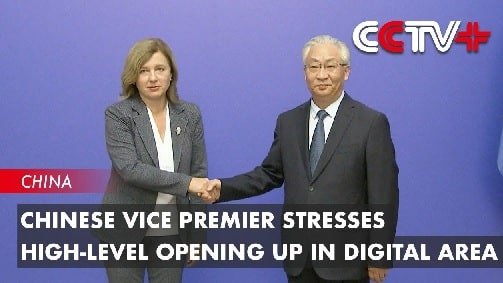
BEIJING, Sept. 19 (Xinhua) — China will continue to promote high-level opening up in the digital area, Chinese Vice Premier Zhang Guoqing said on Monday.↳
Zhang made the remarks during the second China-EU high-level dialogue in the digital area, co-chaired by Zhang and European Commission Vice President Vera Jourova.↳
The two sides had in-depth discussions on issues including development and policy in the digital area, artificial intelligence, standards of communications technology, cross-border data flows, and the safety of non-food products, with a series of results achieved in the process.↳
The two sides stated that China and the EU share broad common interests and strong complementarity in the digital field.↳
China and the EU are ready to work together and strengthen exchanges to push for new results in practical cooperation in the digital area, foster an open, inclusive, fair, just and non-discriminatory environment for the development of the digital economy, and contribute to global digital transformation and economic recovery, they agreed.↳
Companies from all over the world, including Europe, are welcome to share the development opportunities of China’s digital economy and achieve mutual benefit and win-win results, Zhang said.↳
Jourova said that the EU and China have a good foundation and prospects for cooperation in the digital area, and the EU is willing to strengthen dialogue and exchanges with China in relevant fields, as well as deepening practical cooperation.
NANNING, Sept. 19 (Xinhua) — The China-ASEAN Commodity Trading Innovation and Development Forum on Monday helped broker five commodity deals totaling 29.7 billion yuan (about 4.1 billion U.S. dollars).
The procurement deals cover commodities including petroleum, palm oil, coal, and ores, organizers said. The forum was held on Monday in Nanning, capital of south China’s Guangxi Zhuang Autonomous Region.↳
Guangxi has booming trade exchanges with the ASEAN countries. In recent years, the China (Guangxi) Pilot Free Trade Zone has accelerated the construction of a commodity trading platform. From January to July, the free trade zone imported 12.79 million tonnes of commodities, a year-on-year increase of 81.2 percent.↳
The forum also launched the Beibu Gulf (Guangxi) mercantile exchange interactive spot-futures trading platform to help build Qinzhou into a commodity trading hub to mainly serve the ASEAN countries.
More than 200 people from China and ASEAN countries, including commodity trade authorities, business associations, research institutions, representatives of commodity trading platforms and producers and traders, attended the forum.
NANCHANG, Sept. 19 (Xinhua) — China’s Jiangxi Jiangling Group Electric Vehicle Co., Ltd. will deliver 300 new energy vehicles (NEVs) to Türkiye in October, the company said.
The Jiangling “Yi” model to be exported to Türkiye uses a dual motor combination, with a comprehensive output power of 170 kW and a 100-km acceleration within 5.8 seconds, according to Nie Xiaoyong, vice president of the Engineering Research Institute at the company.
According to a cooperation agreement signed by the company and its partner in Türkiye, between 2024 and 2026, its Turkish partner will set up professional sales teams and exhibition halls in Türkiye, and build a sales network with 35 dealers within three years.
Jiangxi Jiangling Group Electric Vehicle Co., Ltd., located in Nanchang City, east China’s Jiangxi Province, was established in 2015. It is a new energy vehicle company that integrates research and development, production, and sales of new energy vehicles and auto parts.
BEIJING, Sept. 19 (Xinhua) — China has been pushing forward the development of intelligent mining amid efforts to improve production safety, according to a Monday press conference on mine safety.
The country has taken a series of measures to boost the development of intelligent mines, which is picking up steam, National Mine Safety Administration official Sun Qingguo told the press conference.
Sun said that there are 730 coal mines in China that are equipped with intelligent working faces, and the total number of the working faces has reached 1,400.
The country has pledged to promote the sector’s development further, with incentives including improved regulations,standards and policy support, according to Sun.
Efforts will be made to encourage universities, research institutes, mines and sci-tech enterprises to work together to carry out research, and to promote the application of unmanned driving and new energy technologies in open-pit mines, he said.
BEIJING, Sept. 19 (Xinhua) — Chinese authorities on Monday announced a tax cut on the research and development (R&D) expenses of eligible integrated-circuit and machine-tool firms between Jan. 1, 2023 and Dec. 31, 2027, to spur enterprise-led innovation.
During the period, such costs, if not covered in the income statement as intangible assets, will be deducted before tax based on 120 percent of the actual amount incurred, in addition to the existing rule that such costs will be deducted before tax, according to the announcement.
If the costs have been taken as intangible assets, they will be amortized at 220 percent as intangible asset costs before tax.
The announcement was jointly made by the Ministry of Finance, the State Taxation Administration, the National Reform and Development Commission, and the Ministry of Industry and Information Technology.