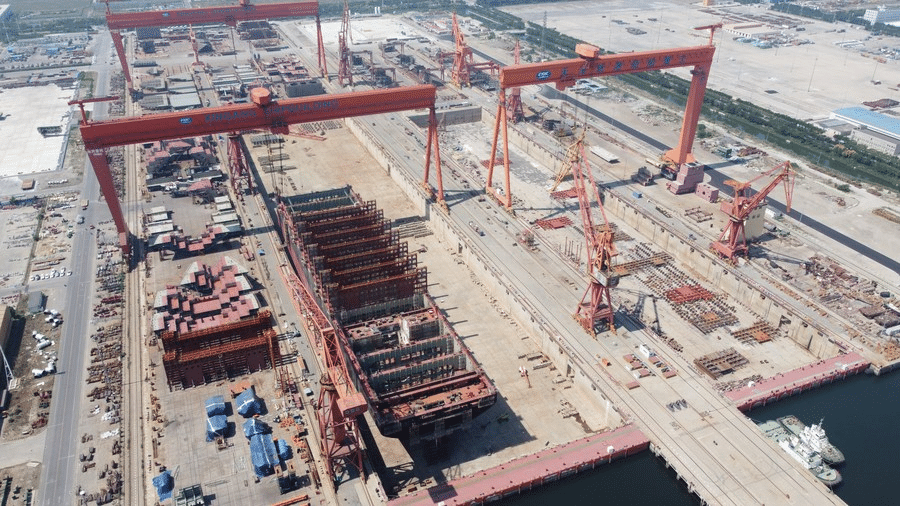
BEIJING, July 13 (Xinhua) -- China's shipbuilding industry recorded sound development in the first half of the year, with double-digit increases in output, new orders and holding orders, according to official data on Wednesday.
The country's shipbuilding output hit 21.13 million deadweight tonnes (dwt) during the period, increasing 14.2 percent year on year and accounting for 49.6 percent of the world's total, data from the Ministry of Industry and Information Technology shows.
New orders, another major indicator of the shipbuilding industry, rose 67.7 percent year on year to 37.67 million dwt, with a global market share of 72.6 percent.
The sector's holding orders totaled 123.77 million dwt at the end of June, expanding 20.5 percent year on year. The volume represented 53.2 percent of the global market share.
XI’AN, July 13 (Xinhua) — The cumulative volume of carbon emissions allowances on China’s carbon market was 237 million tonnes by June 30, with a turnover of more than 10.91 billion yuan (about 1.52 billion U.S. dollars).
China has established the world’s largest carbon market for greenhouse gas emissions, and has significantly reduced its carbon emissions intensity, Vice Minister of Ecology and Environment Guo Fang said at a National Low-Carbon Day activity on Wednesday.
The activity was hosted by the Ministry of Ecology and Environment and the Shaanxi provincial government, and was held in Xi’an, the capital of northwest China’s Shaanxi Province.
China has made positive progress in addressing climate change through a series of measures such as energy conservation, carbon reduction, emissions reduction, and the establishment and improvement of a carbon market, Guo said.
China’s new energy vehicle production and sales have remained first globally for eight consecutive years, its renewable energy has developed rapidly, and its wind power and photovoltaic installations rank first around the world.
Guo said the Ministry of Ecology and Environment will continue to implement a national strategy to respond actively to climate change, promote the construction of a national carbon market in a steady and orderly manner, and participate actively in global governance to address climate change.
China aims to peak its carbon dioxide emissions before 2030 and achieve carbon neutrality before 2060.
National Low-Carbon Day was first observed in 2012 to encourage society to participate in green and low-carbon initiatives.
ISTANBUL, July 12 (Xinhua) -- Chinese technology giant Huawei launched its first localized cloud service in Türkiye on Wednesday at the Huawei Türkiye Cloud Summit in Istanbul.
At the event, Huawei released 78 cloud services covering Data, AI and cloud-native, and a new disaster recovery site in Ankara.
Lu Yong, president of Huawei Europe, said his company is honored to be Türkiye's partner and help the country "go digital."
Noting that Türkiye is a pioneering and innovative country, Lu said, "We are ready to help enterprises accelerate their cloud migration and start innovating in the cloud."
Omer Fatih Sayan, deputy minister of Transport and Infrastructure, thanked Huawei Türkiye for the services.
"I hope that this data center will set an example for other actors in the industry and that more data centers will be established in our country in a short time," he noted.
Huawei started its operation in Türkiye in 2002 and has a large R&D center in Istanbul.
BEIJING, July 13 (Xinhua) — China, the world’s largest producer and user of photovoltaic (PV) modules, will face massive retirement of PV modules, which have service lives of about 25 years.
The country’s PV industry and researchers are working to find sustainable and economical ways to recycle the coming tens of millions of tonnes of retired modules.
MASSIVE RETIREMENT
The International Renewable Energy Agency predicts that by the time the first batch of PV modules come to the end of their service, China will have a large number of PV modules retired from 2025 onwards.
In 2030, the retired PV modules are expected to reach about 8 million tonnes globally and the figure in 2050 will be 80 million tonnes. China will need to recycle 1.5 million tonnes in 2030, and about 20 million tonnes in 2050.
PV modules are mainly composed of glass, backplate, battery, aluminum frame, brazing tape and junction box. Most of these materials, such as glass, copper, aluminum, silicon, silver, gallium and indium, can be recycled. The fluorine-containing backplate, however, is difficult to recycle and has the potential to pollute the environment.
The estimates also show that waste from the PV industry is expected to reach 350,000 to 1.55 million tonnes in China by 2027, and 33.5 million tonnes by 2050. This will be distributed in areas spanning 5 million hectares, becoming new “mines” for the industry to explore.
RECYCLING TECHS
In China’s provincial-level regions such as Jiangxi, Hebei, Henan, Jiangsu and Ningxia, enterprises, universities and research institutes have begun to develop recycling technologies for this untapped field, including mechanical disassembling, physical decomposition and chemical decomposition. Several pilot programs and demonstration lines have been completed or put into operation.
In April, Li Jin, a professor with the School of Materials and New Energy, Ningxia University, led a team in field research at PV power stations built about 15 years ago in the Ningxia Hui Autonomous Region.
The team tested PV modules at those stations to find their defects after years of service and calculated their power generation efficiency to determine when to retire those modules.
Li’s team has invented several types of equipment to disassemble PV modules. One can peel off the components of PV modules layer by layer, while another works like a hot knife to cut through panels with defects.
It’s easy to disassemble PV modules into different parts, just like cars and televisions, but how to reuse the parts with high added value is a more difficult challenge, said Li, whose team plans to develop a disassembling machine to automatically sort disassembled materials for subsequent processing.
The disassembling and recycling of retired PV modules is profitable. According to Li, it takes 30 yuan (about 4.16 U.S. dollars) to buy a retired module. The raw materials disassembled and separated from it, such as glass, aluminum, polymer backplate, silicon, silver, indium and gallium, are worth more than 200 yuan.
GOVERNMENT SUPPORT
China Photovoltaic Industry Association set up a working group in June for recycling retired PV modules and invited government authorities, industrial organizations, PV producers and recycling enterprises for a meeting.
An official with the Ministry of Industry and Information Technology (MIIT) said at the meeting that the ministry will further improve the policy system for solar panel recycling and support the research, development and application demonstration initiatives of the sector.
According to an action plan to peak China’s carbon dioxide emissions by 2030, issued by the State Council in October 2021, it will promote waste recycling in emerging industries, such as retired power batteries, PV modules and wind turbine blades.
In an action plan issued in December 2021, five departments including the MIIT and National Energy Administration called for the research, development and industrial application of recycling technologies for retired PV modules and comprehensive utilization of resources.
In September 2022, the MIIT said that it is necessary to speed up the revision and improvement of the standard system for the photovoltaic industry, and promote the building of public service platforms such as photovoltaic module recycling and carbon footprint verification.
HARBIN, July 13 (Xinhua) — Even in the northeastern Chinese region, where the winter temperature poses challenges for battery-powered cars, the demand for new energy vehicles (NEVs) is growing.
This is largely due to advancements in technology and charging facilities amid China’s green initiative.
“I’ve been driving a gas car all my life and never thought I would switch to an electric one,” said Song Jun in Harbin, capital city of northeast China’s Heilongjiang Province.
The 56-year-old spent 460,000 yuan (about 63,990 U.S. dollars) on his new hybrid electric vehicle.
Harbin is the coldest provincial capital city in China and the lowest temperature in winter can fall to minus 30 degrees Celsius, yet the passion for NEVs has been growing in recent years.
“I think driving NEVs is the future trend as they’re more cost-effective than cars that run on traditional fuel,” said Song.
Song was attracted by the intelligent driving assistance system, interior space and configuration of the electric automobiles.
The new hybrid electric SUV Song bought has a maximum pure electric battery life of 170 km and takes about 6 hours to fully recharge, costing no more than 20 yuan per charge.
“Basically I don’t run on gas in the urban area. The overall cost is much lower than driving a fuel-powered vehicle,” Song said.
Tian Jiwei, an NEV salesperson, said that the EV carmaker would install a charging station for the buyer, and the annual maintenance cost is less than 1,000 yuan.
“A garage is needed in Harbin in winter as the temperature is quite low, but it is not necessary in the southern region,” said Song, who has no “driving range anxiety” and believes NEVs will become more attractive to consumers with the evolution of cells and the expansion of a vast network of charging facilities across the country.
The NEV boom is powered by decades of painstaking efforts that China has made to embrace a greener and more sustainable development pattern.
Encouraged by official policies supporting the emerging industry, China has topped the world in the volume of NEV production and sales for eight consecutive years.
China’s NEV sales rose from 1.37 million in 2020 to 6.89 million in 2022. And in the first half of 2023, NEV sales in the country surged 44.1 percent year-on-year to nearly 3.75 million units, and the NEV output totaled nearly 3.79 million units, expanding 42.4 percent year-on-year, data from the China Association of Automobile Manufacturers showed.
GUIYANG, July 13 (Xinhua) — Speaking of his takeaways from the recently concluded Eco Forum Global Guiyang 2023, Tamas Hajba, senior advisor for China and head of the OECD Beijing Office, mentioned a keyword — “balance.”
Faced with the complexity of economic development, social development, climate goals, and biodiversity conservation, “how you balance these goals and how you make it work for the long-term development is extremely important,” Hajba told Xinhua during the event.
He noted that Guizhou Province, where the forum took place, has accumulated numerous good climate and environmental protection practices while achieving rapid modernization.
As one of the country’s earliest designated ecological civilization pilot zones, Guizhou in southwest China has been striving to balance ecology protection and economic growth.
Located in the upper reach of the Yangtze River and the Pearl River, Guizhou is known as the ecological barrier of the two rivers. Its distinct natural conditions — karst landscape, interwoven river valleys, and mountainous land with thin soil layers– render the local ecology system fragile.
Guizhou once had the largest poverty-stricken population at the provincial level. Economic growth is essential to improving people’s livelihoods.
Eradicating absolute poverty does not come at the cost of environmental degradation. Rather, protecting and improving the environment should be the prerequisite for poverty reduction, said Gao Xiang, president of the Chinese Academy of Social Sciences (CASS), at the forum.
Guizhou has followed the tenet. Industries have been meticulously picked to suit local conditions. A case in point is Chama Township of Qinglong County, once home to the impoverished Qingshan Village. Local land hosts only a thin layer of soil, which is only capable of low crop yields.
The township now boasts over 14,000 mu (933.3 hectares) of Chinese pepper as its pillar industry. The plant is drought-tolerant, with a sophisticated root system and powerful water retention capacity.
The choice proved rewarding as it greened the hills previously resigned to rocky desertification and deepened villagers’ pockets.
“Now, as long as you wish, you can find work to do every day and earn some 80 yuan (11.15 U.S. dollars) per day and a monthly income of over 2,000 yuan,” said Luo Wenmei, a resident of Qingshan Village.
Planting tea trees is another choice for some previously poverty-stricken and landlocked areas in Guizhou to improve locals’ livelihood while expanding green coverage.
Sanjiaotian Village in Leishan County of Miao-Dong Autonomous Prefecture of Qiandongnan, with an elevation of about 1,200 meters, now boasts a landscape of undulating hills layered with lush tea trees.
However, only a handful of ancient tea trees used to dot these hills without proper protection. It was not until six years ago that tea tree seeds from southeast Fujian Province were introduced here and planted in large swaths of land.
Now, across Leishan County, with a population of 164,000, the total acreage of tea plantations reached 163,000 mu, about one mu per capita. Fang Qiqin, a resident of Sanjiaotian Village, can earn over 20,000 yuan from her family’s three-mu tea tree land each year once spring tea gets sold, plus a 300-to-400-yuan daily wage from a local tea-leaf processing factory.
Today, Guizhou boasts forest coverage of over 62 percent. The annual per capita net income of people lifted out of poverty reached 13,200 yuan, according to official data.
Wei Xia, a research fellow with the Guizhou Academy of Social Sciences, noted that Guizhou has integrated ecological protection and economic development. “Lush mountains and lucid water increasingly become people’s immovable assets of happiness and ‘green cash machines’.”
The two-day Eco Forum Global Guiyang 2023, China’s only national-level global forum themed on ecological civilization, concluded Sunday in Guiyang, capital of Guizhou.
BEIJING, July 13 (Xinhua) — China’s customs data showed
Thursday that the country’s total goods imports and exports expanded 2.1 percent year on year in yuan terms in the first half of 2023.
BEIJING, July 11 (Xinhua) -- China's railways transported a higher volume of coal for power generation during the first half of this year compared with the same period of 2022, the country's railway operator said Tuesday.
China's railways handled 777 million tonnes of thermal coal during the period, up 13.1 percent year on year, according to the China State Railway Group Co., Ltd.
In total, more than 1.05 billion tonnes of coal was handled by the railways during the period, up 1.6 percent from a year earlier.
The railway group said it would closely monitor the coal transport demand of power generation companies to ensure the supply of energy for this summer.
WUHAN, July 11 (Xinhua) — By the end of June, central China’s Hubei Province recorded a total installed power generation capacity of over 100 million kilowatts for the first time, with 64.4 percent of the generated electricity powered by clean energy.
Currently, Hubei has a total installed hydropower capacity of 37.84 million kilowatts, including that contributed by the renowned Three Gorges Hydroelectric Power Station on the Yangtze River, accounting for more than one-third of its total power generation capacity. Wind and solar power contribute about 27 million kilowatts of its electricity, while conventional thermal power generates nearly 36 million kilowatts, said the State Grid Hubei Electric Power Co., Ltd.
Hubei’s record-high installed power generation capacity is indicative of the booming development of its new energy sector, according to Zhang Hao with the company’s power dispatch control center.
On June 28 alone, the province saw power output and generated electricity contributed by its photovoltaic and wind power both reaching new heights. Output power stemming from photovoltaic and wind power sources helped meet more than 40 percent of the overall electricity load across the province on that day, Zhang added.
HONG KONG, July 11 (Xinhua) — The economies in the Asia-Pacific have been showing resilience and are poised to gain steam mainly owing to faster growth of the Chinese economy after its reopening from the COVID-19 pandemic.
ASIA-PACIFIC ECONOMY POISED TO MOVE FORWARD
Developing economies in Asia and the Pacific this year are projected to see better performances than in 2022 as the continued easing of pandemic restrictions boosts consumption, tourism and investment, the Asian Development Bank (ADB) has said, highlighting “China’s reopening is the main factor brightening the region’s growth prospects.”
Economies in Asia and the Pacific are forecasted to grow 4.8 percent this year and next year, compared to an increase of 4.2 percent in 2022, according to the latest Asian Development Outlook report released in April.
Improved consumption and investment are boosting recovery in many regional economies, offsetting the impacts of elevated food and energy prices triggered by the Russia-Ukraine conflict and other global headwinds, the report said, adding that tourism and remittances are trending upward as pandemic restrictions ease further, and in many tourism-dependent economies, visitor arrivals are steadily improving toward pre-pandemic levels.
With the adjustment of its COVID-19 strategy, the Chinese economy is expected to grow 5.0 percent this year and 4.5 percent in 2024, compared with a 3.0-percent growth in 2022, it said.
Strong tourism performance and robust domestic demand are boosting Southeast Asian economies such as Indonesia, the Philippines and Vietnam, with the subregion projected to grow 4.7 percent this year and 5.0 percent in 2024, it added.
“Prospects for economies in Asia and the Pacific are brighter, and they are poised for a strong recovery as we return to normalization following the pandemic,” ADB Chief Economist Albert Park said.
“People are starting to travel again for leisure and work, and economic activities are gathering pace. Because many challenges remain, governments in the region need to stay focused on policies that support stronger cooperation and integration to promote trade, investment, productivity and resilience,” he said.
However, risks still persist, the report said, citing the Russia-Ukraine conflict which could stoke renewed spikes in commodity prices and global inflation and induce further monetary tightening if protracted or escalated.
Trade in goods and services, cross-border investment, labor mobility, and technology transfers all support the creation of a much larger, regionally integrated market, which is catalyzed by the Regional Comprehensive Economic Partnership (RCEP), the world’s largest free trade pact taking effect to all its 15 members in June, according to trade experts.
ADB experts told Xinhua that RCEP is expected to help facilitate intraregional trade and investment through tariff elimination, streamlined rules of origin and regional cumulation provisions, which are expected to provide flexibility to businesses to tap into the benefits of preferential market access, while strengthening regional supply chains.
Also, the Belt and Road Initiative (BRI), a reference to the Silk Road Economic Belt and the 21st Century Maritime Silk Road, initiated by China in 2013 to build trade and infrastructure networks connecting Asia to Europe and Africa on and beyond ancient Silk Road trade routes, pushed ahead with connectivity in the Asia-Pacific region.
Joseph Matthews, professor at the BELTEI International University in the Cambodian capital Phnom Penh, told Xinhua that the BRI has complemented the Master Plan on ASEAN Connectivity, and the initiative has provided great benefits to Cambodia, ASEAN and the rest of the world.
Pointing to Asia’s pivotal role in climate change and sustainability, AI and digital, as well as innovation, the aphorism that the world’s center of gravity is shifting toward Asia could be in mind, said Neeraj Aggarwal, chair of the Asia Pacific at the Boston Consulting Group (BCG).
“Over the last decade, market capitalization in Asia-Pacific increased by 15 trillion U.S. dollars, nearly doubling the size of the region’s equity markets. Not just this, Asia is home to one-third of the world’s unicorns and within a couple of years is predicted to have more unicorns than the rest of the globe,” he said.
CHINESE ECONOMY REMAINS DRIVING FORCE OF GLOBAL GROWTH
According to the latest data from the National Bureau of Statistics, the purchasing managers’ index (PMI) for China’s manufacturing sector came in at 49 in June, up from 48.8 in May, ending a three-month decline, another encouraging sign of strengthening economic momentum.
China aims to expand its economy by around 5 percent in 2023, according to this year’s government work report. The country’s GDP grew 4.5 percent year-on-year to 28.5 trillion yuan (about 3.97 trillion dollars) in the first quarter of 2023, official data showed.
Amid challenges on both domestic and external fronts, mainly weak domestic demand and geopolitical risks, the government has ramped up efforts to shore up growth momentum.
The central bank has reduced the one-year interest rate of its medium-term lending facility, a tool adding liquidity to the banking system, by 10 basis points to 2.65 percent. About 237 billion yuan (33.15 billion U.S. dollars) was pumped into the market through the operation.
The government has worked to lower financing costs for business entities and increase loans to small and micro firms. Sectors dedicated to technological innovation or key industrial chains will enjoy tailor-made tax and fee cutting measures, and small taxpayers with monthly sales of less than 100,000 yuan (13,880 U.S. dollars) will be exempted from value-added tax by the end of this year.
In May, China’s value-added industrial output went up 3.5 percent year-on-year, retail sales of consumer goods gained 12.7 percent, and the service sector index rose 11.7 percent, the statistics agency said.
China’s economic growth in the second quarter will be significantly faster than in the January-March period and economic performance will return to normal level in the second half, Fu Linghui, spokesperson for the National Bureau of Statistics, said.
Despite challenges ahead, China, with its solid material and technological foundation, huge market and strong innovation capacity, is capable of overcoming difficulties and promoting the recovery and improvement of the economy, Fu said.
Experts believe that China’s economic outlook for upward trajectory in the long term remains unchanged.
In its China Economic Update, the World Bank maintained its China growth forecast at 5.6 percent in 2023, led by a rebound in consumer demand, stressing that capital spending on infrastructure and manufacturing is expected to remain resilient.
The Organization for Economic Cooperation and Development said that China’s reopening will provide impetus for world economic growth.
According to a recent report by the China Council for the Promotion of International Trade, 97 percent of the surveyed foreign companies rated China’s foreign investment policy since the fourth quarter of last year “satisfied” or above.
A report issued by the EU Chamber of Commerce in China shows that the size of China’s market, strong demand, the fast pace of commercialization of R&D results and ample local talents steer a large share of European companies toward deeper localization, and close to 60 percent of the companies surveyed said that they would increase R&D expenditure in China in the coming five years.
An AmCham China survey shows that 66 percent of U.S. companies in China will maintain or increase investment in China in the coming two years.
Liao Tianshu, chairman of BCG Greater China, told Xinhua that there is huge potential for the Chinese economy, and over the medium and long term, consumption market will be on the rise due to expansion of middle class, and advanced digital technology will play a big role in promoting economic growth.