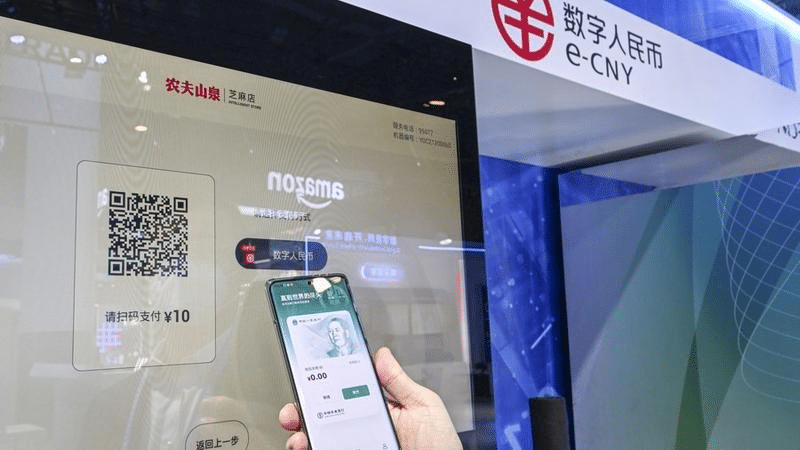
BEIJING, July 10 (Xinhua) -- China's digital payment sector expanded last year to cover more global clients and shore up the domestic real economy, according to a report by China UnionPay, the country's largest bank card payment processor.
In 2022, online payment services provided by China Unionpay extended to over 22 million clients in over 200 countries and regions overseas, said the annual report on the development of China's bank card industry.
Over 41 million people across China received consumption vouchers from China Unionpay's payment app last year, which brought about transactions worth nearly 50 billion yuan (about 6.9 billion U.S. dollars).
The company's offline payment network reached out to 38 million corporate clients in 181 countries and regions worldwide, as Chinese payment companies sought to enhance their global presence through means such as creating cross-border payment products and services, the report revealed.
BEIJING, July 10 (Xinhua) -- China's benchmark prices for spot interbank gold transactions were lower Monday, according to the China Foreign Exchange Trade System.
The benchmark price for gold that is 99.95 percent pure or above stood at 449.44 yuan (about 62.49 U.S. dollars) per gram, down 0.61 yuan from the previous trading day, while the price for gold that is 99.99 percent pure or above lost 0.49 yuan to 449.92 yuan per gram.
Spot transaction prices on the interbank price inquiry market are allowed to rise or fall within 15 percent from the benchmark prices each trading day.
The interbank gold price inquiry business was introduced in 2012 to enhance market liquidity and enrich trading models.
HARBIN, July 10 (Xinhua) -- Daqing Oilfield, China's largest onshore oilfield, produced 15.09 million tonnes of crude oil in the first half of 2023, said the oilfield, a subsidiary of the China National Petroleum Corporation.
During the same period, the oilfield yielded around 2.97 billion cubic meters of natural gas, an increase of 63 million cubic meters compared with the same period last year.
Since the beginning of 2023, Daqing Oilfield has focused on the target tasks of stabilizing oil production and increasing gas production.
Daqing Oilfield is one of China's largest oil production bases. Located in the northeastern province of Heilongjiang, the oilfield has made a significant contribution to China's modern petroleum industry.
Up to now, Daqing Oilfield has produced over 2.5 billion tonnes of crude oil, accounting for 36 percent of China's total domestic onshore crude oil production.
From 2003 to 2022, its annual oil and gas production at home and abroad stood above 40 million tonnes of oil equivalent.
SHANGHAI, July 10 (Xinhua) — China is in the midst of an artificial intelligence (AI) boom this year, which has shown massive potential in reshaping the world’s second-largest economy.
In a clear indication of the AI fever, over 30 cutting-edge products, including deep-learning large language models and general-purpose humanoid robots, are making their global debut at the World Artificial Intelligence Conference (WAIC) 2023 in Shanghai.
Industry insiders and experts believe that China’s AI revolution demonstrates the country’s determination to push forward the digital economy and a new round of industrial revolution. AI technologies are transforming a wide range of industries, injecting further growth momentum into China’s economy as well as that of the world.
AI FRENZY
Over 400 companies are participating in the WAIC this year, occupying a sprawling exhibition area spanning 50,000 square meters. Both figures are at their highest levels since the inaugural event in 2018.
Since ChatGPT took the world by storm late last year, Chinese tech giants and startups have been rushing to join the AI race by launching similar AI chatbots one after another.
China has 79 major AI large language models, with tech giants including Baidu, Alibaba, Tencent, Meituan and iFLYTEK all venturing into this field, according to a report released in May by a research center affiliated with the Ministry of Science and Technology.
China’s AI industry is in the midst of a development boom, with the scale of the core industry at 500 billion yuan (about 69 billion U.S. dollars) and the number of AI enterprises exceeding 4,300, according to Vice Minister of Industry and Information Technology Xu Xiaolan.
China has been accelerating its construction of AI-related infrastructure, with the country’s total computing power already ranking second globally, Xu said.
“The strong demand for computing power provides a huge market, and domestic chip companies will have more opportunities given the tight supply of and export restrictions on foreign computing chips,” said Cai Quangen, vice chairman of chip maker Iluvatar CoreX.
Tesla CEO Elon Musk on Thursday lauded China’s AI industry development while addressing the WAIC via video link. He said he expects China to have strong AI prowess in the future.
Liu Hongbin, with the Hong Kong Institute of Science and Innovation under the Chinese Academy of Sciences, echoed similar views. Given the number of people working in AI-related fields, the advantage of a huge amount of AI data, the advanced AI infrastructure and supportive policies of the government, China will become a world leader in AI by 2030, Liu said.
RESHAPING ECONOMY
Spawning a large number of applications for industries and scientific research, the AI boom is driving the development of China’s digital economy and reshaping the economic landscape.
More than 2,500 digital and intelligent workshops and factories have been built across the country, which has helped shorten the research and development cycle by 20.7 percent and improve production efficiency by 34.8 percent, according to Xu.
XtalPi Inc., a pharmaceutical technology company powered by AI and automation, exhibited a drug discovery automation solution at the AI event in Shanghai. Gu Liang, XtalPi’s chief technology officer, told Xinhua that its AI technology can help break through the speed bottleneck in chemical synthesis, improve the success rate of drug development experiments, and shorten the development cycles of new drugs.
Huawei on Friday launched its Pangu Large Model 3.0 at Huawei Cloud Developer Conference. It had sub-models for drug development, mining and railway transport.
“In addition to applications such as conversations, poetry writing and painting, the AI big models should be applied in real-economy fields including urban development, fintech, biomedicine, manufacturing and scientific research,” said Wu Hequan, an academician with the Chinese Academy of Engineering.
To date, AI large models in China have shown great potential for applications in fields such as smart mines, drug development, meteorology, e-government, finance, intelligent manufacturing, and railroad management.
“In the future, we will move towards an era of intelligent interaction, where people and machines are more seamlessly connected and machines are better equipped to help us accomplish greater tasks,” said He Xiaodong, head of JD Explore Academy. “AI large models will eventually shift to multimodality, bringing more innovation and possibilities to all industries.”
WIN-WIN OPPORTUNITIES
China takes the digital economy as an important means to promote economic transformation and high-quality development, said Tang Lan, head of the cyberspace governance research center under the China Institutes of Contemporary International Relations.
China has witnessed a significant increase in the size of its digital economy over the past seven years. According to a research report released Wednesday at the Global Digital Economy Conference 2023 in Beijing, from 2016 to 2022, the scale of China’s digital economy increased by 4.1 trillion U.S. dollars, with a compound annual growth rate of 14.2 percent.
The scale of China’s digital economy reached 50.2 trillion yuan in 2022, accounting for 41.5 percent of the country’s GDP.
“Digital technologies are driving a new round of technological and industrial revolution and the development of China’s digital economy will continue to create a huge market space and bring about lots of win-win business opportunities for foreign investors,” Tang said.
China’s participation in the technological revolution will also help stimulate the sluggish global economy, she added.
Countries around the world should uphold an open and cooperative mindset and work together to resolve differences and reach a consensus to jointly build a community with a shared future in cyberspace, Tang said.
BEIJING, July 10 (Xinhua) -- China's e-commerce logistics index rose for the sixth consecutive month in June 2023, industry data shows.
Last month, the index tracking e-commerce logistics activities went up 1.1 points from the May level to 110.6 points, according to a survey jointly conducted by the China Federation of Logistics and Purchasing and the e-commerce giant JD.com.
Eight out of the nine major sub-indices measuring e-commerce logistics activities in different fields rose last month.
Specifically, the index for e-commerce logistics business volume rose 2.3 points month on month, while that for rural business volume jumped 3.3 points from the previous month, according to the survey.
Boosted by relevant consumption promotion policies and corporate promotion activities, the sector recorded steady growth on both the demand and supply sides.
GUIYANG, July 10 (Xinhua) — Southwest China’s Guizhou Province has seen a robust expansion in the new-energy sector amid efforts to ramp up energy production and storage and promote green development, an industry report showed.
In the first quarter of this year, the industrial output of Guizhou’s new-energy battery and material sector was about 20.38 billion yuan (about 2.83 billion U.S. dollars), according to the report from the Guizhou Institute of Industrial Development released during the ongoing two-day Eco Forum Global Guiyang 2023, scheduled until July 9 in Guiyang, capital of Guizhou Province.
The figure surged 68.7 percent year on year, according to the report. It has predicted the annual industrial output of the sector to reach 100 billion yuan in 2023.
Last year, the total industrial output of the sector in the province stood at 53.29 billion yuan, and the new-energy installed capacity exceeded 20 million kilowatts.
With its phosphorite reserve ranking third in China, Guizhou has also shored up the development of the phosphorus chemical industry, which has played an important role in driving the growth of the new-energy battery and material sector, the report noted.
It also projected that the annual production capacity of lithium iron phosphate material will reach 1.4 million tonnes in 2025, making the overall industrial chain supply capacity the third highest across the country.
BEIJING, July 10 (Xinhua) -- The Agricultural Bank of China, one of the country's largest commercial lenders, has scaled up support for the manufacturing sector.
By the end of May, the bank's outstanding loans to the manufacturing sector exceeded 2.8 trillion yuan (about 388.6 billion U.S. dollars), according to the bank.
Newly-added loans to the manufacturing industry during this period is 1.5 times that of the same period last year, data from the lender showed.
Amid efforts to promote high-end, intelligent and green development of the manufacturing sector, loans issued to high-tech manufacturing industries increased by over 34 percent from the beginning of the year, according to the bank.
BEIJING, July 10 (Xinhua) -- China's warehouse storage sector expanded at a slower pace in June, according to a survey jointly released by the China Federation of Logistics and Purchasing and CMST Development Co., Ltd.
The index tracking the sector's development stood at 50.7 percent last month, down 0.6 percentage points from May, the survey showed.
A reading above 50 percent indicates expansion, while a reading below 50 percent reflects contraction.
Driven by e-commerce sales promotion activities, the warehouse sector was brisk in June, said Wang Yong, vice president of CMST Development.
The survey shows that companies in the sector are upbeat about future market prospects, Wang added.
With supporting policies such as tax and fee cuts, as well as improving business policies, the sector is predicted to gradually resume stable and sound operation this year with the stable recovery of the macroeconomy, according to analysts.
BEIJING, July 10 (Xinhua) -- Fixed-asset investment in China's railways expanded 6.9 percent in the first six months of this year as the country steadily advanced railroad construction, industry data showed.
Total fixed-asset railway investment came in at 304.9 billion yuan (about 42.3 billion U.S. dollars), data from China State Railway Group Co., Ltd. showed.
The group said it has intensified efforts to build a modern railway infrastructure system, and progress has been achieved across several key projects during the reporting period.
The group has pledged to continue supporting the implementation of the country's major strategies and work to inject vitality into the high-quality development of the economy and society.
BEIJING, July 10 (Xinhua) -- The China Development Bank (CDB), one of the country's policy banks, stepped up financial support to cultivate high-standard farmland in the first half of this year.
The lender issued 4.3 billion yuan (about 596.77 million U.S. dollars) in loans to support high-standard farmland cultivation and farmland infrastructure upgrading projects in Jilin, Jiangsu, Sichuan, Guangxi and Ningxia during the period.
By the end of June, the lender had issued a total of 23.5 billion yuan of loans for farmland cultivation, which will help foster 4.25 million mu (about 283,333 hectares) of high-standard farmland in the country.
The bank said it will continue to leverage the role of development finance to support agricultural infrastructure construction and roll out more favorable credit policies for farmland cultivation.
Founded in 1994, the CDB is designed to provide finance to major national projects and development strategies.