Wednesday, November 25, 2026

Home Blog Page 104

Country Eyes Satellite Internet Leap With Record Filings

0

By CHENG YU and MA SI | CHINA DAILY | Updated: 2026-01-14

China’s record number of satellite applications filed with the International Telecommunication Union is set to energize the entire space industry chain, from manufacturing to launching, propelling the nation’s aerospace sector into a new phase of industrial scale-up and capability building, experts said on Tuesday.

 Their comments came as China recently filed network information plans with the ITU to deploy 203,000 satellites across 14 constellations, marking the country’s largest-ever coordinated international filing for satellite frequency and orbital resources.

 The volume represents a significant increase compared with China’s previous submissions. The nation’s ITU applications are dominated by China Satellite Network Group, based in Hebei province, which plans to deploy 12,992 satellites, and Shanghai-based Yuanxin Satellite Technology, which aims for more than 15,000 satellites.

 Submitting information to the ITU is the first step for satellite operators worldwide in deploying satellite systems. Under ITU rules, satellite networks must clear technical review and meet deployment milestones through actual launches before spectrum rights and orbital positions are formally secured.

 Yang Feng, founder and CEO of commercial satellite company Spacety, based in Changsha, Hunan province, said the 203,000 satellite filings reflect long-term national strategy and space resource planning rather than immediate engineering capability.

 “China’s satellite internet development is characterized by nationwide coordination, in which different parties are involved. This has elevated satellite internet from a stand-alone commercial venture to the Chinese government’s new infrastructure effort,” he said.

 This time, the two largest constellations — groups of satellites working together as a unified system — have been filed by the Institute of Radio Spectrum Utilization and Technological Innovation, a newly registered national research institute on radio spectrum innovation and commercialization based in Hebei.

 The applicants include not only satellite operators like China Sat-Net and Yuanxin, but also commercial space companies and major telecom operators, such as China Mobile and China Telecom.

 “Leading in terms of filing applications does not mean surpassing in final execution. Turning these plans into operational constellations faces major challenges in terms of systems engineering, manufacturing and launch capacity,” Yang said.

 The industry expert’s comments mirrored recent stock market performance. On Monday, some commercial space stocks surged on the A-share market, with several companies hitting a daily price increase limit of 10 percent. On Tuesday, however, the commercial space sector swung from gains to losses, with multiple stocks falling more than 10 percent.

 As of May 2025, there were about 10,824 operational satellites in low-Earth orbit, with orbital resource utilization reaching 18 percent. The United States held the leading position through the Starlink program of its aerospace company SpaceX, accounting for 75.94 percent of all active spacecraft globally. China accounted for only 9.43 percent.

 As the gap is now narrowing, Zhang Zhilong, an associate professor at Beijing University of Posts and Telecommunications, said that China may need another five to 10 years to catch up to Starlink in terms of launch volume.

 “China needs to explore the broader ecosystem, including direct-to-handset standards, terminal costs and pricing, and service model. Closer coordination across the industry chain is also essential,” he added.

 Contact the writers at chengyu@chinadaily.com.cn
Article inline ad

Hard-Tech Firms Spearhead New IPO Listing Wave

0

By Cheng Yu | chinadaily.com.cn | Updated: 2026-01-13

China’s most closely watched artificial intelligence and robotics start-ups, collectively known as the “six little dragons” of Hangzhou, are gearing up for stock market listings, signaling a renewed IPO push for hard-tech firms.

 Brain-computer interface company BrainCo has filed for an initial public offering in Hong Kong, according to Bloomberg, making it the latest among the group to pursue public funding as competition intensifies for capital, talent and global visibility.

 Since the fourth quarter of 2025, several companies within the group have disclosed listing-related progress. Cloud robotics firm Deep Robotics has completed IPO tutoring filings with Zhejiang’s securities regulator, while Unitree Robotics, a global supplier of quadruped robots, has entered the final stage of IPO counselling.

 The “six little dragons” of Hangzhou refer to six high-tech firms based in Hangzhou, Zhejiang province. They include DeepSeek, an AI large-model developer; Unitree Technology, a leading maker of quadruped and humanoid robots; video game studio Game Science; brain-computer interface specialist BrainCo; interior design software provider Qunhe Technology; and cloud robotics firm Deep Robotics.

 Founded in 2015, BrainCo is one of China’s most active players in brain-computer interface technology, a frontier sector that policymakers have singled out as strategically important for healthcare, rehabilitation and human–machine interaction.

 The company confirmed to China Daily that it recently completed a private funding round of about 2 billion yuan ($280 million), led by venture capital firms IDG Capital and Walden International, and supported by strategic investors including Lens Technology and Will Semiconductor. The deal ranks as the world’s second-largest BCI financing after Elon Musk’s Neuralink.

 BrainCo said the funds would be used to speed up core technology development, engineering breakthroughs and large-scale production of BCI products, including neural-controlled prosthetics and rehabilitation devices.

 chengyu@chinadaily.com.cn

Article inline ad

World’s First 20-Megawatt Offshore Wind Turbine Installed

0

By Zheng Xin | chinadaily.com.cn | Updated: 2026-01-14

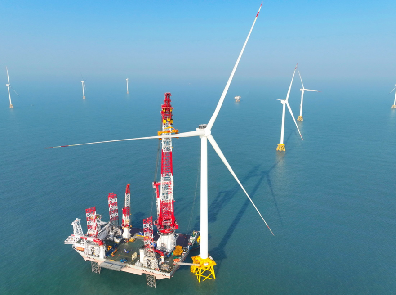
The world’s first 20-megawatt offshore wind turbine was successfully installed in the waters off of East China’s Fujian province on Tuesday, its operator, China Three Gorges Corp (CTG), said.

 As part of a national key research and development program, the project has all its major components independently developed and produced in China, it said.

 Located more than 30 kilometers off the coast of Fujian province, in waters exceeding 40 meters deep, the installation proves that massive-scale wind power is now viable in harsh, far-shore environments, CTG said.

 Once connected to the grid, the single turbine is expected to generate 80 million kilowatt-hours of electricity annually — enough to meet the yearly energy demand of about 44,000 households.

 It is also expected to save about 24,000 metric tons of standard coal and reduce carbon dioxide emissions by about 64,000 tons each year.

Article inline ad

China’s Foreign Trade Up 3.8% In 2025

0

chinadaily.com.cn/Xinhua | Updated: 2026-01-14

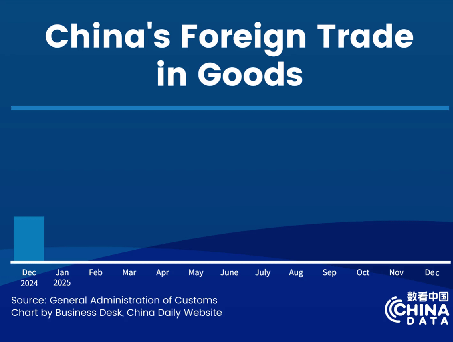
 Last year, the country’s foreign trade value hit 45.47 trillion yuan (about $6.48 trillion), according to data released by the General Administration of Customs. This marks the ninth consecutive year of growth for China’s foreign trade since 2017.

 Exports grew 6.1 percent year-on-year to 26.99 trillion yuan in 2025. Imports reached a record 18.48 trillion yuan, with year-on-year growth of 0.5 percent, cementing China’s status as the world’s second-largest import market for 17 years in succession.

 During the 14th Five-Year Plan period (2021-25), China’s cumulative import and export value had exceeded 200 trillion yuan, representing a 40-percent surge from the 13th Five-Year Plan period and an average annual growth rate of 7.1 percent.

 At a government press conference held in Beijing on Wednesday, Wang Jun, deputy head of the General Administration of Customs, said that China’s foreign trade achievements are “truly remarkable and hard-won” amid global economic challenges.

 Wang attributed the steady growth of China’s foreign trade to three major drivers: The country’s pro-trade stabilization policies, the sustained release of import demand from its vast domestic market, and a sophisticated industrial system that continuously adapts to evolving overseas needs.

Article inline ad

Report: Shanghai Rising As Leader In AI Integration

0

By WANG YING in Shanghai | China Daily | Updated: 2026-01-14

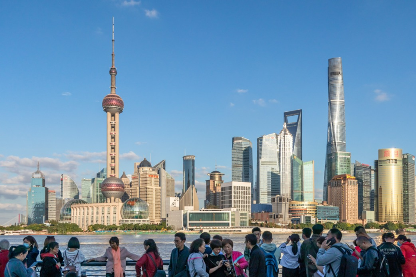
In light of factors such as its explosive growth in artificial intelligence at an industrial scale and the fact that Shanghai is home to approximately a third of Chinese AI professionals, the city is rapidly establishing itself as a hub for AI, particularly in the integration of AI with manufacturing, said a recent report.

 As of Dec 24, a total of 139 large AI models had completed registration in Shanghai. The city is also home to nearly 300,000 AI professionals — representing roughly one-third of the nation’s total talent pool, said the report, which was released at a conference on Thursday in Shanghai.

 Shanghai’s AI sector is seeing explosive growth. According to the report, in the first nine months of 2025, the combined output of the city’s 394 AI enterprises above designated size — defined as those with annual revenue of 20 million yuan ($2.86 million) or more — hit 435.49 billion yuan, surging 39.6 percent year-on-year. Over the same period, these firms’ aggregated profits rose 11.4 percent year-on-year to reach 40.78 billion yuan.

 Concluding with the construction progress of Shanghai’s modern industrial system, the report focuses on policy deployment, application scenarios with technological breakthroughs, and ecosystem development, said Wu Xiaodong, vice-president of the Shanghai Industrial Internet Association.

 “Through systematically reviewing Shanghai’s practical experience and implementation models in AI manufacturing, the white paper analyzes opportunities and challenges, as well as offers policy recommendations,” Wu said.

 “Shanghai will promote large-scale development of AI manufacturing during the 15th Five-Year Plan (2026-30) period,” said Zhang Ying, deputy secretary-general of the Shanghai municipal government.

 Through coordinated efforts across industry, academia, research and application, Shanghai is advancing industrial models, industrial intelligent agents and intelligent equipment products. These efforts are driving innovation in manufacturing organization models, deepening scenario integration and forming an innovation framework that links technology, application scenarios and ecosystems, Zhang said.

 Enterprises have seen many concrete benefits from AI adoption. “AI applications have proved highly effective, whether in accelerating design processes, shortening product delivery times, reducing costs or improving success rates,” said Gu Guifeng, vice-president of Shanghai Kaiquan Pump (Group) Co Ltd.

 “Taking traditional hydraulic model design as an example, previously, a researcher with 10 to 15 years of experience would need at least one month to design multiple models and conduct optimization tests, while simulation calculations alone could take at least one week. With AI assistance, engineers can now design the most effective hydraulic model within 24 hours,” said Gu.

 AI has also delivered significant cost savings, as developing and deploying a high-quality hydraulic model typically requires an investment of more than 3 million yuan.”By maximizing the use of accumulated data and validation results, AI significantly reduces verification and trial costs,” Gu said.

 Yu Fangqiang, chief information officer of Shanghai Construction Group, said that although AI currently accounts for only about 10 percent of the group’s daily operations, its future potential is virtually unlimited.

 “While the application of AI may take time to move from consumer sectors into construction, enterprises must proactively embrace it,” Yu said.

 Shanghai’s latest AI manufacturing achievements come as the Ministry of Industry and Information Technology and seven other central government departments issued the implementation guidelines for the special action on AI manufacturing on Jan 7. The document sets a target of achieving a secure and reliable supply of key AI technologies, along with globally leading industry scale and empowerment capacity, by 2027.

 The guideline specifies a roadmap for achieving AI integration in manufacturing, which includes the widespread application of three to five general large AI models in the sector by 2027. Additionally, it aims to promote 500 typical application scenarios, cultivate two to three leading globally influential enterprises, and create a robust ecosystem for AI-enabled manufacturing. These efforts are designed to contribute to the global integration of AI and manufacturing, offering China’s solutions for this transformation.


Article inline ad

Key Inland Port Turns Into Global Trade Artery

0

By ZHAO RUIXUE in Jining, Shandong | China Daily | Updated: 2026-01-14

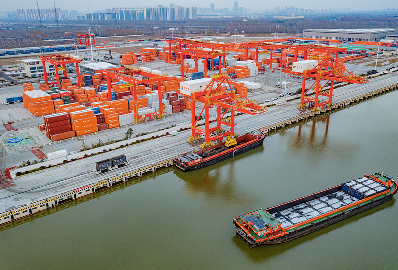
Jining, a key hub on the Beijing-Hangzhou Grand Canal in Shandong province, is transforming its ancient waterway into a modern global trade artery by integrating advanced technologies with ecofriendly practices.

 Jining’s port cargo throughput surpassed 100 million metric tons in 2025, making it the first inland port in northern China to achieve this economic milestone, according to the Shandong Development and Reform Commission.

 At the city’s Longgong Port, automated rail cranes efficiently manage containers, while unmanned trucks equipped with Beidou navigation and intelligent sensing technologies shuttle between stacks with precision.

 “Previously, moving the same volume required about 60 truck drivers working in three shifts. Now, just three workers in the control center can manage the 16 unmanned trucks to complete the work,” said Gu Qiang, head of the port’s dispatching and command center, highlighting the dramatic increase in efficiency.

 Longgong Port has built a transport system that integrates canal, railway and sea routes.

 “The port’s proximity to railway lines, less than 1 kilometer away, is a distinct advantage,” said Gu.

 The cost of transporting coal from Shaanxi province via rail to Longgong Port and then by waterway to the Yangtze River Delta is only one-third that of pure rail transport and one-seventh of road transport.

 With the railway connection, the port’s reach has expanded to include Gansu, Shaanxi and Henan provinces, driving a substantial surge in throughput through combined rail-water transport.

 The port’s annual container throughput exceeded 380,000 twenty-foot equivalent units (TEUs) last year, marking a 69 percent year-on-year increase.

 Strategically located on the middle stretch of the Beijing-Hangzhou Grand Canal, Jining connects the Beijing-Tianjin-Hebei region with the Yangtze River Delta. The city has developed 360 kilometers of waterways and 103 berths capable of handling 1,000-ton vessels.

 It operates 30 container shipping routes, with a logistics network covering 152 cities nationwide.

 “Foreign trade was a standout growth area in 2025,” Gu said, noting the creation of a one-stop export channel from Longgong Port directly to Qingdao Port for international shipping, saving about 10 percent in logistics costs per container.

 Industrial upgrades are driving development across the entire chain.

 At Shandong Xinneng Shipbuilding Co Ltd, industrial robots and laser cutters work on building pure-electric powered inland container vessels.

 “From welding and painting to outfitting, the intelligent production line ensures a fully green and standardized process,” said Zhang Bo, team leader of the manufacturing department’s processing team.

 The company has secured orders for over 180 new-energy vessels during past two years, exporting new-energy vessels to countries including Vietnam and Tanzania.

 “Jining will accelerate the construction of commercial logistics, multimodal transport, port-industry clusters, green shipbuilding and shipping services to build a northern inland shipping center,” said Chen Peng, director of the Jining transportation bureau.


Article inline ad

Cherry Supplies Sidestep Preholiday Woes

0

China Daily | Updated: 2026-01-14

CHENGDU/SANTIAGO — For much of the past decade, Chile’s export of cherries to China ran on a narrow calendar.

 From December to early the following year, the fruit ripened in Chile’s central valleys. Weeks later, just ahead of the Chinese New Year, those cherries arrived as a seasonal luxury, scarce, expensive and tightly bound to the holiday. The logic was simple: southern-hemisphere harvests met Northern Hemisphere festivities, and value depended on timing as much as taste.

 That logic is now weakening.

 In early 2026, more than a month before Chinese New Year, Chilean cherries were already widely available in China at prices far below previous norms. Boxes of JJ-level Chilean cherry (with a diameter of 28 to 30 millimeters) weighing about 2.5 kilograms were selling for around 159 yuan ($22.7) in major supermarkets in Chengdu, Southwest China’s Sichuan province, with some promotional prices falling to 99 yuan, roughly 40 percent lower than a year earlier.

 At local wholesale markets, prices fell even more sharply, with some high-grade cherries priced at nearly half of last year’s level.

 Such movements do not point to a weakening of demand. Rather, they reflect a structural change in how supply reaches the market.

 Importers say the traditional preholiday bottleneck has eased, as improved logistics have reduced the need for cherries to flood the market in a short festive window.

 The redistribution of time has institutional roots.

 China and Chile’s upgraded free trade agreement in 2017 placed more than 97 percent of traded products under zero tariffs, lowering the fixed costs of entry for Chilean cherries. Over time, it encouraged not just higher volumes but investment in logistics capable of delivering large quantities with greater predictability.

 The result is a highly concentrated trade relationship. In the previous harvest season, more than 90 percent of Chile’s cherry exports went to China. That degree of demand certainty has allowed the industry to organize production and shipments across the entire season, rather than around a single holiday peak.

 Claudia Soler, executive director of the Cherries Committee of Fruits from Chile, described the relationship as both economic and cultural. China, she said, is the market that enabled the industry’s expansion. The cherry’s red color and rounded shape, she added, closely align with Chinese cultural symbolism, especially around the Chinese New Year, when cherries became a popular gift symbolizing happiness and success.

 Since 2018, Chile has operated a direct shipping route to China known as the “cherry express”, cutting transit time from roughly 30 days to about 23 days. By the end of 2025, this dedicated shipping corridor had been further scaled up, doubling the number of direct sailings compared with the previous year. This allows cherries to arrive in China in greater volumes during the peak harvest season.

 This shift has reshaped incentives at the production end. Data from the office of agrarian studies and policies at Chile’s Ministry of Agriculture show that the cherry planting area has expanded roughly twenty-fold since 2000, nearly doubling from about 38,392 hectares in 2019 to 70,686 hectares by 2024.

 Industry participants attribute this rapid growth in part to the gradual formation of a logistics system geared toward the Chinese market, which has given Chilean growers clearer expectations over timing, allowing them to expand planting and plan output with greater confidence.

 Processing hubs in Chile’s central regions now operate on a different temporal logic. Time remains critical, but it is no longer singular. In the past, a delayed shipment could miss the Chinese New Year altogether, erasing margins and turning a strong harvest into a liability. Today, improved transport has allowed exporters to distribute shipments across the season, reducing the risk concentrated in any single sailing.

 For Chinese consumers, cherries are no longer limited to a short preholiday rush, easing the need for concentrated buying ahead of Chinese New Year. Fruit exporters from Chile estimate that in the 2025-2026 season, Chile will export about 110 million boxes of cherries (five kilograms per box, roughly 550,000 metric tons), with more than 90 percent destined for China.

 Xinhua – China Daily

Article inline ad

Role As Transformer Producer Enhanced

0

By Zheng Xin | China Daily | Updated: 2026-01-14

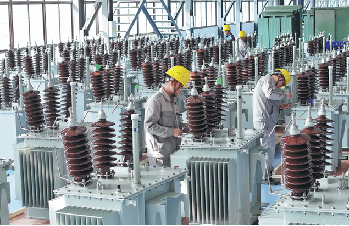
China is at the forefront of a booming $103 billion market, emerging as the dominant player even as a global shortage of power transformers threatens to stall progress in both artificial intelligence and the shift to green energy, said industry experts and analysts.

 China currently controls approximately 60 percent of global transformer production capacity, according to the International Energy Agency, a dominance built on a sophisticated industrial ecosystem that has transitioned from domestic technology dependence to global leadership in Ultra-High-Voltage (UHV) systems.

 Analysts describe this concentration of manufacturing power as an industrial “dream team”, where State-owned giants and agile private firms define international grid standards.

 China can build transformers and grid substations faster and cheaper than Western peers and scale AI data centers without the infrastructure lag currently hitting North American markets, said Lin Boqiang, head of the China Institute for Studies in Energy Policy at Xiamen University.

 As the AI-driven “power crunch” is expected to intensify throughout 2026, these “hearts of the grid” — responsible for regulating voltage levels — have become as critical as the semiconductors they power.

 According to Lin, China is moving from exporting low-value goods to controlling the “hearts of the grid.”

 Because power transformers are essential for everything including EV charging networks, this dominance allows Beijing to exert leverage over global industrial resilience, he said.

 Lin said China’s dominance is anchored by a potent combination of State-owned giants and agile private firms.

 While State conglomerates provide the industrial backbone for massive strategic infrastructure, private manufacturers have achieved immense global scale, successfully penetrating key Western markets to cement China’s role over the international supply chain, he said.

 The global surge in demand is fueled by the explosive growth of data centers, with electricity requirements forecast to double by 2030 as AI training and inference requirements hit a “power wall”.

 Total data center power consumption is projected to rise from 860 terawatt-hours in 2025 to 1,587 TWh by 2030, according to S&P Global Market Intelligence.

 Analysts expect these shortages to persist through 2026, creating a prolonged peak cycle for the equipment market.

 While global rivals are launching aggressive expansion plans, China’s internal infrastructure provides a foundation that competitors struggle to match.

 Siemens Energy is planning to invest 2 billion euros ($2.3 billion) in its global network of transformer and switchgear factories by 2028, while Hitachi has said it would invest more than $6 billion globally between 2024 and 2027 in its grid equipment business.

 State Grid Corp of China reported record fixed-asset investment of over 650 billion yuan ($93 billion) in 2025 alone as it builds a new power system for the nation’s 15th Five-Year Plan (2026-30).

 This domestic investment peak, combined with world-leading UHV technology — which operates at voltages exceeding 800 kilovolts of direct current or 1,000 kV of alternating current — allows Chinese firms to dominate the entire value chain.

 Zhao Yongzhan, president of Hitachi Energy Greater China, noted that China’s advanced transmission networks are essential for linking remote renewable energy hubs to urban centers, a trend that is setting global standards for grid resilience.

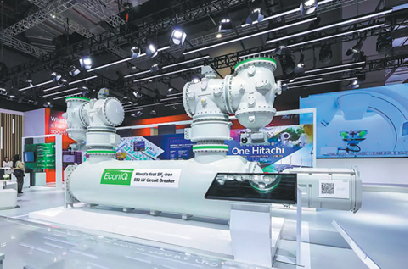
 China has emerged as the central pillar of a massive global investment strategy by Hitachi Energy, as the industry leader aligns its expansion with the country’s world-leading UHV networks and surging AI-driven power demand.

 The company is aggressively scaling its operations across Chinese industrial hubs, including Xi’an, Chongqing, and Xiamen, to capitalize on a domestic market that is outpacing global peers in grid modernization.

 “China, with world-class UHV capabilities and robust local manufacturing, is in a peak period of power grid investment, and this high-intensity commitment to UHV technology will continue,” said Zhao.

 “This high-intensity commitment to UHV technology is expected to strengthen further under the nation’s 15th Five-Year Plan as renewable energy is transported from remote hubs to urban centers.”


Article inline ad

Hitachi Energy To Play Key Role In Country’s Grid Modernization

0

By Zheng Xin | China Daily | Updated: 2026-01-14

China has emerged as the linchpin of a $9 billion global investment surge by Hitachi Energy, as the world’s largest transformer manufacturer hitches its growth to the country’s world-leading ultrahigh voltage expansion and an exponential explosion in artificial intelligence-driven power demand.

 The Zurich-based company, which reported record-high order backlogs in 2025, is aggressively expanding its footprint across Chinese industrial hubs, including Xi’an, Shaanxi province; Xiamen, Fujian province; and Chongqing, to capitalize on a domestic market that is outpacing the rest of the world in grid modernization.

 “China, with world-class UHV capabilities and robust local manufacturing, is in a peak period of power grid investment, and this high-intensity commitment to UHV technology will continue,” said Zhao Yongzhan, Hitachi Energy’s executive vice-president and China head.

 UHV transmission lines refer to power transmission cables operating at voltages exceeding 800 kilovolts of direct current or 1,000 kV of alternating current.

 This is in accordance with the surge of total grid investment in China in recent years, which was expected to hit record levels in 2025, led by State Grid Corporation of China and China Southern Power Grid.

 According to the International Energy Agency, the surge in power demand is being fueled by a “perfect storm” of AI data center construction and the integration of large-scale renewable energy.

 Global data center electricity consumption is expected to more than double by 2030, with China’s domestic power demand projected to grow at a compound annual rate of 8 to 9 percent through the end of the decade as AI infrastructure matures, the IEA said.

 “The current wave of AI investment is stimulating global energy demand at an exponential rate,” said Zhao, adding that the complexity of connecting volatile renewables requires a level of grid resilience far beyond previous standards.

 To meet this demand, Hitachi Energy is significantly boosting capacity at its Xi’an manufacturing base, a facility that supports the world’s first UHV flexible direct current transmission project.

 Zhao said that Hitachi Energy focuses on creating infrastructure synergy by linking remote renewable megabases in western China to high-demand eastern load centers, while simultaneously deepening local manufacturing to bolster supply chain resilience for both Chinese and global energy systems.

 Industry experts believe that UHV technology will serve as the critical “super-highway” system that makes it possible to reconcile the massive geographical gap between its western energy bases and eastern demand centers.

 By scaling up transmission capacity by 2030, UHV corridors will act as the primary conduit for China’s vast wind and solar resources, particularly those located in the remote Gobi Desert and other desert regions, experts said.

 Ye Xiaoning, a senior engineer at the new energy department of the State Grid Energy Research Institute, said that China’s continuous commitment to grid modernization and transmission expansion has fundamentally enhanced the country’s ability to balance and optimize renewable energy assets on a national scale.

 The recommendations for formulating the 15th Five-Year Plan (2026-30) outlined a strategic shift toward a new power system in China with a higher proportion of renewable energy, and key priorities such as advancing a diversified energy portfolio and optimizing the balance between local energy uptake and long-distance transmission.

 These measures are designed to promote the high-quality growth of clean energy while strengthening the power system’s overall reliability, flexibility and cross-regional mutual support capabilities.

 Hitachi Energy is further cementing its technological leadership by advancing “green” and digitalized power hardware tailored for China’s 15th Five-Year Plan period, ensuring the grid can handle the dual challenges of high-capacity transmission and carbon neutrality, Zhao said.

Article inline ad

Remegen Shares Trade Over 9% Amid Abbvie Licensing Deal

0

By Li Jing | chinadaily.com.cn | Updated: 2026-01-13

RemeGen shares surged more than 9 percent in Hong Kong trading as of 10 am Tuesday, leading a broader rally among pharmaceutical stocks, after the Chinese biotech firm secured a massive licensing agreement with US drugmaker AbbVie.

 In a statement released on Monday, AbbVie said it has agreed to pay $650 million upfront to license an experimental cancer therapy from China’s RemeGen, in a deal that could eventually be worth nearly $5.6 billion.

 The exclusive licensing agreement gives AbbVie the rights to develop, manufacture and commercialize RemeGen’s RC148 outside of China.

 RC148 is a novel bispecific antibody that targets both PD-1 and VEGF, two pathways often involved in tumor growth and immune evasion. It is currently being developed for multiple advanced solid tumors.

 AbbVie plans to use the asset to bolster its oncology pipeline, specifically looking to combine it with antibody-drug conjugates. The company noted that the drug could be paired with its own investigational ADC, telisotuzumab adizutecan, to treat conditions such as non-small cell lung cancer and colorectal cancer.

 “By combining the immune checkpoint inhibition and anti-angiogenic activity of RC148 together with the targeted cytotoxic activity of ADCs, we have the potential to identify meaningful options for patients across a range of solid tumors,” said Daejin Abidoye, AbbVie’s vice-president.

 Under the terms of the deal, RemeGen is eligible to receive up to $4.95 billion in additional payments tied to development, regulatory and commercial milestones, plus double-digit tiered royalties on net sales outside China.

 Fang Jianmin, CEO of RemeGen, said the partnership highlights the potential of RC148 to address unmet medical needs and demonstrates the company’s commitment to bringing therapies to patients globally.

 RemeGen, dual-listed on the Hong Kong and Shanghai stock exchanges, specializes in autoimmune, oncology and ophthalmic diseases, and currently has two approved products in China: telitacicept and disitamab vedotin.


Article inline ad