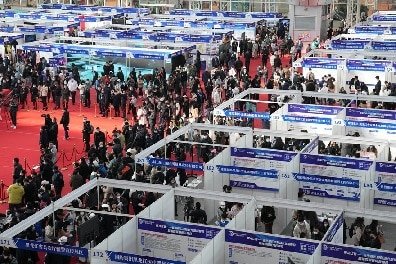
BEIJING, April 27 (Xinhua) — The Global Trade and Investment Promotion Summit of 2023 will take place in Beijing on May 24, the China Council for the Promotion of International Trade (CCPIT) said on Wednesday.
The summit aims to serve as a high-level dialogue platform for business communities from different countries to jointly address global issues, nurture new growth points of international economic cooperation and promote the reform of the global economic governance system, said Wang Linjie, spokesperson of the CCPIT.
A number of foreign leaders, heads of international organizations and economic institutions, executives from multinationals and overseas scholars will attend the summit, said Wang.
The summit will have parallel forums focusing on Chinese modernization, green development and digital economy, she said.
BEIJING, April 27 (Xinhua) — Chinese authorities had issued 201,700 certificates of origin under the Regional Comprehensive Economic Partnership (RCEP) agreement by March 2023, China’s trade council said on Wednesday.
The certificates are related to exports valued at a total of 8.41 billion U.S. dollars, and are expected to reduce tariffs by 126 million U.S. dollars for Chinese products in RCEP importing countries, Wang Linjie, spokesperson for the China Council for the Promotion of International Trade, told a press conference.
Since the RCEP agreement entered into force on Jan. 1, 2022, the council has supported local authorities, industries and enterprises to seize opportunities and expand trade and investment cooperation with RCEP members, Wang said.
RCEP certificates of origin have been welcomed by more and more enterprises, and have brought tangible benefits to China’s foreign trade companies in securing orders on the global market, Wang said.
In the first quarter of this year, a total of 45,700 RCEP certificates of origin were issued, surging 105.54 percent year on year and involving approximately 1.64 billion U.S. dollars, Wang said.
Certificates of origin are documents widely used in international trade transactions. They state that the products listed have met sufficient criteria to be considered as originating in a particular country. The issuance of these certificates is widely regarded as a barometer of foreign trade.
BEIJING, April 27 (Xinhua) — China will continue to enjoy rich human resources and pick up its pace to improve the quality of the labor force to drive the country’s high-quality economic development, according to analysts.
A large population remains China’s basic national condition and the demographic dividend will continue to underpin the economic growth for a long time to come, said Wang Qinchi, a researcher at the China Population and Development Research Center.
The rich supply of human resources has provided an abundant labor force and rapid accumulation of capital for the nation’s economic development, helping the country to become an ultra-large consumer market and an economic heavyweight in the global arena.
China now has a nearly 900 million working-age population, exceeding the total amount of working-age population of all developed countries in the world. The country also boasts the world’s largest talent pool with the most complete categories.
Despite a declining fertility rate and a deepening aging population in recent years, experts have dismissed concerns over the diminishing demographic dividend in the country.
A population of 1.4 billion means a tremendous market, which remains a prominent strength of China, said Wang.
Chinese authority has stressed that when assessing demographic dividends, it is quality rather than quantity that is more important.
More than 240 million people have received higher education in China. The gross enrollment rate of China’s higher education hit 57.8 percent in 2021, according to the Ministry of Education.
Efforts to nurture talent for technological innovation have helped China sit atop the world in terms of the number of valid invention patents and the number of scientific articles that are included in the Scientific Citation Index.
The profound changes in labor force resulted from China’s continuous efforts to raise the education level of its population.
China views education, science and technology, and human resources as important foundational and strategic pillars for building a modern socialist country in all respects.
Up to 2022, China’s fiscal spending on education remained above 4 percent of its GDP for 10 consecutive years, laying a solid foundation for a higher-quality labor force.
A professional in sci-tech innovation can make a much greater contribution to social and economic development, said Sun Rui, a researcher at the Chinese Academy of Personnel Science, adding that talent has become a key factor in the competition for national strength.
Nurturing outstanding creative talent will help upgrade demographic dividend into talent dividend, providing long-lasting impetus for high-quality development, Sun said.
BEIJING, April 27 (Xinhua) — The value of loans to the manufacturing sector in China in the first quarter of 2023 was higher compared with the same period last year, official data showed on Wednesday.
New loans to the manufacturing sector reached 2.2 trillion yuan (about 317.75 billion U.S. dollars) from January to March, an increase of 381.9 billion yuan year on year, according to data from the China Banking and Insurance Regulatory Commission.
New loans to private enterprises hit 3.7 trillion yuan during the period, up 1 trillion yuan year on year, while those to small and micro-sized companies amounted to 2.3 trillion yuan, an increase of 808.8 billion yuan.
Commercial banks reaped net profits of 667.9 billion yuan in the first quarter, up 1.3 percent from a year ago, data also revealed.
BEIJING, April 27 (Xinhua) — China will take multi-pronged and adjusted measures to expand employment and maintain its stability, per a new circular released by the General Office of the State Council.
Adhering to an employment-first strategy, the country will create more jobs by extending employment-oriented subsidies to companies and sectors that hire recent graduates, as well as other key groups of job seekers, the circular said.
It will also strengthen credit support for business startups and foster professional skills training.
Companies are being encouraged to hire young employees, including college graduates, who can also find posts in primary-level institutions or start businesses in urban or rural communities, the document said.
To help job seekers in difficulty, the country will issue one-time subsidies for eligible graduates, and provide insurance compensation and temporary allowances for the unemployed.
BEIJING, April 27 (Xinhua) — Chinese stocks opened lower on Thursday, with the benchmark Shanghai Composite Index down 0.24 percent to open at 3,256.23 points.
The Shenzhen Component Index opened 0.4 percent lower at 11,140.89 points.
BEIJING, April 27 (Xinhua) — The ChiNext Index, tracking China’s Nasdaq-style board of growth enterprises, was down 0.45 percent to open at 2,283.63 points Thursday.
The ChiNext Index, together with the Shenzhen Component Index and other indices, reflects the performance of stocks listed on the Shenzhen Stock Exchange.
BEIJING, April 27 (Xinhua) — The following are the central parity rates of the Chinese currency renminbi, or the yuan, against 24 major currencies announced on Thursday by the China Foreign Exchange Trade System:
Currency Unit Central parity rate in yuan
U.S. dollar 100 692.07
Euro 100 764.35
Japanese yen 100 5.1859
Hong Kong dollar 100 88.166
British pound 100 863.08
Australian dollar 100 457.31
New Zealand dollar 100 423.45
Singapore dollar 100 518.37
Swiss franc 100 776.78
Canadian dollar 100 507.75
Malaysian ringgit 64.389 100
Ruble 1,182.70 100
Rand 265.30 100
Korean won 19,319 100
UAE dirham 53.062 100
Saudi riyal 54.199 100
Hungarian forint 4,893.38 100
Polish zloty 59.97 100
Danish krone 97.53 100
Swedish krona 149.12 100
Norwegian krone 153.64 100
Turkish lira 280.676 100
Mexican peso 262.40 100
Thai baht 493.12 100
The central parity rate of the yuan against the U.S. dollar is based on a weighted average of prices offered by market makers before the opening of the interbank market each business day.
The central parity rate of the yuan against the Hong Kong dollar is based on the central parity rate of the yuan against the U.S. dollar and the exchange rate of the Hong Kong dollar against the U.S. dollar at 9 a.m. in international foreign exchange markets on the same business day.
The central parity rates of the yuan against the other 22 currencies are based on the average prices offered by market makers before the opening of the interbank foreign exchange market.
BEIJING, April 27 (Xinhua) — China’s central bank continued to inject funds into the financial system through open market operations Thursday.
The People’s Bank of China said it has conducted 93 billion yuan (about 13.44 billion U.S. dollars) of seven-day reverse repos at an interest rate of 2 percent.
The move aims to keep month-end liquidity in the banking system stable, according to the central bank.
A reverse repo is a process in which the central bank purchases securities from commercial banks through bidding, with an agreement to sell them back in the future
BEIJING, April 27 (Xinhua) — China’s benchmark prices for spot interbank gold transactions were higher Thursday, according to the China Foreign Exchange Trade System.
The benchmark price for gold that is 99.95 percent pure or above stood at 445.68 yuan (about 64.4 U.S. dollars) per gram, up 2.48 yuan from the previous trading day, while the price for gold that is 99.99 percent pure or above went up 0.49 yuan to 445.93 yuan per gram.
Spot transaction prices on the interbank price inquiry market are allowed to rise or fall within 15 percent from the benchmark prices each trading day.
The interbank gold price inquiry business was introduced in 2012 to enhance market liquidity and enrich trading models.