China‘s benchmark prices for spot interbank gold transactions were higher Thursday, according to the China Foreign Exchange Trade System.
The benchmark price for gold that is 99.95 percent pure or above stood at 414 yuan (about 60.17 U.S. dollars) per gram, up 0.84 yuan from the previous trading day, while the price for gold that is 99.99 percent pure or above went up 2.06 yuan to 414.75 yuan per gram.
Spot transaction prices on the interbank price inquiry market are allowed to rise or fall within 15 percent from the benchmark prices each trading day.
The interbank gold price inquiry business was introduced in 2012 to enhance market liquidity and enrich trading models.
Chinese stocks closed higher on Tuesday, with the benchmark Shanghai Composite Index up 0.66 percent to 3,279.61 points.
The Shenzhen Component Index closed 0.70 percent higher at 11,783.8 points.
The combined turnover of stocks covered by the two indices stood at 756.8 billion yuan (about 108.86 billion U.S. dollars), slightly up from 753.6 billion yuan on the previous trading day.
Shares related to textiles and electronic information led the market gains, while those related to coal, shipbuilding and chemical fertilizers were among the biggest losers.
The ChiNext Index, tracking China’s Nasdaq-style board of growth enterprises, gained 0.8 percent to close at 2,429.03 points Tuesday.
U.S.-listed Chinese companies traded roughly flat on Tuesday, with five of the top 10 stocks by weight in the S&P U.S. Listed China 50 index ending the day on an upbeat note.
Shares of BeiGene and PDD Holdings rose 3.98 percent and 2.01 percent, respectively, leading the advancers in the top 10 stocks.
Shares of NetEase and Alibaba Group Holding slipped 1.7 percent and 1.64 percent, respectively, leading the decliners in the top 10 stocks.
Wall Street’s major averages dropped on Tuesday, weighed by prospects of further Federal Reserve rate hikes.
The Dow Jones Industrial Average fell 232.39 points, or 0.71 percent, to 32,656.7. The S&P 500 sank 12.09 points, or 0.30 percent, to 3,970.15. The Nasdaq Composite Index slid 11.44 points, or 0.10 percent, to 11,455.54.
The Cboe Volatility Index, widely considered as the best fear gauge in the stock market, dipped 1.19 percent to 20.7.
As of Monday, the S&P U.S. Listed China 50 index, which is designed to track the performance of the 50 largest Chinese companies listed on U.S. exchanges by total market cap, stood at 2,665.5, marking an 8.42-percent loss for the month-to-date returns and a 3.73-percent increase for the year-to-date returns.
Chinese customs offices have achieved substantial progress in promoting cross-border trade facilitation in recent years, an official said on Tuesday.
“The overall customs clearance time for import and export goods has become shorter,” Zhao Zenglian, an official from the General Administration of Customs, told a press conference.
In 2022, the overall time taken for import and export goods to complete customs clearance was 32.02 hours and 1.03 hours, respectively, dropping 67.1 percent and 91.6 percent from 2017, Zhao said.
Other improvements include lower costs and streamlined procedures for imports and exports, aiming to reduce enterprises’ financial burdens and better meet their business needs.
Tuesday’s press conference also revealed that the administration handled 148 suggestions from deputies to the National People’s Congress and 141 proposals from members of the National Committee of the Chinese People’s Political Consultative Conference last year.
China reduced energy consumption and carbon dioxide (CO2) emissions in 2022 amid efforts to promote high-quality and green development, according to an official statistical communique published on Tuesday.
Last year, the country’s energy consumption per 10,000 yuan (about 1,438.46 U.S. dollars) of gross domestic product decreased by 0.1 percent from 2021, while CO2 emissions per 10,000 yuan of GDP fell 0.8 percent year on year, according to the communique released on the website of the National Bureau of Statistics (NBS).
China accelerated the green transformation of development while stabilizing the economy in 2022, witnessing the country’s ecological condition continuously improved and the formation of green and low-carbon production and life-styles sped up, said Sheng Laiyun, deputy head of the NBS.
China has continued to advance the low-carbon transformation of energy consumption, seeing rapid growth of clean energy production and continuous expansion of non-fossil energy consumption, Sheng said.
Last year, the power generation of clean energy, such as hydro, wind, solar and nuclear energy, rose 8.5 percent year on year, while non-fossil energy consumption went up 0.8 percentage points to account for 17.5 percent of the country’s total power consumption.
The China-Pakistan Economic Corridor (CPEC), a flagship project under the China-proposed Belt and Road Initiative (BRI), has been playing a pivotal role in promoting green development in Pakistan, highlighting China’s commitment to harmonious coexistence of human beings and nature, Pakistani officials and experts said.
Talking to Xinhua, Convener of National Parliamentary Task Force on Sustainable Development Goals, Romina Khurshid Alam, said the cooperation between Pakistan and China under the CPEC in the fields of energy, transport, agriculture and industrial production has helped Pakistan boost green, low-carbon sustainable development.
Besides assisting Pakistan in overcoming energy crisis and infrastructure upgrading through the CPEC, Chinese companies in Pakistan have been strictly following international and local standards on safety and environmental protection, Alam said.
In implementing infrastructure projects, ecological factors have been fully considered and a number of green and clean energy projects including solar, wind and hydropower have been completed across the Asian country over the past several years, reducing carbon emissions and contributing to economic development, environment protection and improvement of living standards of the locals, said the official.
Citing the example of recently completed 720-megawatt Karot hydropower project, Alam said that a comprehensive biodiversity management plan was developed for construction and operation stages of the project to protect environment and wildlife around the project site.
Pakistan and China have further stepped up their cooperation in green energy for the benefit of the region under the CPEC, helping Pakistan mitigate the adverse impacts of climate change, said Hassan Daud Butt, senior advisor at the China Study Center of the Sustainable Development Policy Institute, an Islamabad-based think tank.
“Pakistan is one of the most vulnerable countries to climate change, with the country facing the worst climate-induced catastrophic floods recently. As the CPEC is making progress, it can help the country to tackle the climate change issue by increasing investment in renewable energy, green building construction, decreasing energy loss, and innovative practices such as green finance and other measures,” Butt told Xinhua.
Calling the CPEC a game changer and a green corridor, Shakeel Ahmad Ramay, chief executive officer of the Asian Institute of Eco-civilization Research and Development, said that the flagship project of the BRI is people-centric, environmentally friendly, inclusive and green and sustainable initiative.
China has been utilizing new technologies and making investments in BRI partner countries to support green development. Pakistan can learn from the Chinese experience and technology to realize its vision of high-quality green and sustainable development, Ramay told Xinhua.
“The CPEC has changed the landscape of Pakistan and has accelerated growth while bringing about socio-economic benefits for the people of Pakistan … China’s commitment to promoting carbon-free global economy is commendable,” he said.
China braved the economic headwinds and emerged from multiple challenges in 2022 with hard-won feats, according to an official statistical communique published on Tuesday.
After experiencing multiple ups and downs, the country’s economy continued to withstand the downward pressures and scored 3-percent growth year on year in 2022, said the communique released on the website of the National Bureau of Statistics (NBS).
In a comment article on the communique, Sheng Laiyun, deputy head of the NBS, said that the steady macroeconomic fundamentals were underpinned by China’s enhanced implementation of policies in 2022, when the economy was faced with a turbulent environment abroad and arduous development tasks at home.
DEFYING HEADWINDS
Looking back on 2022, China’s economy started off the year with a better-than-expected growth of 4.8-percent in the first quarter. The growth rate narrowed sharply in the second quarter due to the shocks from multiple unexpected factors.
However, the economy was quickly brought back on track in the third quarter as China promptly introduced a package of pro-growth policies and follow-up measures, Sheng said.
These included a combination of tax refunds, as well as tax and fee cuts and deferrals, that totaled 4.2 trillion yuan (about 604.15 billion U.S. dollars) in 2022. Such efforts helped China sustain its recovery momentum in the fourth quarter, Sheng noted.
China’s GDP reached a record high of 121 trillion yuan in 2022, a new high after the country broke the thresholds of 100 trillion yuan and 110 trillion yuan in 2020 and 2021, respectively.
NURTURING NEW DRIVERS
Despite seeing fiercer competition in international markets amid intensified external suppression of the technological sector and heightened decoupling risks in 2022, China still made headway on technological innovation and has continued to increase its research input, according to Sheng.
In 2022, China’s total expenditure on research and development (R&D) amounted to 3.1 trillion yuan, up 10.4 percent year on year, maintaining double-digit growth for seven consecutive years.
The role of innovation in technological development became more prominent, with the country’s ratio of R&D expenditure to GDP increasing to 2.55 percent in 2022, a rise of 0.12 percentage points.
The investment led to fruitful results. The total number of valid invention patents in China had reached 4.21 million by the end of 2022, taking first place globally, Sheng said.
EXPLORING OPENING-UP
Against a backdrop of flagging global economic recovery and a more volatile global financial market, China has steadily advanced institutional opening-up, retaining its appeal for foreign companies and investors, according to Sheng.
In 2022, China saw the total trade in goods reach 42.1 trillion yuan, up 7.7 percent year on year. It was the first time the figure had exceeded 40 trillion yuan, making a new breakthrough on a high base, Sheng said.
Foreign direct investment into the Chinese mainland, in actual use, expanded 6.3 percent year on year in 2022, serving as evidence to suggest that China is still a magnet for foreign investment, according to Sheng.
While warning of mounting uncertainties ahead, Sheng said that “the strong resilience, great potential and robust vitality of the Chinese economy have not changed.”
The country has the foundation, confidence and ability to fend off various sorts of risks and challenges, he added.
The time-honored China Import and Export Fair is scheduled to kick off its 133rd session on April 15 in Guangzhou, capital of south China’s Guangdong Province. The event will take place both offline and online.
Also known as the Canton Fair, the event has been held twice a year since 1957.
Chu Shijia, deputy director and secretary general of the fair and also head of the China Foreign Trade Center, said that the exhibition area would be expanded to 1.5 million square meters this year from previous 1.18 million square meters.
It is estimated that more than 30,000 Chinese and foreign enterprises will take part in the 133rd session. Participating Chinese enterprises include more than 5,000 leading manufacturing and high-tech enterprises of the country.
The Canton Fair, the event has been held twice a year since 1957 will feature three new exhibition areas for industrial automation and intelligent manufacturing, new energy and intelligent connected vehicles, and maternity, infant and children’s products, as well as three new special zones focused on intelligent life, the sliver economy, and testing reagents and protective products, Chi said.
These new additions bring the number of exhibition areas to 54 and special zones to 159, Chu added.
With the additions of new exhibition areas and new special zones, as well as increase in import exhibitions, this year’s Canton Fair is expected to share new development opportunities with the rest of the world, Chu said.
Enterprises from Germany, Spain, Italy, Türkiye, the Republic of Korea, India and Malaysia are expected to participate in the exhibition.
More activities such as international trade forums and trade promotions will also be held at the fair.
During an ongoing exhibition at the National Museum of China, it was revealed that China plans to expand its space station in near-Earth orbit by launching a new module that will dock with the existing structure and create a cross-shaped combination.
At the exhibition of achievements in China’s manned space program of 30 years, the China Manned Space Agency (CMSA) made public its follow-up plans after the assembly and construction of the space station’s T-shape structure last year.
The new module, which will function as a node cabin, will have multiple docking ports like the core module Tianhe, allowing the space station to accommodate more spaceships, according to the CMSA.
The agency added that China plans to extend the in-orbit operation of its space station by implementing updates and upgrades.
The exhibition also showcased China’s development of a new-generation reusable near-Earth crewed spacecraft with the capacity to carry four to seven astronauts into space and bring back over 700 kg of payloads to Earth. The country’s existing spaceship can launch three astronauts into space and bring back 50 kg of payloads.
The space station will shift its priority from technological breakthroughs in the building stage to the performance of space applications. A slew of experiments is currently underway or poised to begin, in the space station. Some of them are aimed at figuring out how to resist microbes that may damage spacecraft metals, produce oxygen from algae in space, and convert heat energy into electricity.
Recently, the in-orbit Chinese astronauts of the Shenzhou-15 crew successfully obtained 3D structural images of their skin cells with the country’s self-developed two-photon microscope, which is the first of its kind in the world.
In the coming years, over 1,000 applications across 65 projects will be implemented on the space station. This effort aims to advance key technologies in special material preparation, stem cell and regenerative medicine, high-precision time-frequency systems, and quantum precision measurement, according to the CMSA.
Chinese Survey Space Telescope, also known as the Chinese Space Station Telescope (CSST), will be launched as a part of the space station project, and the telescope, during its normal observations, will fly independently in the same orbit as China’s space station.
The CSST is a space-based optical observatory for astronomers to carry out sky surveys, capturing a general map or images of the sky. It can dock with the space station for refueling and servicing as scheduled or as needed, making its maintenance more affordable than Hubble.
This flagship telescope of China is projected to survey an all-sky area with 17,500 square degrees in 10 years after its operation, in order to explore frontier sciences like the accelerating expansion of the universe, dark matter and dark energy, according to the CMSA.
During this exhibition, the CMSA also unveiled China’s blueprint for human lunar exploration, which aims to send three astronauts into lunar orbit and allow two to land on the Moon.
Plans are underway for a lunar probe and sample return that will involve collaboration between humans and machines.
A scale-down model of the Long March-10 rocket was also displayed at the exhibition. The new-generation launcher will be used to bring no less than 27-tonne payloads including the lunar lander and moon craft into Earth-Moon transfer orbit.
The rocket measuring 88.5 meters in height, will have a liftoff thrust of about 2,678 tonnes and will be powered by liquid hydrogen, liquid oxygen and kerosene.
According to the exhibit profile, a rectified version of the rocket, without roll boosters and with a liftoff thrust of approximately 873 tonnes, is planned for the space station’s manned and freight missions. Additionally, a portion of the rocket will be designed for reusability.
The miniature models of the lunar lander and moon craft have also been put on display at the exhibition, which began on Friday and will run for three months.
The museum’s central hall showcases a variety of exhibits, including a same-sized replica of the space station’s core module, the re-entry capsule of the Shenzhou-13 spaceship, rocket engines, spacesuits, and other life-supporting facilities in space, drawing a constant stream of visitors.
Macao’s cross-border vehicle traffic in January grew by 45.0 percent year on year to 430,011 trips, the Macao Special Administrative Region’s (SAR) statistical service said on Tuesday.
The latest report from the Statistics and Census Service showed that the gross weight of port containerized cargo in January went down by 20.2 percent year on year to 11,501 tonnes.
Arriving and departing commercial flights totaled 1,687 trips in January, an uplift of 14.8 percent year on year, showed the report.
Licensed motor vehicles in Macao totaled 249,580 at the end of January, up by 0.5 percent year on year. New registration of motor vehicles in January went down by 37.4 percent year on year to 784.
The report showed that the number of traffic accidents in January dipped by 2.5 percent year on year to 1,072, with two people killed and 327 people injured.


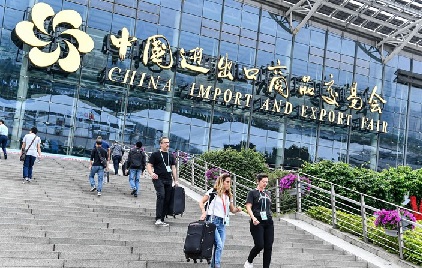 The time-honored China Import and Export Fair is scheduled to kick off its 133rd session on April 15 in Guangzhou, capital of south China’s Guangdong Province. The event will take place both offline and online.


