The publication of the rules is a ‘landmark’ move in the country’s efforts to build a nationwide power market, one expert tells Caixin
China has published its first national rules for electricity spot markets as the country continues its drive toward the use of renewable energy and building a national power market.
The trial rules, issued on Monday by the National Development and Reform Commission (NDRC), China’s top economic planner, and the National Energy Administration (NEA), clarify how electricity spot markets should be operated and managed and lay out a plan for their future development……
This article has a total of 1340 words. Continue reading after subscribing.
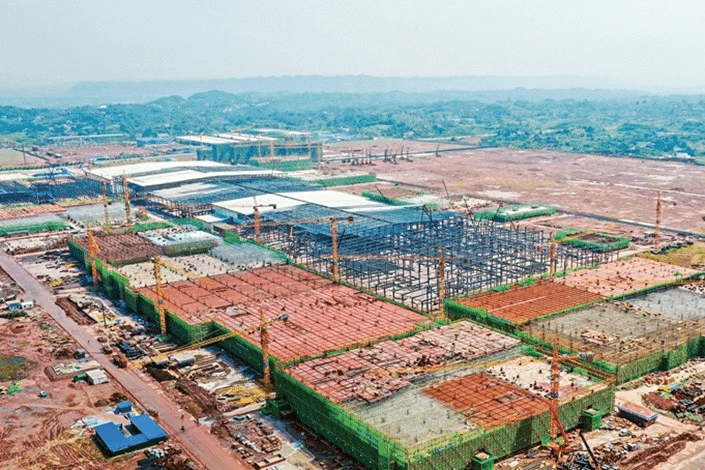
Manufacturing hubs like Yibin are bending over backward to win business from giants like CATL as they seek to boost jobs and economic growth
A handful of things put the southwestern Chinese city of Yibin on the map.
There’s Wuliangye, a popular brand of fiery liquor baijiu. The iconic Bamboo Sea that formed a key location for Ang Lee’s 2000 martial arts hit Crouching Tiger, Hidden Dragon. And there are the fuel rods it pumps out as one of China’s most important nuclear hubs, where enriched uranium is processed for plants around the country………..
This article has a total of 1217 words. Continue reading after subscribing.
China became a net exporter of innovative treatments for the first time in the first half of the year, but with more ‘out-licensing’ agreements come more cancellations
With ever tighter profit margins in the domestic market, China’s innovative drug developers are increasingly partnering with foreign companies to pitch their products overseas. But while this route of “out-licensing” drugs is lucrative, it can also be precarious, with multiple contracts terminated this year alone…….
This article has a total of 2001 words. Continue reading after subscribing.
A China-made whole-body magnetic resonance imaging (MRI) system, with an ultra-high magnetic field of 5.0 Tesla, was unveiled at the European Congress of Radiology (ECR) which opened here on Wednesday.
The whole-body ultra-high-field MRI system, called uMR Jupiter 5.0T, is the first of its kind in the world, according to its manufacturer, Chinese medical equipment company United Imaging Healthcare.
The company said uMR Jupiter 5.0T, with a high resolution and signal-to-noise ratio thanks to its high magnetic field, allows radiologists to see small anatomical structures which are undetectable on systems with lower magnetic fields.
The new system can thus enhance diagnostic accuracy, facilitate precise preoperative planning, and help researchers break new ground in such fields as precision medicine and translation medicine, the company added.
Zhang Qiang, chairman and co-chief executive officer of United Imaging Healthcare, said that with the unveiling of its new MRI system, the company aimed to showcase its passion for innovation and its focus on customer experience in the highly competitive European market.
Founded in 2011, the Shanghai-based company produces medical imaging products, radiotherapy equipment and life science instruments. It has overseas subsidiaries and R&D centers in the United States, Japan, Australia and Poland.
The ECR, the annual meeting of the European Society of Radiology, is one of the world’s largest radiological meetings that brings together radiology professionals, physicists and industry representatives to discuss the latest developments in radiology and showcase state-of-the-art technologies in the field.
As of December 2022, the number of users of internet-based medical services in China had reached 363 million, accounting for 34 percent of the total number of Chinese netizens, according to a report released Thursday.
The user number increased by 21.7 percent year on year, making internet-based medical services the fastest-growing application in terms of the user base, said the report on China’s internet development released by the China Internet Network Information Center.
China had nearly 1.07 billion internet users by December 2022, an increase of 35.49 million year-on-year, said the report, adding that the internet penetration rate had reached 75.6 percent.
As the potato-planting season approaches, baby potatoes from northwest China’s Xiji County are making their way to the fields of farmers across the country’s major potato-producing area.
The county, sometimes referred to as China’s “potato land,” recently saw a bumper potato crop, thanks in part to the success of the soilless farming technologies patented by a local potato cultivation center.
He Jiandong, the center’s general manager, has been busy promoting baby potatoes among the farmers in the area.
“The baby potatoes we cultivate here are free from any diseases or poisonous substances found in soil. This is because they are initially grown in a clean indoor environment,” He said. “The best seedlings are selected and placed on shelves, their roots are hung in boxes, and they are sprayed with water to allow them to grow fast.”
He’s cultivation center and two other similar baby potato producers in Xiji produce 60 million baby potatoes each year, providing seedlings for the county’s farmers, who in turn produce quality potatoes across a total area of 666.67 hectares.
“By adopting the new technology, we have raised the potato productivity rate by 30 percent, while reducing the production costs of farmers by 40 percent and cutting the soil pollution rate to below 2 percent,” He said.
The baby potatoes, which are the size of walnuts and light in weight, are easy to transport and are sold to a variety of locations, especially to those with similar natural conditions to Xiji.
“Farmers can simply bury them in the soil and wait for them to grow, and urban households can also plant them in pots,” He said.
Situated in Xihaigu, a region crossing the central and southern parts of the Ningxia Hui Autonomous Region that was once deemed uninhabitable, Xiji was lifted from poverty two years ago and has built itself into one of China’s most famous potato-producing counties.
“We have plenty of good-quality potato products and plan to build a whole potato production chain, with products ranging from noodles to chips and crisps. We are now introducing a production line from Fujian Province,” said Bai Xuegui, the Party chief of Xiji County.
The production of Xiji potato noodles could date back nearly 90 years. When the CPC-led Red Army arrived in Xiji as early as in 1935, they taught local farmers to make potato noodles. The noodles now have the trademark “Red Army Noodles” and are being manufactured in several local factories.
The following is a summary of published science and technology news of China.
SATELLITE LAUNCH
China on Wednesday evening successfully sent a new experiment satellite into space from the Jiuquan Satellite Launch Center in northwest China.
The Shiyan-19 satellite was launched at 7:41 p.m. (Beijing Time) by a Long March-11 carrier rocket and entered its planned orbit successfully.
This experiment satellite will primarily be used for land resource surveys, urban planning, disaster prevention and mitigation, and other missions.
LUNAR SAMPLE DATA
China’s space agency has published the online database of the 6th batch of lunar samples brought back by the Chang’e-5 probe.
Researchers and the public can access the Lunar and Deep Space Exploration Scientific Data and Sample Release System via the website www.clep.org.cn, where they can apply for data and samples, according to the China National Space Administration.
ARTIFICIAL THROAT
Chinese researchers have devised a graphene-based intelligent, wearable artificial throat (AT), sensitive to human speech and vocalization-related motions.
The AT’s perception of the mixed modalities of acoustic signals and mechanical motions enables it to acquire signals with a low fundamental frequency while remaining noise resistant.
The study showed that the mixed-modality AT could detect base speech elements (phonemes, tones, and words) with an average accuracy of 99 percent.
A group of Chinese astronomers identified a peculiar neutron star candidate in a binary system, 385 light years away from the Earth, which could be the nearest and lightest neutron star ever known if confirmed.
The researchers from Peking University and the National Astronomical Observatories under the Chinese Academy of Sciences reported the discovery based on observations of China’s Large Sky Area Multi-Object Fiber Spectroscopic Telescope (LAMOST) and the Nanshan 1-meter Wide-field Telescope (NOWT) in northwest China’s Xinjiang Uygur Autonomous Region.
The candidate, a dark companion to an old-age star, with only approximately 0.98 times the solar mass, is presumed to resemble an X-ray-dim isolated neutron star (XDINS), but in binary, according to the study published in The Astrophysical Journal Letters.
To date, only seven XDINSs, peculiar objects with barely-detected radio signals, have been discovered. They are nicknamed the Magnificent Seven, about 391 to 1,630 light years away from the Earth.
The neutron stars are previously believed to have taken shape through the core-collapse supernovae, but they tend to be above 1.17 times solar mass.
LAMOST’s spectral data also implied the presence of a small accretion disk around the neutron star candidate and/or a level of accretion disk activity, according to the study.
The new findings hinted at the radio-quite, XDINS-like compact object possibly being born in an alternative channel like the collapse of a white dwarf after it accretes, said the researchers.
A research team from Tsinghua University has made a breakthrough in autonomous driving, developing a technology that allows vehicles to self-learn while driving to deal with unfamiliar situations, an innovation that could resolve self-driving safety concerns.
The technology enables continuous performance improvements in cars using the data collected during autonomous driving, unlike the conventional method of training cars as much as possible in various driving scenarios in advance, according to the study findings published in the journal Nature Machine Intelligence.
Conventional self-driving technology is based on an algorithm with more data collected through lengthy trainings in possible driving scenarios, whereby the car has a preset response plan in case of emergency. Therefore, the car might not know how to react in unfamiliar situations in which it has not trained, posing a threat to driving safety.
The research team evaluated the newly-proposed technology through both simulations and road tests, with the results showing that cars could learn in new situations and their performance was continuously improved as the driving mileage and data volume increased, said Cao Zhong, a team member from Tsinghua University.
The technology was applied in vehicles at the 2022 Beijing Winter Olympics, said Yang Diange, the team leader, noting that the new technology will be further verified on a large scale on open roads with multiple scenarios.
A group of Chinese material scientists created a biodegradable and recyclable form of glass with a minimal environmental footprint, which may contribute to the sustainable economy if commercialized in the future.
Glass is essential to human life, but the widespread use of non-biodegradable glass that cannot be naturally eliminated causes long-term environmental hazards.
The major challenge of manufacturing glass of biological origin is that its molecules are thermally unstable and tend to decompose easily at high temperatures.
The researchers from the Institute of Process Engineering under the Chinese Academy of Sciences fabricated a family of eco-friendly glasses of biological origin, using biologically-derived amino acids or peptides through heating-quenching, a classic industrial procedure.
The work is practicable since they chemically modified these amino acids and peptides at their ends so they form a super-cooled liquid before decomposition, according to the study published on Saturday in the journal Science Advances.
This family of glasses exhibits good glass-forming abilities and optical characteristics, and these glasses are amenable to three-dimensional-printed additive manufacturing and mold casting.
The concept of biomolecular glass, though still in the lab stage, may represent a green-life technology for a sustainable future, said the researchers.