Wednesday, November 25, 2026

Home Blog Page 184

True Power Of AI Lies Beyond Automation

0

By Ma Si | China Daily | Updated: 2025-08-13

China stands at the forefront of global artificial intelligence innovation and deployment, serving as an unparalleled benchmark for enterprise transformation, according to Ryoji Sekido, co-CEO of Accenture Asia Pacific.

 In an exclusive interview with China Daily, Sekido emphasized China’s distinctive momentum after extensive regional observations, saying: “There is no better place to witness AI progress than right here in China and Shanghai. The ecosystem’s rapid evolution is impressive.”

 Sekido highlighted how Chinese companies are transitioning from isolated AI experiments to comprehensive, enterprise-wide reinvention. He pointed to electric vehicle giant BYD as a paradigm-shifting case.

 “This isn’t about simple AI use cases. BYD harnessed AI end-to-end — from battery R&D and design automation to manufacturing and autonomous driving systems — fundamentally reinventing operations to accelerate time-to-market and capture dominant market share,” Sekido said.

 This approach, he stressed, represents “corporate reinvention”, where AI becomes a strategic engine rather than a productivity tool.

 Sekido’s insights are powerfully reinforced by new data from Accenture’s latest China Digital Transformation Index. The report revealed that nearly half, or 46 percent, of surveyed Chinese companies are deploying generative AI at scale, embedding this cutting-edge technology into complex, mission-critical functions like research and development, manufacturing and supply chain management.

 Furthermore, a significant majority, or 53 percent, is integrating AI to seamlessly connect and orchestrate multiple business processes — a figure that notably surpasses the global average by 11 percentage points. Demonstrating robust digital infrastructure readiness, 58 percent of polled enterprises showcased agility in updating cloud and cybersecurity strategies.

 However, the report also pointed to a critical challenge: only 9 percent of these companies report achieving significant improvements in productivity, revenue or profitability from their AI investments. This gap underscores Sekido’s central warning that the true power of AI lies beyond mere automation.

 Sekido articulated a rigorous framework essential for unlocking AI’s full potential, urging companies to fundamentally rethink their operations. He emphasized that success requires moving far beyond simply streamlining existing processes. Instead, businesses must proactively reimagine core workflows, designing adaptive and autonomous systems where human intelligence and AI agents collaborate dynamically to solve problems and create value.

 Ryoji Sekido

Concurrently, Sekido stressed the non-negotiable need for cultivating more AI talent and continuous workforce reskilling. While acknowledging that AI will inevitably disrupt traditional roles, he pointed to the immense opportunity it unlocks. “AI empowers humans to explore new potential, focusing on higher-value, strategic and creative work that was previously out of reach.”

 While praising China’s large manufacturing enterprises as global pioneers in AI adoption, Sekido directed attention toward a vast, untapped opportunity: leveraging the expertise and platforms of these industry leaders to uplift the country’s enormous small and medium-sized enterprise manufacturing base.

 Li Lecheng, minister of industry and information technology, China’s top industry regulator, chaired a meeting in Beijing in June, outlining a comprehensive strategy to accelerate AI technological innovation and integrated application, thereby positioning AI as a core driver for China’s new industrialization.

 Ma Jun, senior vice-president of Volvo Group and president of Volvo (China) Investment, said: “We see great potential in China’s AI growth. With its vast market and diverse application scenarios, China provides a unique space for AI innovation. I look forward to seeing more creative AI solutions in the transportation and infrastructure sectors, to help reduce logistics costs further and support sustainable development in China and globally.”


 

Article inline ad

Seamless Application Of Computing Power

0

By Ma Si | China Daily | Updated: 2025-08-13

Infinigence AI, a rising star in China’s AI infrastructure landscape, is revolutionizing access to computational resources under the leadership of its 32-year-old co-founder and CEO, Xia Lixue.

 Founded just over two years ago in May 2023, the company champions a bold vision: making powerful AI computing resources as readily available and simple to use as turning on a water tap or flipping an electrical switch.

 This mission comes at a pivotal moment, as Xia identifies AI as “China’s biggest technological opportunity since the industrial revolution”, positioning the nation at the center of a transformative global stage.

 Xia’s path to entrepreneurship is deeply rooted in academic excellence. Spending a decade at Tsinghua University, progressing from undergraduate studies to a doctorate degree, he focused on a critical challenge.

 His research team addressed the fundamental communication barrier between diverse AI chipsets, each operating with distinct architectural “languages”. Their breakthrough invention of a chip “Esperanto” effectively created an information superhighway, enabling seamless collaboration between heterogeneous processors. “To others, entrepreneurship might seem fraught with uncertainty,” Xia reflected. “For me, it’s the natural culmination of years of preparation.”

 This deep integration of expertise spanning algorithms, hardware and real-world application scenarios has fueled rapid progress at Infinigence AI. Within its first year, the company achieved a significant milestone by launching the industry’s inaugural one thousand-card hybrid chip training platform. This innovation boasts an unprecedented computing utilization rate of 97.6 percent, maximizing the potential of domestic hardware.

 Looking ahead, Xia sets an even more ambitious target: reducing chip operating energy consumption to merely one-tenth of current levels through innovative co-design of hardware and software.

 Central to Xia’s vision is the development of an agile middle-ware platform. This platform acts as a universal adapter, seamlessly connecting large, complex AI models with diverse underlying chips. It empowers model developers and application providers to effortlessly access and harness the combined computational power from industry leaders like Huawei, Biren and Cambricon, with a single, simplified command.

 “Our fundamental aim is to make using computing power as convenient and ubiquitous as using water or electricity,” Xia emphasized. “We’re essentially building a ‘Taobao’-like online market place for computing power resources — an online platform designed to help clients swiftly find the perfectly suited computational service while simultaneously enabling a vastly more efficient allocation and utilization of the nation’s entire computing resource pool.”

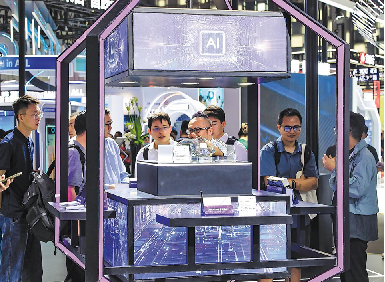
 The company made a debut at the 2025 World Artificial Intelligence Conference in Shanghai in July. The centerpiece of its showcase was a stack of three distinct “boxes”, representing the launch of its latest solution suite, which provides comprehensive, full-scenario support, encompassing everything from sophisticated model scheduling and performance optimization to seamless application deployment, all unified across diverse and complex computing architectures.

 Xia explained the strategic imperative. “Building large-scale computing infrastructure resembles constructing a ‘giant power plant’, but the actual needs of AI applications demand readily available ‘plug-and-play sockets’.Current AI computing infrastructure must fundamentally adapt to effectively serve the multitude of small, widespread AI application enterprises that require agile, on-demand production resources.”

 Li Wei, deputy head of the cloud computing and big data research institute at the China Academy of Information and Communications Technology, said that traditionally if companies want to use computing power, they either build the infrastructure themselves or rent the computing power via cloud subscriptions, which is expensive. But now with platforms such as Infinigence AI, they can easily find and use computing power resources that are scattered across China in a more efficient way.

 Wu Hequan, an academician at the Chinese Academy of Engineering, said that every yuan ($0.14) invested in computing power drives 3 to 4 yuan in GDP growth.

 “In the global race for AI leadership, expanding computing power supply is critical,” Wu added.

 Xia passionately highlighted the vital role of young talent and China’s unique market advantage in driving innovation. He recalled a pivotal early breakthrough significantly boosted by a 24-year-old intern, whose insight tripled algorithm efficiency on hardware. The company fosters this spirit through weekly open tech forums, where young engineers freely exchange ideas, sparking continuous innovation.

 Xia views China’s position as the world’s largest AI application market as an unparalleled catalyst for growth. “This vast potential naturally energizes young practitioners and injects genuine, lasting momentum into the entire industry,” he said.

Article inline ad

Momentum Builds In A-Share Market

0

By SHI JING in Shanghai | chinadaily.com.cn | Updated: 2025-08-13

The signs of a bull run are slowly but steadily emerging in China’s A-share market, underpinned by ongoing structural reforms and sustained long-term capital inflows. Experts said the developing rally is expected to gain further traction on the back of policy support and a gradually improving external environment.

 Their remarks came on Wednesday as the benchmark Shanghai Composite Index rose for an eighth straight session, climbing 0.48 percent to close at 3,683.46 — its highest level since December 2021.

 The Shenzhen Component Index gained 1.76 percent, while the tech-heavy ChiNext surged 3.62 percent. The total turnover on the Shanghai and Shenzhen stock exchanges topped 2.1 trillion yuan ($292.69 billion) — a 13.5 percent increase from the previous day.

 Investor enthusiasm is surging on both the institutional and retail fronts. July witnessed a record monthly number of new mutual fund launches, reflecting rising interest among households in equity assets as returns from traditional savings and wealth management products continue to decline. Total assets under management in public mutual funds have now exceeded 34 trillion yuan.

 Insurance companies are also ramping up their presence in the A-share market. The number of public disclosures triggered by insurers’ equity holdings surpassing the 5 percent threshold has already exceeded last year’s total. Analysts said insurers are increasingly focusing on companies from the emerging industries and advanced manufacturing sectors, supporting China’s shift toward high-quality development.

 Yang Delong, chief economist at First Seafront Fund, said that insurance companies have played an increasingly stabilizing role in the A-share market by boosting their equity allocations. He noted that insurers have recently focused more of their research on companies engaged in new quality productive forces, a move that supports China’s broader push to upgrade its real economy and enhance long-term investment value.

 Retail investor participation is also rising. Nearly 14.6 million individual trading accounts were opened in the first seven months of 2025, a 37 percent year-on-year increase, according to data provider Wind Info.

 Furthermore, foreign investors have been steadily increasing their exposure to Chinese equities, including A-shares and Hong Kong-listed stocks. Net foreign inflows totaled $2.7 billion in July, more than double the level in June, according to a recent report by Morgan Stanley.

 Analysts said the macro environment is becoming increasingly favorable for Chinese equities. Expectations of a weaker US dollar and potential interest rate cuts by the Federal Reserve are improving the outlook for emerging markets. The narrowing interest rate differential between China and the United States could further accelerate foreign capital inflows.

 Hong Hao, chief investment officer at Lotus Asset Management, said the upward momentum of Chinese stocks will sustain for a long time if the US dollar’s weakness proves to be a multiyear trend. Also, the Chinese market has been increasingly resilient in the face of negative tariff headlines.

 Given the current favorable liquidity conditions in the Chinese market and the fear-of-missing-out sentiment, any corrections in the A-share market are likely to be quickly absorbed by buyers, he added.

 Zhu Liang, chief investment officer at AllianceBernstein China, said that despite strong gains in recent weeks — with the Shanghai Composite Index up nearly 7 percent and the Shenzhen Component Index up more than 10 percent since July — valuations in the A-share market remain attractive.

 Sounding a word of caution, some experts said that risk appetite in the A-share market may be suppressed by factors such as changes in tariff talks between China and the US, as well as domestic challenges facing the Chinese economy.

 He Kang, chief strategy analyst at Huatai Securities, said that there are still challenges regarding China’s economic recovery, as efforts by policymakers to create a fairer competition environment may take time to show effect, and this may affect the profitability outlook of A-share companies.

 shijing@chinadaily.com.cn


Article inline ad

China-Made ‘Intelligent Production’ Large Model Drawing Spotlight In Malaysia

0

By Han Jingyan | chinadaily.com.cn | Updated: 2025-08-13

A China-made “intelligent production” large model, being displayed at a global artificial intelligence trade event in Malaysia, is attracting wide attention due to its intelligent applications in multi-scenarios.

 The large model, developed by Shandong Inspur Intelligent Production Technology Co Ltd, is being exhibited at the ASEAN AI Malaysia Summit 2025 held at Malaysia International Trade & Exhibition Centre between Aug 12 and 13, drawing a large number of industry experts and visitors.

 The summit brought together delegates of government departments and enterprises from member states of the Association of Southeast Asian Nations and around the world to showcase the cutting-edge achievements and application practices of artificial intelligence.

 Wang Xiaofeng, deputy general manager of the Overseas Sales Department at Inspur Intelligent Production, said the product they showcased at the event is a professional industrial model they independently developed, with a focus on equipment manufacturing, electronics, food, textile, food, petrochemical, mining, steel, aluminum and other industries.

 Based on the general big model, it is superimposed on the corpus of relevant professional knowledge of industries, spheres and enterprises, and provides enterprise-level customers with tailor-made big models and intelligent applications through continuous iteration and fine-tuning, she said.

 The big model can offer over 300 industry-specific sub-models, which support zero-code rapid orchestration of business personnel, and can complete tasks through prompts in zero-sample and cold start scenarios, significantly reducing the use threshold and improving the platform usability, she added.

Article inline ad

Intersport Breaks Mold, Shifting Its Product Manufacturing To China

0

By Wang Zhuoqiong | China Daily | Updated: 2025-08-13

Intersport International Corp, a leading sporting goods retailer based in Switzerland, is weighing a production pivot toward China.

 The retailer sees an opportunity to tap China’s unrivaled supply chain efficiency at a time when rivals are shifting production to Southeast Asia and other developing-country markets.

 Intersport International’s new CEO, Tom Foley, told the Financial Times recently that the group is considering sourcing a greater share of its private-label products from China. The category accounted for about 1.4 billion euros ($1.53 billion) in revenue last year.

 The move comes as many sporting goods brands increasingly shift production to countries such as Bangladesh and Vietnam, where tariff rates are lower. Such moves, Foley said, “might put pressure on production capacities in markets that ordinarily would not have that”.

 Intersport, with 5,500 stores across 42 countries, generated 14 billion euros in revenue last year. It sells both its own private-label goods and products from brands such as Nike and Adidas. The company did not respond to a China Daily request for comment.

 Industry experts said China remains a formidable manufacturing base for sporting goods despite cost and tariff pressures.

 “China’s sporting goods manufacturing sector has evolved into a comprehensive, well-matured ecosystem that spans virtually every product category,” said Adam Zhang, founder of Key-Solution Sports Consulting.

 Zhang pointed to recent breakthroughs in advanced materials such as carbon fiber. “Who could turn down a supply chain that is superior in quality, highly efficient and the global benchmark for cost leadership?”

 Quanzhou, Fujian province, is one such hub, producing one in five pairs of athletic shoes sold worldwide, said Ding Wanyu of Haiou Shoes Materials Co, which is based in Quanzhou.

 Ding said the city’s industrial cluster allows all components to be sourced within a 50-kilometer radius in under 72 hours, while Shoe & Textile City — a trading mall in Quanzhou — offers one-stop procurement. Local firms also invest heavily in in-house research and development, combining biomechanics, materials science and data analytics to improve performance, she said.

 Bai Ming, a researcher at the Chinese Academy of International Trade and Economic Cooperation, said that sportswear players such as Adidas and Nike have been shifting some production out of China in the past several years due to rising labor costs and higher tariffs.

 However, for companies where labor is a small proportion of total costs and demand for high quality products, technology and know-how is critical, China’s seamless integration of its supply chain, ability to quickly integrate design changes, and speed-to-market capabilities remain hard to match, said Bai.

Article inline ad

Demand For Nvidia’s H20 Chip Lackluster

0

By Ma Si | chinadaily.com.cn | Updated: 2025-08-12

Nvidia’s H20 artificial intelligence chip, designed specifically for the Chinese market in compliance with Washington’s export controls, is encountering tepid demand, according to industry sources.

 In the rapidly developing market, this reluctance opens a strategic window for ambitious Chinese AI chip designers to expand their market share amid growing domestic efforts to hone chip prowess, they added.

 “The demand for H20 chips was lower than expected, according to the latest feedback of our customers,” said a regional manager of a major Chinese information technology distributor, on condition of anonymity.

 The manager said that for chips like the H20, demand depends heavily on large corporations, which are reluctant to buy the products of Nvidia, a United States-based semiconductor company, after the Cyberspace Administration of China summoned the US company for alleged cybersecurity threats in late July.

 An engineer at a Chinese internet company, also on condition of anonymity, said: “Cybersecurity is of crucial importance to us. We cannot tolerate any potential risks. Even if H20 chips are available now, we are not that eager to buy.”

 Pan Helin, a member of the Ministry of Industry and Information Technology’s Expert Committee for Information and Communication Economy, said: “If Nvidia’s chips really have backdoor risks, that will become its self-dug grave. Users, not only companies in China, but also clients across the world, may abandon their chips over fears of remote shutdowns or data theft.”

 The Financial Times reported on Monday that Nvidia has agreed to pay the US government 15 percent of its revenue from H20 chip sales in China as part of a deal to secure export licenses to Beijing.

 In response to the report, Nvidia said in a statement to China Daily, “We follow rules the US government sets for our participation in worldwide markets.”

 Charlie Dai, vice-president and principal analyst at market research company Forrester, said the 15 percent fee agreement represents an “unprecedented” move.

 “It starkly underscores how trade tensions drive up market access costs, creating substantial financial pressure and strategic ambiguity for technology firms worldwide,” Dai said.

 Xiang Ligang, director-general of the Zhongguancun Modern Information Consumer Application Industry Technology Alliance, a telecom industry association, said, “The US government’s move will fuel Chinese companies’ distrust toward Nvidia, which will accelerate the adoption of domestic AI chips.”

 According to Xiang, Nvidia’s dominance in the global AI chip market relies not only on chip performance, but also on its entrenched CUDA ecosystem — a 20-year-old framework for AI compatibility. While Chinese chips such as Huawei’s Ascend series can rival the H20 technically, they lack CUDA’s universal adaptability for AI large language models.

 “However, if security concerns and the 15 percent ‘geopolitical premium’ drive users toward Chinese chips, developers could shift their focus to compatibility layers for domestic alternatives, eroding Nvidia’s ecosystem advantage,” he added.

 Ecosystem booming

 China’s domestic AI chip ecosystem is moving quickly. In July, StepFun, a Shanghai-based Chinese AI company, formed a “model-chip synergy ecosystem innovation alliance” with nearly 10 leading domestic AI chip and infrastructure companies, including Huawei, Moore Threads, Beijing Biren Technology Development Co and Cambricon Technology.

 The alliance’s core mission is clear: to collaboratively optimize large language models to run efficiently on domestic AI chips.

 The goal is to create a virtuous cycle. As more AI workloads shift to Chinese chips, economies of scale will drive costs down and improve performance and ecosystem maturity — making homegrown solutions increasingly viable and attractive, according to StepFun.

 “For domestic AI chips to better support China’s homegrown large language models, the first priority is ensuring a sufficient supply of advanced computing power,” said Zhang Wen, founder, chairman and CEO of Beijing Biren Technology Development Co. “The production capacity of advanced domestic AI chips will be crucial for the future of China’s AI industry.”

 masi@chinadaily.com.cn

Article inline ad

Momentum Builds In A-Share Market

0

By SHI JING in Shanghai | chinadaily.com.cn | Updated: 2025-08-13

The signs of a bull run are slowly but steadily emerging in China’s A-share market, underpinned by ongoing structural reforms and sustained long-term capital inflows. Experts said the developing rally is expected to gain further traction on the back of policy support and a gradually improving external environment.

 Their remarks came on Wednesday as the benchmark Shanghai Composite Index rose for an eighth straight session, climbing 0.48 percent to close at 3,683.46 — its highest level since December 2021.

 The Shenzhen Component Index gained 1.76 percent, while the tech-heavy ChiNext surged 3.62 percent. The total turnover on the Shanghai and Shenzhen stock exchanges topped 2.1 trillion yuan ($292.69 billion) — a 13.5 percent increase from the previous day.

 Investor enthusiasm is surging on both the institutional and retail fronts. July witnessed a record monthly number of new mutual fund launches, reflecting rising interest among households in equity assets as returns from traditional savings and wealth management products continue to decline. Total assets under management in public mutual funds have now exceeded 34 trillion yuan.

 Insurance companies are also ramping up their presence in the A-share market. The number of public disclosures triggered by insurers’ equity holdings surpassing the 5 percent threshold has already exceeded last year’s total. Analysts said insurers are increasingly focusing on companies from the emerging industries and advanced manufacturing sectors, supporting China’s shift toward high-quality development.

 Yang Delong, chief economist at First Seafront Fund, said that insurance companies have played an increasingly stabilizing role in the A-share market by boosting their equity allocations. He noted that insurers have recently focused more of their research on companies engaged in new quality productive forces, a move that supports China’s broader push to upgrade its real economy and enhance long-term investment value.

 Retail investor participation is also rising. Nearly 14.6 million individual trading accounts were opened in the first seven months of 2025, a 37 percent year-on-year increase, according to data provider Wind Info.

 Furthermore, foreign investors have been steadily increasing their exposure to Chinese equities, including A-shares and Hong Kong-listed stocks. Net foreign inflows totaled $2.7 billion in July, more than double the level in June, according to a recent report by Morgan Stanley.

 Analysts said the macro environment is becoming increasingly favorable for Chinese equities. Expectations of a weaker US dollar and potential interest rate cuts by the Federal Reserve are improving the outlook for emerging markets. The narrowing interest rate differential between China and the United States could further accelerate foreign capital inflows.

 Hong Hao, chief investment officer at Lotus Asset Management, said the upward momentum of Chinese stocks will sustain for a long time if the US dollar’s weakness proves to be a multiyear trend. Also, the Chinese market has been increasingly resilient in the face of negative tariff headlines.

 Given the current favorable liquidity conditions in the Chinese market and the fear-of-missing-out sentiment, any corrections in the A-share market are likely to be quickly absorbed by buyers, he added.

 Zhu Liang, chief investment officer at AllianceBernstein China, said that despite strong gains in recent weeks — with the Shanghai Composite Index up nearly 7 percent and the Shenzhen Component Index up more than 10 percent since July — valuations in the A-share market remain attractive.

 Sounding a word of caution, some experts said that risk appetite in the A-share market may be suppressed by factors such as changes in tariff talks between China and the US, as well as domestic challenges facing the Chinese economy.

 He Kang, chief strategy analyst at Huatai Securities, said that there are still challenges regarding China’s economic recovery, as efforts by policymakers to create a fairer competition environment may take time to show effect, and this may affect the profitability outlook of A-share companies.

 shijing@chinadaily.com.cn

Article inline ad

Solid Monetary Readings Signal Steady Policy Support

0

By Zhou Lanxu | chinadaily.com.cn | Updated: 2025-08-13

 in Haian, Jiangsu province. [Photo/Sipa]China’s aggregate social financing and broad money supply growth remained solid in July, official data showed on Wednesday, underscoring the continuation of an accommodative monetary policy that is providing a suitable financial environment for the real economy.

 The country’s aggregate social financing — the total amount of financing to the real economy — stood at 23.99 trillion yuan ($3.34 trillion) in the first seven months of the year, up by 5.12 trillion yuan from the same period last year, said the People’s Bank of China, the country’s central bank.

 The PBOC said that the country’s outstanding aggregate social financing totaled 431.26 trillion yuan as of the end of July, marking a 9 percent year-on-year increase, compared with 8.9 percent as of the end of June.

 The broad money supply, or M2, reached 329.94 trillion yuan at the end of last month, up 8.8 percent year-on-year, compared to 8.3 percent seen a month earlier, the central bank said.

 Meanwhile, the country’s M1 money supply — which represents how much money is actively being used in the economy — grew by 5.6 percent year-on-year, up from 4.6 percent as of the end of June, which experts said pointed to rising spending appetites among market players.

 China’s new yuan-denominated loans totaled 12.87 trillion yuan in the first seven months of the year, compared with 12.92 trillion yuan in the first half, the PBOC added, with experts attributing the July decline to seasonal factors.

Article inline ad

China Imposes Countermeasures Against Two EU Banks Over Sanctions

0

By Zhong Nan | chinadaily.com.cn | Updated: 2025-08-13

China has imposed countermeasures on two European banks — UAB Urbo Bankas and AB Mano Bankas — in response to the European Union’s sanctions on Chinese financial institutions, the Ministry of Commerce said on Wednesday.

 Under the measures, organizations and individuals in China are prohibited from engaging in transactions, cooperation or other related activities with these two banks, said a ministry spokesperson in an online statement.

 The move follows the EU’s decision to add two Chinese financial institutions to its sanctions list on grounds related to Russia, despite China’s repeated opposition. The sanctions took effect on Aug 9.

 The spokesperson stressed that the sanctions “seriously violate international law and the basic norms governing international relations, severely harm the legitimate rights and interests of Chinese companies, and exert a negative impact on China-EU economic, trade and financial cooperation.”

 The ministry official urged the EU to uphold the long-standing cooperation between China, the bloc and its member states in the economic, trade and financial spheres, correct its wrongful actions, and refrain from endorsing measures that harm China’s interests or undermine China-EU cooperation.

Article inline ad

China Draws Foreign Investors As Evolving Economy Meets Proactive Policies

0

Xinhua | Updated: 2025-08-13

BEIJING — During last month’s third China International Supply Chain Expo (CISCE), overseas exhibitors made up 35 percent of participants — up 3 percentage points from 2024 and 9 points from the inaugural 2023 edition — with industry giants like Honeywell, GE Healthcare, and Siemens already securing their spots for next year, underscoring foreign firms’ growing commitment to China.

 As a major national platform for global industrial collaboration, the CISCE embodies the enduring appeal of the Chinese market during its 14th Five-Year Plan period (2021-2025), marked not only by increased foreign investment but also by significant shifts in investment fields that reflect China’s broader economic transformation.

 HARD-WON GAINS

 The expo’s momentum echoes wider trends. By June 2025, China’s actual utilized foreign direct investment (FDI) reached $708.73 billion since 2021, hitting the 14th Five-Year Plan target of $700 billion six months ahead of schedule.

 In the same period, 229,000 new foreign-invested enterprises were launched, 25,000 more than in the 2016-2020 period.

 Despite fluctuations in FDI in recent years, China’s ability to maintain steady foreign capital inflows stands out in a challenging global environment.

 According to the United Nations, global FDI fell 11 percent in 2024, marking the second straight year of decline after a sharp drop in 2023. Early data for the first quarter of 2025 offers little optimism, suggesting a possible third consecutive year of contraction.

 “Weak global direct investment has weighed on China’s FDI, but a closer look shows resilience,” said Fan Penghui, a senior researcher with the Chinese Academy of International Trade and Economic Cooperation, a think tank with the Ministry of Commerce. “A periodic slowdown after a peak is normal. Investment cycles ebb and flow.”

 FOCUS ON HIGH-TECH SECTORS

 In fact, China’s high-tech industries and service sectors have seen continuous growth in foreign investment, which underscores that foreign capital is riding on the development wave of China’s new quality productive forces, Fan noted.

 In 2024, high-tech industries attracted 34.6 percent of foreign investment, up 6 percentage points from 2020. The first half of 2025 accelerated this shift. High-tech sectors attracted 127.87 billion yuan in foreign capital, with e-commerce services surging 127.1 percent, chemical pharmaceuticals up 53 percent, and aerospace equipment manufacturing rising 36.2 percent.

 Amid China’s artificial intelligence (AI) boom and computing capacity boost, US materials science giant Corning plans to localize the production of high-end optical fibers in Shanghai, responding to the need for denser, faster data transmission in AI data centers, where fiber requirements are much higher than those in traditional facilities, according to Lin Chunmei, president and general manager of Corning Greater China.

 For many multinational corporations, China has evolved beyond a sales market into a hub for growth and innovation, prompting increased R&D investment to tap into the country’s innovation potential.

 According to Leng Yan, executive vice president of Mercedes-Benz China, the company has poured over 10.5 billion yuan into Chinese R&D over five years, and with its Shanghai R&D center, the company’s local innovation now “leads global development.”

 HOLD IT STEADY

 China’s success in attracting foreign investment is underpinned by a deliberate policy push to keep foreign investment steady, including opening more fields to foreign firms and creating a more welcoming environment.

 The negative list for foreign investment has been steadily shortened, with all manufacturing restrictions eliminated in 2024. Pilot programs are also opening up services like value-added telecom and biotechnology.

 To build trust and cut red tape, a roundtable consultation system for foreign businesses was established. Since 2023, the Ministry of Commerce has held over 30 meetings, resolving more than 1,500 operational issues raised by foreign firms.

 Plans are in motion to expand these efforts. A revised catalogue of industries encouraged for foreign investment is in the works. The updated list will guide more foreign capital toward advanced manufacturing, modern services, high-tech, energy conservation, and environmental protection sectors, as well as into central, western and northeastern regions, according to the country’s top economic planner.

 “As China continues to expand institutional opening up, foreign investment is expected to integrate more deeply into domestic innovation and supply chains, striking a new balance with growing emphasis on quality,” Fan said.

Article inline ad