Tuesday, November 24, 2026

Home Blog Page 41

Capital Market Reform Set To Play Central Role In China’s Next Development Phase

0

According to a report by China Daily on March 9th…

China is placing capital market reform at the center of its strategy for high-quality economic development, as policymakers seek to strengthen financial support for technological innovation and industrial upgrading.

The draft outline of China’s 15th Five-Year Plan (2026–2030) highlights the need to combine an effective market with a proactive government while allowing the market to play a decisive role in allocating resources. Within this framework, the capital market is expected to become a critical pillar of China’s modern financial system.

According to Wu Xiaoqiu, former vice-president of Renmin University of China, the capital market should evolve beyond its traditional role as a financing platform to become a comprehensive system that also provides incentive mechanisms and wealth management functions.

Supporting Innovation And Industrial Upgrading

As China transitions toward an innovation-driven economy, the capital market is expected to play a larger role in channeling financial resources into emerging industries and technology companies.

Reforms during the 15th Five-Year Plan period are expected to focus on:

  • improving foundational market institutions

  • strengthening information disclosure and investor protection

  • expanding the registration-based IPO system

  • increasing market openness and international participation

These measures aim to improve the efficiency of capital allocation while strengthening the global competitiveness of China’s financial markets.

Building A More Competitive Market Ecosystem

Policymakers are also emphasizing the need to enhance the overall ecosystem of China’s capital market by improving the quality of listed companies and encouraging long-term institutional capital to participate more actively.

China’s manufacturing sector already accounts for a significant share of global output. The country’s share of global manufacturing reached 31.6 percent in 2024, reflecting the growing importance of capital markets in supporting industrial development and technological innovation.

Looking ahead, reforms are expected to allow more high-growth technology companies — including those that may not yet be profitable — to access capital markets, reflecting a shift toward supporting innovation-driven growth.

Strengthening The Foundations Of A Financial Powerhouse

China’s long-term financial strategy also involves strengthening two major pillars:

  1. Internationalization of the renminbi

  2. Development of globally competitive capital markets

The goal is to gradually establish renminbi-denominated assets as a new global asset class comparable with assets denominated in major international currencies.

To achieve this objective, reforms will likely focus on restructuring both the asset side and the funding side of the market. This includes improving the risk-return profile of listed companies and allowing greater participation by large institutional investors.


Key Signals

1. Capital market reform is now a national strategic priority.
Financial markets are increasingly viewed as a core pillar supporting China’s innovation-driven development model.

2. The registration-based IPO system will deepen.
China is moving toward a more market-oriented capital market framework with stronger disclosure and investor protection.

3. Institutional capital will be encouraged to enter the market.
Policymakers are likely to reduce barriers for large institutional funds, helping deepen market liquidity.


Market Implications

For global investors:
China is signaling continued opening of its financial markets and a stronger push to attract long-term capital.

For technology companies:
Capital markets will play a larger role in financing innovation and high-growth sectors.

For global financial markets:
The development of renminbi-denominated assets could gradually reshape the international financial landscape.

Article inline ad

China Expands “Shopping in China” Campaign to Boost Global Consumer Appeal

0

According to a report by China Daily on March 9th…

China is stepping up efforts to position itself as a major global consumption destination through the “Shopping in China” initiative, a nationwide campaign aimed at improving the shopping environment for international visitors while expanding opportunities for domestic and foreign brands.

Launched in April 2025, the initiative focuses on building a more internationally friendly retail ecosystem by streamlining visa procedures, improving tax-refund policies for overseas shoppers and upgrading payment services for inbound travelers.

Analysts say the campaign reflects China’s broader strategy to unlock the potential of its vast consumer market while reinforcing the country’s commitment to opening up.

According to Guan Lixin, a researcher at the Chinese Academy of International Trade and Economic Cooperation, supportive policies are helping lower market-entry barriers for foreign brands while enabling them to reach China’s increasingly sophisticated consumer base.

At the same time, the initiative is also creating opportunities for Chinese companies to enhance global brand recognition by promoting smart products, green consumer goods and homegrown brands.

Foreign Brands Expand Presence

Global companies are already responding to the initiative with expanded investment.

New York-based luxury group Tapestry Inc described China as one of its most important growth markets. The company plans to open more than 100 new stores in China over the next three years, expanding its presence from over 400 stores in 90 cities to more than 100 cities nationwide.

Meanwhile, health and beauty retailer Watsons has been introducing new retail concepts to attract consumers. The company recently launched a retro-themed “Watson’s the Chemist” pop-up store in Guangzhou, designed to recreate a traditional Western pharmacy environment while showcasing more than 40 exclusive products.

Strong Consumption Momentum

China’s consumer market continues to demonstrate resilience.

According to the National Bureau of Statistics, retail sales of consumer goods reached 50.12 trillion yuan ($7.26 trillion) in 2025, up 3.7 percent year-on-year.

Inbound tourism is also recovering rapidly. In 2025, the number of foreign nationals entering and exiting China reached 82.04 million, an increase of 26.4 percent from the previous year.

Meanwhile, China has been expanding its tax-refund network for overseas shoppers. By the end of 2025, nearly 13,000 tax-refund stores were operating nationwide, while sales of tax-refund goods surged 95.9 percent year-on-year, according to the Ministry of Commerce.

Consumption Upgrading Ahead

Researchers say several structural factors are likely to support continued consumption growth.

These include consumption upgrading, pro-consumption policy support, the continued rollout of the “Shopping in China” initiative and duty-free policies linked to the development of the Hainan Free Trade Port.

As China seeks to position itself as a global consumption hub, the campaign is expected to attract more international brands, encourage tourism spending and further integrate China’s consumer market with the global economy.

Article inline ad

China Weekly Economic Brief

0

Period: March 2 – March 7, 2026
Sources: China Economy | China Signals | AI Consumerization


🔹 Key Headlines

  • Spring Festival Consumption Boom: Travel, retail, and AI-powered home appliances surged, signaling resilient domestic demand.

  • Inland Industrial Upgrades: Ningxia, Jilin, and Gansu focus on advanced manufacturing, green energy, and digital infrastructure.

  • Global Confidence: Multinationals reaffirm long-term market potential in China following GDP target announcements.

  • AI Consumerization: Humanoid robots and AI home devices lead technology adoption and commercial applications.


📈 China Economy: Regional & Industrial Trends

Travel & Consumption Recovery

  • Cross-regional travel: 2.8 billion trips (+8.2% YoY)

  • Hainan duty-free sales: 2.72 billion yuan (+30.8% YoY)

  • AI-powered products: >50% of new-product sales

Provincial Industrial Upgrades

  • Ningxia: Chemicals, coal-to-liquids fuels, wine industry with AI quality tracing; computing capacity expansion to 600,000 petaflops.

  • Jilin: Automotive & petrochemical upgrades; high-tech clusters; ice-snow economy & winter sports industrial chains.

  • Gansu: Green transformation of traditional sectors; mining modernization; data centers supporting AI & emerging industries.


💼 China Signals: Policy & Investment Insights

  • 2026 GDP Target: 4.5–5%

  • Foreign Trade Growth: FIEs foreign trade value reached 13.27 trillion yuan ($1.92T)

  • Business Environment: Multinationals like Henkel, Schneider Electric, Fonterra expand in China

  • Tourism & Consumption: Visa-free expansion, digital tax refund services, social media promotion boost foreign tourist spending


🤖 AI Consumerization: Innovation in Action

Application-Driven AI Leadership

  • China leads globally in AI large-model deployment, surpassing the U.S. in some metrics

  • Government policies focus on real-world applications to drive innovation and commercialization

Humanoid Robots

  • >140 manufacturers, 330+ models

  • 54% of global industrial robot installations

  • Deployed in factories, warehouses, and services (logistics, education, chemical parks)

  • Algorithms from performances (Spring Festival Gala) applied to industrial operations

Government Support

  • State-backed pilot bases accelerate deployment, scenario testing, and industry collaboration

  • Supports research commercialization and matches supply-demand for humanoid robots and AI solutions

Consumer AI Devices

  • AI-enabled vacuums, smart air conditioners, and climate-control appliances lead holiday sales growth

  • Over 50% of new-product sales are AI-integrated devices


💡 Weekly Investment Takeaways

  1. Domestic Consumption: Experiential and AI-enabled consumption recovering strongly

  2. Inland Industrial Hubs: Opportunities in advanced manufacturing, green energy, and digital infrastructure

  3. AI & Robotics: Rapid commercialization, global competitiveness in applications

  4. Stable Policy Environment: GDP targets and reform initiatives encourage foreign investment and long-term market engagement

Article inline ad

China Emerges as a Global Leader in AI Applications and Humanoid Robotics

0

According to a report by China Daily on March 8,

China is rapidly solidifying its position at the forefront of artificial intelligence (AI) deployment, leveraging massive domestic markets, diverse real-world scenarios, and strong government support to accelerate innovation and commercialization. Analysts and industry leaders highlight that China is not only advancing AI research but also leading globally in applied technologies.


Application-Driven AI Leadership

According to Pan Jiaofeng, deputy to the National People’s Congress and president of the Institutes of Science and Development at the Chinese Academy of Sciences, China has already surpassed the United States in the use of AI large models, nearly doubling U.S. deployment in some areas.

“China is ahead in application-driven development,” Pan said. He emphasized that while gaps remain in high-end chips and foundational model architectures, China’s strategy of using applications to drive innovation is expected to spur upstream technological breakthroughs over time.

The 2026 Spring Festival Gala showcased this progress, demonstrating AI’s integration into entertainment, robotics, and industrial applications, offering the public a tangible view of technological achievements.


Humanoid Robots: From Training to Real-World Jobs

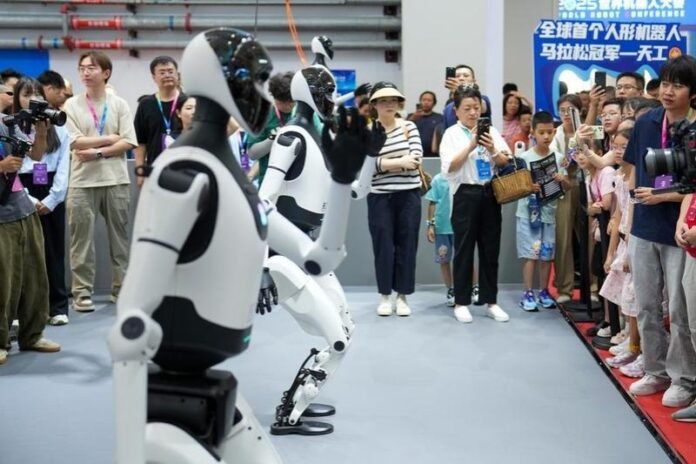
China’s humanoid robot industry is transitioning from demonstrations to practical deployments across factories, warehouses, and service sectors. At specialized robot training centers in Shandong, Zhejiang, and Anhui, humanoid robots are learning tasks such as transporting goods, folding clothes, and providing home care.

Performances at national events, including the Spring Festival Gala, highlight robots’ coordination, perception, and adaptability. Algorithms developed for stage formations and obstacle handling are directly applicable to warehouse management, factory automation, and service robotics.

Over 140 humanoid robot manufacturers and more than 330 robot models exist in China. According to a 2025 Morgan Stanley report, China accounts for 54 percent of global industrial robot installations and has filed five times more humanoid robot patents than the United States over the past five years.


Industry Support and Commercialization

Government-backed pilot bases, funded primarily with state capital, have been instrumental in fostering cooperation, identifying application scenarios, and accelerating deployment. Companies like Unitree Robotics, Xingjie Innovation Robotics, and Gelanruo are leveraging these platforms to expand into intelligent manufacturing, smart warehousing, and service-oriented robotics.

“The surge in humanoid robots is driven by enhanced AI capabilities and growing computing power of AI chips, enabling robots to operate in increasingly complex environments,” said Li Dezheng, general manager of Xingjie Innovation Robotics. Government support has created opportunities for real-world testing, giving Chinese firms a competitive edge internationally.


Investment and Innovation Outlook

China’s AI industry exemplifies application-led innovation, combining cutting-edge research with early deployment in commercial and public sectors. The government’s involvement ensures supply-demand alignment, fast-tracks regulatory approvals, and cultivates a robust ecosystem for experimentation.

Investors and international partners can look to China as a key hub for:

  • Humanoid robotics for industrial, logistics, and service applications

  • Large-model AI deployment for enterprise solutions

  • Embedded AI in manufacturing and digital infrastructure

  • Research commercialization supported by policy and state-backed pilot programs

China’s AI landscape is entering a critical stage of large-scale implementation, offering global investors access to one of the world’s most advanced and rapidly expanding AI markets.

Article inline ad

China’s Industrial and AI Transformation: Opportunities for Investors and Global Partners

0

ZH edited based on a March report from China Daily.

China’s inland provinces are accelerating industrial upgrades, expanding digital infrastructure, and fostering emerging technologies, while multinational firms remain confident in the country’s long-term market potential. From the deserts of Gansu to the vineyards of Ningxia and the industrial heartland of Jilin, regional authorities are leveraging local resources, innovation, and policy support to position themselves at the forefront of China’s modernization drive.


Regional Industrial Transformation

Ningxia: Coal, Chemicals, and Computing Power

Northwest China’s Ningxia Hui Autonomous Region is modernizing its industrial base with advanced manufacturing, clean energy, and digital infrastructure. Chen Chunping, vice-chairman of the regional government, emphasized six industrial clusters and four key sectors aimed at integrating technology, green development, and digital upgrades.

Ningxia is a hub for modern chemicals, coal-to-liquids fuels, and high-performance fibers such as spandex and aramid. Its wine industry, centered in the Helan Mountains foothills, is gaining international recognition, with AI-enabled quality tracing systems integrating production with tourism.

The region is also rapidly expanding its computing capacity, hosting 22 large data centers. Total computing power could reach 600,000 petaflops under national plans, supporting AI applications and digital industrialization.


Jilin: Industrial Upgrades and the Ice-Snow Economy

Northeast China’s Jilin Province is focused on industrial modernization alongside urban and infrastructure development. Traditional sectors such as automotive manufacturing and petrochemicals are being upgraded, while emerging industries including AI, bio-manufacturing, renewable energy, and advanced materials are expanding.

The Changchun metropolitan area, accounting for over half the province’s population, will see more than 700 projects, enhancing transportation, industrial collaboration, and smart-city integration. By 2030, authorities aim for economic output of 1.35 trillion yuan ($195 billion).

Jilin is also leveraging its ice and snow resources, with 68 large ski resorts and national leadership in ski tourism. Winter sports industrial chains are emerging, producing domestic bobsleds, carbon-fiber skis, and high-tech skates. The 33rd Winter Universiade in 2027 is expected to boost regional growth and tourism-linked manufacturing.


Gansu: Resource-Based Industrial Transformation

Northwest China’s Gansu Province is strengthening its traditional industrial base through innovation, green development, and digitalization. Governor Ren Zhenhe highlighted modernizing legacy sectors, including mining, metals processing, and manufacturing, while launching hundreds of industrial upgrade projects annually.

Leveraging abundant energy and mineral resources, Gansu has established two national-level and 14 provincial-level advanced manufacturing clusters. By 2025, these clusters generated over 900 billion yuan ($130 billion), accounting for nearly 90 percent of industrial growth.

Under the national East Data West Computing initiative, the Qingyang data center cluster is supporting AI, cloud computing, and data-intensive industries. Emerging sectors include hydrogen energy, energy storage, commercial aerospace, and the low-altitude economy.


Overseas Investment Confidence

China’s 2026 GDP growth target of 4.5–5 percent, alongside continued opening-up policies, has strengthened multinational firms’ confidence. Analysts say these measures provide stability for long-term planning and market engagement amid global uncertainties.

Executives highlighted new opportunities in manufacturing, consumer goods, and industrial automation:

  • Henkel: Deepening participation in China’s industrial development and innovation.

  • Schneider Electric: Expanding industrial parks in Wuxi and Xiamen for medium-voltage equipment production.

  • Fonterra: Investing in innovation and application centers to supply premium dairy products to meet growing domestic demand.

Foreign trade data underscores the trend, with foreign-invested enterprises achieving 13.27 trillion yuan ($1.92 trillion) in 2025, marking seven consecutive quarters of growth, particularly in food processing, pharmaceuticals, and communications equipment.


China AI: Humanoid Robots Train for Real-World Jobs

China’s humanoid robot sector is moving rapidly from demonstrations to practical applications. At training centers in Shandong, Zhejiang, and Anhui provinces, humanoid robots are learning tasks such as transporting goods, folding clothes, and assisting in healthcare and industrial operations.

Public showcases, including the Spring Festival Gala, demonstrate robots’ coordination, perception, and adaptability, with algorithms developed for performances being repurposed for warehouse scheduling and factory operations. Over 140 manufacturers and 330 models exist, with China holding 54 percent of global industrial robot installations and filing five times more patents than the U.S. in the past five years.

Government-backed pilot bases are fostering cooperation, identifying application scenarios, and accelerating deployment, giving China a technological advantage in embodied AI and intelligent robotics.


Investment Takeaways

China’s inland provinces illustrate how industrial upgrading, digitalization, and AI innovation are reshaping regional economies:

  • Ningxia: Advanced manufacturing, digital infrastructure, and wine industry globalization.

  • Jilin: Industrial modernization, green energy, ice-snow economy, and metropolitan development.

  • Gansu: Resource-based industrial clusters, green manufacturing, and data center expansion.

  • China AI: Humanoid robots, intelligent manufacturing, smart warehousing, and service applications.

For international investors, these trends signal opportunities in advanced manufacturing, green energy, digital infrastructure, AI and robotics, and regional industrial hubs.

Article inline ad

Humanoid Robots in China Train for Real-World Jobs, Attracting Global Attention

0

According to a report by China Daily on March 8…

China’s humanoid robot industry is rapidly moving from lab demonstrations to practical applications, with training centers across the country preparing robots for real-world tasks ranging from factory logistics to home care.

At a “robot school” in Jinan, Shandong province, dozens of humanoid robots are learning to carry trays, fold clothes, and fetch bottled water under human supervision. The center, led by Su Kairui, trains robots across 11 application scenarios, including industrial operations and domestic services. “Our ultimate goal is to enable them to perceive and adapt to environments like humans,” Su said.


Robots Enter the Spotlight

Humanoid robots have captured public attention beyond laboratories. For the second year in a row, they starred at China’s most-watched Spring Festival Gala, performing complex gymnastic and martial arts routines. Hangzhou-based Unitree Robotics showcased formations from drunken fist to Thomas Flair, demonstrating coordination, perception, and adaptability—skills directly transferable to industrial and service scenarios.

The performance drew international visitors, including German Chancellor Friedrich Merz, highlighting China’s growing visibility as a global hub for robotics innovation.


Turning Technology into Practical Use

Companies say the gala and other public demonstrations are not just for show—they reflect real advances in robotics technology. Algorithms that allow multiple robots to coordinate on stage, for instance, can be adapted for warehouse scheduling. Similarly, adaptive balance and perception systems are essential for safe operations in factories, hospitals, and homes.

Training centers are expanding rapidly in Shandong, Zhejiang, and Anhui provinces, and early commercial orders have begun. Li Dezheng, general manager of Xingjie Innovation Robotics in Binzhou, said humanoid robots are already deployed in chemical parks, data centers, shopping malls, and schools. Corporate customers account for roughly 70 percent of demand, with government purchases and educational institutions making up the remainder.


Emerging Applications

Industry leaders identify three immediate sectors for humanoid robots:

  1. Intelligent manufacturing – automating repetitive production tasks

  2. Smart warehousing – improving logistics efficiency

  3. Emotional companionship and care – assisting in healthcare and service industries

Guo Jishun, GM of Gelanruo Robotics in Wuhan, said that AI capabilities and high-performance computing are driving the surge in humanoid deployment, enabling robots to operate in complex, dynamic environments.


Policy Support and Industry Growth

The Chinese government has prioritized future industries like embodied AI in the 15th Five-Year Plan (2026–30), fostering an environment for technological innovation and market adoption. By 2025, China had more than 140 humanoid robot manufacturers and over 330 models. A Morgan Stanley report shows that over the past five years, China filed 7,705 humanoid robot patents—five times the number in the U.S.—and accounted for 54 percent of global industrial robot installations.

Pilot bases, largely funded by state capital, support collaboration between companies, identify new application scenarios, and accelerate deployment. “Government involvement is critical,” said Li Xingteng of Hangzhou Embodied Intelligence Pilot Base Technology Co. Ltd. “It’s difficult for a single enterprise to achieve these results alone.”


Global Implications

Experts note that early public exposure and government-backed application programs give China an edge over overseas peers. “If you don’t train robots in real-world scenarios, you can’t truly advance the technology,” said Li Chao, co-founder of DEEP Robotics.

As humanoid robots transition from demonstrations to practical use, China is positioning itself as a global leader in embodied AI and intelligent robotics, offering opportunities for foreign investors, technology partners, and industrial adopters seeking to tap into the country’s expanding AI-driven automation market.

Article inline ad

Innovation Key In Pursuit Of High-Quality Development

0

By Ouyang Shijia and Zhang Chenxu | China Daily | Updated: 2026-03-08 

China is committed to pushing forward its high-quality development, with a focus on economic structural optimization and quality enhancement as outlined in the country’s new five-year plan, the nation’s top economic regulator said on Saturday.

 Zheng Bei, deputy head of the National Development and Reform Commission, made the remarks at a news conference in Beijing while elaborating on the key points of the draft outline of the 15th Five-Year Plan (2026-30) for national economic and social development.

 Highlighting the strong focus on high-quality development, Zheng said the draft outline describes the GDP growth target set for the next five years as staying “within a reasonable range, with annual adjustments based on circumstances”.

 This target is designed to steer all stakeholders toward pursuing tangible growth, thereby leaving necessary policy space for shifting the growth model, making structural adjustments and deepening reforms, she said.

 As a pivotal step in China’s pursuit of high-quality growth, the development of new quality productive forces is prioritized in the draft outline, with policymakers emphasizing the integration of technological and industrial innovation.

 Bai Jingyu, director of the NDRC’s department of innovation and high-tech development, said the country will strengthen fundamental research and adopt a strategic, forward-thinking and systematic paradigm.

 “We will enhance the involvement of enterprises in national major technological innovation decisions, focusing on the key common technological needs of businesses in national science and technology programs,” Bai said, underscoring the efforts to solidify the central role of enterprises in technological innovation.

 Against the backdrop of an accelerating technological revolution and industrial transformation, the emergence of new technologies, industries and business models presents China with “unprecedented opportunities” for advancing its modernization drive, Bai added.

 According to the draft outline, authorities will fully implement the “AI Plus” initiative, fostering the deep integration of artificial intelligence with scientific innovation, industrial development, culture, public welfare and social governance. The goal is to “seize the commanding heights of AI industrial applications” and comprehensively “empower a wide range of sectors”, it said.

 Pan Jiaofeng, a deputy to the National People’s Congress, China’s top legislature, and president of the Chinese Academy of Sciences’ Institutes of Science and Development, said the rise of emerging sectors has given China significant global advantages. “We’ve seen the booming development of the ‘new trio’ — electric vehicles, lithium-ion batteries and photovoltaic products. In the next five years, another ‘new trio’ is expected to emerge,” he said.

 Yuan Da, secretary-general of the NDRC, said that strengthening the domestic market will be among priorities, with policies aimed at expanding domestic demand, optimizing supply and streamlining domestic circulation. He highlighted the importance of improving and expanding the service sector, refining the policy support system and addressing weak points in the productive services industry.

 Carl Fey, a professor of strategy at BI Norwegian Business School in Oslo, Norway, said that China has “room to increase domestic consumption, because Chinese people save a larger percentage of their income than people in many other countries”.

 Contact the writers at zhangchenxu@chinadaily.com.cn

Article inline ad

Multinational Firms See Growth Opportunities in China’s 2026 Economic Plan

0
(231103) -- SHANGHAI, Nov. 3, 2023 (Xinhua) -- This aerial panoramic photo taken on Jan. 10, 2023 shows a view of Lujiazui area in the China (Shanghai) Pilot Free Trade Zone in east China's Shanghai. The sixth China International Import Expo (CIIE) is scheduled to take place from Nov. 5 to Nov. 10 in Shanghai. With the sixth CIIE just around the corner, preparations are in full swing. (Xinhua/Fang Zhe)

According to a report by China Daily on March 8…

China’s latest economic targets and policy priorities, outlined in the 2026 Government Work Report, are boosting confidence among multinational companies, signaling new opportunities for investment, innovation, and long-term growth.

As China enters the first year of its 15th Five-Year Plan (2026–2030), policymakers have set pragmatic GDP growth targets of 4.5–5 percent, alongside a commitment to expand two-way investment and deepen integration with global supply chains. Analysts say these measures are designed to anchor expectations, support high-quality development, and enhance the stability of China’s market environment amid global uncertainties.

Denis Depoux, global managing director at Germany-based consultancy Roland Berger, noted that the growth target reflects a strategic shift toward people-centered, innovation-driven development. “For foreign companies, China’s opening-up measures and clear growth trajectory provide the certainty needed for long-term planning,” he said.


Foreign Investment and Industrial Expansion

Executives from multinational firms highlighted growing opportunities in sectors ranging from industrial manufacturing to consumer goods.

  • Henkel, the German industrial and consumer goods group, said China’s continued opening-up enables foreign companies to engage more deeply in industrial development, creating fresh opportunities for innovation and long-term value creation.

  • Schneider Electric, the French industrial conglomerate, plans to complete a new industrial park in Wuxi and launch another in Xiamen by mid-2026, establishing the country as a key global production hub for medium-voltage equipment.

  • Fonterra, the New Zealand dairy and nutrition company, is expanding its application and innovation centers across China to supply more premium grass-fed dairy products in response to rising domestic demand.


Trade Data Underscore Market Potential

The latest customs data show sustained growth among foreign-invested enterprises:

  • In 2025, foreign-invested businesses recorded foreign trade value of 13.27 trillion yuan ($1.92 trillion), up 3.7 percent year-on-year, marking seven consecutive quarters of growth.

  • Strong growth was observed in food processing, pharmaceutical manufacturing, and computer and communications equipment sectors, reflecting China’s evolving industrial structure and continued integration into global value chains.


Innovation and Reform as Growth Drivers

China’s focus on technological innovation and market-oriented reforms is shaping the investment landscape:

  • Policies aim to integrate digital and green technologies into manufacturing and service sectors.

  • Efforts to boost consumption and expand imports are creating new avenues for foreign companies to participate in China’s domestic market.

  • Analysts say these reforms provide both short-term stability and long-term opportunities for multinational firms seeking to anchor operations and innovation locally.


Outlook for International Investors

Executives say the combination of pragmatic growth targets, stable policies, and a commitment to deeper market openness reinforces China’s position as a reliable and strategic destination for global investment.

“The improving business environment gives us the confidence to move from simply entering the market to creating lasting value together,” said Anna An, president of Henkel China.

With robust policy support, expanding domestic demand, and a strategic push toward innovation, multinational companies are increasingly viewing China not just as a major market, but as a critical hub for industrial development, technology deployment, and global competitiveness.

Article inline ad

China’s Inland Provinces Race to Build Data Centers and New Industrial Clusters

0

Edited report based on China Daily, March 8.

China’s inland provinces are accelerating efforts to modernize their industrial bases, expand digital infrastructure, and cultivate strategic emerging sectors, as part of a broader national push for high-quality economic growth.

From the deserts of northwest Gansu to the wine-growing hills of Ningxia and the industrial heartland of northeastern Jilin, provincial authorities are pursuing coordinated strategies to upgrade traditional industries, leverage local resources, and position themselves in the country’s rapidly evolving digital and energy economy.


Ningxia: From Coal and Chemicals to Computing and Wine

Northwest China’s Ningxia Hui Autonomous Region has outlined an ambitious plan to develop advanced manufacturing, digital infrastructure, and clean energy sectors while maintaining a strong industrial base.

Chen Chunping, vice-chairman of the regional government, said Ningxia is promoting six major industrial clusters and four strategic sectors, combining technology, green development, and digital upgrades to transform traditional industries into competitive strengths.

The province has become a hub for modern chemicals, coal-to-liquids fuels, and high-performance fibers such as spandex and aramid. At the same time, its wine industry, centered on the Helan Mountains foothills, is gaining global recognition. Authorities are integrating wine production with tourism and digital tools, including AI-enabled quality tracing systems, to build internationally recognized brands.

Emerging sectors such as clean energy, new materials, and the digital economy are also priorities. Ningxia has positioned itself as a key node in China’s national computing infrastructure, with 22 large and ultra-large data centers currently operating and plans to scale total computing capacity to 600,000 petaflops.


Jilin: Industrial Upgrades and the Ice-Snow Economy

Northeast China’s Jilin Province is targeting industrial modernization alongside high-quality urban and infrastructure development.

Provincial leaders plan to upgrade traditional sectors such as automotive manufacturing and petrochemicals, while expanding new industries including renewable energy, advanced materials, pharmaceuticals, artificial intelligence, and bio-manufacturing.

The metropolitan area centered on Changchun is a key focus, accounting for over half of the province’s population and nearly 70 percent of economic output. More than 700 projects are planned to strengthen transportation, industrial collaboration, and urban services. By 2030, local authorities aim to boost the metropolitan area’s economic output to 1.35 trillion yuan ($195 billion).

Jilin is also leveraging its exceptional ice and snow resources. The province has 68 large ski resorts and ranks first nationwide for ski visitors, with winter tourism linked to an emerging industrial chain for sports equipment, including domestically developed bobsleds, carbon-fiber skis, and high-tech skates. The 33rd Winter Universiade in 2027 is expected to further strengthen the local winter economy.


Gansu: Resource-Based Transformation Meets Digital Expansion

Northwest China’s Gansu Province is focusing on transforming its traditional industrial base through innovation, green development, and digitalization.

Governor Ren Zhenhe highlighted efforts to modernize legacy sectors such as mining, metals processing, and heavy manufacturing. The province has launched hundreds of industrial upgrade projects annually, improving efficiency and reducing energy and water intensity.

Gansu is leveraging its abundant mineral and energy resources to build competitive industrial clusters. Notably, the province has developed nickel-copper-cobalt new materials clusters recognized nationally for small and medium-sized enterprises. By 2025, advanced manufacturing clusters had generated more than 900 billion yuan ($130 billion) in industrial output, accounting for nearly 90 percent of the province’s industrial growth.

Under the national East Data West Computing initiative, the Qingyang data center cluster has attracted over 370 enterprises. Total computing capacity is expected to exceed 150,000 petaflops by 2026, supporting AI, cloud computing, and other data-intensive industries.

Emerging sectors such as hydrogen energy, advanced energy storage, commercial aerospace, and low-altitude economy are also being promoted, with the goal of building a resilient, higher-quality regional economy.


Inland Provinces Drive China’s Broader Industrial Strategy

These three provinces illustrate a growing national trend: leveraging local strengths, upgrading traditional industries, and embedding digital and green technologies into industrial clusters. By combining established manufacturing bases with emerging sectors and data infrastructure, inland China is seeking to narrow the development gap with coastal regions, attract investment, and strengthen its role in the global economy.

For overseas investors, these strategies signal opportunities in clean energy, advanced manufacturing, digital infrastructure, and specialized regional industries—from Ningxia’s wine and computing hubs to Jilin’s ice-snow economy and Gansu’s mineral and data clusters.

Article inline ad

Northwest China’s Gansu Pushes Industrial Upgrade and Digital Infrastructure Expansion

0

According to a report in China Daily on March 8th…

Northwest China’s Gansu Province is accelerating the transformation of its traditional industrial base as local authorities seek to modernize the regional economy and support higher-quality growth.

Speaking during discussions linked to the annual session of the National People’s Congress, Gansu governor Ren Zhenhe said the province is pursuing an industry-driven development strategy centered on upgrading traditional sectors, strengthening industrial supply chains and cultivating competitive manufacturing clusters.

“As a traditional industrial base, transformation through innovation is imperative,” Ren said, noting that the province is working to integrate technological upgrades, green manufacturing and digital tools across key industries.

Transforming Traditional Industries

Over the past several years, Gansu has launched hundreds of industrial upgrade projects annually, aimed at modernizing legacy sectors such as mining, metals processing and heavy manufacturing.

Since 2021, roughly 300 industrial transformation projects have been initiated each year, promoting smart manufacturing and energy-efficient production across factories.

Green transformation has become a central component of the province’s strategy. By the end of 2025, energy consumption per unit of industrial output had declined by more than 13 percent, while water usage per unit of output also fell steadily.

Digital technologies are playing an increasing role in this transition. Industrial internet platforms, 5G connectivity and smart production systems are being adopted to link factory equipment and production lines, helping manufacturers improve efficiency and reduce emissions.

Rather than replacing traditional industries, officials say the goal is to move them up the value chain through technological upgrading.

Resource Industries Remain Strategic

Gansu has long served as one of China’s key resource-producing regions, with abundant mineral and energy reserves.

The provincial government is now seeking to convert these natural advantages into higher-value industrial capacity by expanding exploration and downstream processing.

New rounds of mineral exploration are under way, particularly for gold and other strategic metals. Production of key materials such as copper, silver and nickel has increased in recent years, reinforcing the province’s position as an important national resource base.

These efforts have helped support the formation of several advanced manufacturing clusters. Gansu currently hosts two national-level advanced manufacturing clusters and 14 provincial-level clusters.

One of the province’s most prominent industrial groups focuses on nickel-copper-cobalt new materials, which has been recognized nationally as a characteristic industrial cluster for small and medium-sized enterprises.

By 2025, advanced manufacturing clusters generated more than 900 billion yuan ($130 billion) in industrial output, contributing nearly 90 percent of the province’s industrial growth.

Digital Economy and Data Infrastructure

Alongside industrial upgrading, Gansu is positioning itself as an emerging hub for China’s digital infrastructure.

Under the national East Data West Computing initiative, the data-center cluster in Qingyang has attracted more than 370 companies involved in the digital economy.

Total computing capacity in the cluster is expected to exceed 150,000 petaflops by 2026, supporting data-intensive sectors including artificial intelligence, cloud computing and big-data services.

Officials say the expansion of computing infrastructure is intended to help inland regions participate more actively in China’s rapidly growing digital economy.

Expanding Strategic Emerging Industries

Looking ahead, Gansu plans to further expand emerging sectors including hydrogen energy, advanced energy storage, the low-altitude economy and commercial aerospace.

Authorities also say they will continue improving the business environment to attract private investment and strengthen market-oriented reforms.

The broader goal, according to provincial leaders, is to create a more resilient and diversified economic structure that supports China’s long-term modernization strategy.

Article inline ad