Tuesday, November 24, 2026

Home Blog Page 50

Banking Sector Risk Note: China’s Rmb75 Trillion Deposit Maturity Wave Puts Liability Structures in Focus

0

According to a report by China Daily on February 28…

A projected wave of maturing household time deposits in 2026 — estimated at roughly 75 trillion yuan ($10.9 trillion) — is set to test the resilience and adaptability of China’s banking sector.

 According to estimates by China International Capital Corporation (CICC), about 67 trillion yuan of these deposits carry maturities of one year or longer. While not all funds will leave the banking system, even marginal reallocations could materially affect liquidity distribution and funding costs across different types of lenders.

 1️⃣ Liability Stability Under a Low-Rate Regime

 Household time deposits have served as a relatively stable funding base for Chinese banks, particularly during recent periods of economic uncertainty and subdued risk appetite.

 However, the current environment presents new dynamics:

 Interest rates remain low

 Alternative asset options are gradually expanding

 Wealth management products (WMPs) are regaining appeal

 Equity markets show early signs of stabilization

 If depositors seek higher returns, even modest shifts could increase competition for funding, especially among smaller institutions.

 Importantly, most of these deposits are held by risk-averse households prioritizing principal protection. Analysts expect that a significant portion of funds will likely remain within low-risk products such as fixed-income wealth management vehicles or money market funds rather than move directly into equities.

 2️⃣ Pressure on Small and Mid-Sized Banks

 The deposit maturity cycle may disproportionately affect smaller lenders.

 Large state-owned banks, with stronger brand recognition and distribution advantages, continue to scale back high-yield long-term deposits and focus on balance sheet quality. In contrast, rural commercial banks and smaller institutions have responded by:

 Issuing large-denomination certificates of deposit

 Temporarily raising time deposit rates by 10–20 basis points

 Offering regionally targeted deposit products

 Data from the **National Interbank Funding Center show more than 600 announcements related to large-denomination certificates of deposit since the start of 2026, predominantly from rural commercial banks.

 This suggests rising competitive pressure in liability management at the local level.

 3️⃣ Funding Cost vs. Asset Growth Trade-Off

 At the beginning of each year, Chinese banks face pressure to expand lending. To support asset growth, sufficient deposit funding is required.

 For smaller banks, selectively raising deposit rates may help retain customers but also increases liability costs, potentially compressing net interest margins.

 The key risk variables to monitor include:

 Whether deposit rate competition intensifies

 The scale of outflows toward non-bank asset management products

 Net interest margin trends in quarterly earnings

 Regional liquidity imbalances

 If deposit diversion accelerates, some smaller institutions could face higher funding volatility, though systemic liquidity stress appears unlikely given the overall size of China’s deposit base.

 4️⃣ Wealth Management as a Buffer Channel

 China’s banking wealth management market remains substantial. By the end of 2025, outstanding bank WMPs totaled over 33 trillion yuan, with more than 95 percent concentrated in moderate-to-low risk products.

 This suggests that even if deposits migrate, much of the capital may stay within the broader banking ecosystem through affiliated wealth management subsidiaries rather than exit the system entirely.

 In this sense, the maturity wave may represent more of a structural reallocation within the financial system than a liquidity shock.

 Risk Assessment

 Systemic risk: Low

Margin pressure risk (SMEs & rural banks): Moderate

Deposit competition risk: Rising but manageable

Liquidity shock probability: Limited under current policy support

 Strategic Implication

 The 2026 deposit maturity wave is unlikely to trigger systemic instability, but it may expose structural differences in funding resilience between large state-owned banks and smaller regional lenders.

 For investors, monitoring liability costs, deposit retention rates and margin trends — particularly among small and mid-sized banks — will be essential in assessing sector performance this year.

Article inline ad

Investment Strategy Brief: Earnings Recovery May Anchor a Reflation-Led Rally in Chinese Equities

0

According to a report by China Daily on February 28…

A growing consensus among global strategists suggests that improving corporate profitability could become the primary catalyst for a renewed upswing in Chinese equities this year.

 Recent research from UBS and Morgan Stanley points to early signs of an earnings recovery in the A-share market, driven by technology investment, policy support and a stabilizing macro environment.

 1️⃣ Reflation as the Core Macro Thesis

 According to strategists at UBS, A-share indices could have as much as 20 percent upside if China enters a reflation cycle this year. Analysts expect consumer prices to rise moderately after last year’s deflationary pressures, which would help lift nominal revenue growth and corporate margins.

 The reflation thesis rests on several pillars:

 Stabilization in the property market

 Gradual recovery in consumer demand

 Ongoing fiscal and monetary support

 Continued capital expenditure in technology and advanced manufacturing

 If sustained, improving profitability could mark a shift from liquidity-driven market performance to earnings-driven valuation expansion.

 2️⃣ Earnings Inflection Already Emerging

 Strategists note early evidence that A-share company profits are improving, particularly among industrial and technology-linked sectors. Rising R&D expenditure has helped preserve global competitiveness in artificial intelligence and high-end manufacturing, reinforcing longer-term growth narratives.

 Consumption-related names may become early beneficiaries if wage growth accelerates alongside corporate earnings.

 Notably, foreign investor participation in the A-share market remains below 10 percent of total market ownership, suggesting room for further allocation increases if confidence strengthens.

 3️⃣ Foreign Flows and Market Access Channels

 International demand for Chinese assets remains resilient despite global uncertainties.

 Data from the Singapore Exchange (SGX) show that a newly launched ETF by CSOP Asset Management, tracking the CSI A500 Index, attracted significant net inflows in January, ranking among the most active equity ETFs listed on SGX.

Last year’s $14 billion net inflow into Chinese stocks underscored renewed foreign interest, and strategists argue that China’s integrated industrial supply chain and technological depth continue to differentiate its equity market from other emerging markets.

 4️⃣ Structural Themes to Watch

 Several longer-term drivers underpin the constructive outlook:

 Optimization of industrial structure

 Rising dividend payout ratios among A-share constituents

 Corporate governance improvements

 Expansion of Chinese firms into overseas markets

 Competitive positioning in AI and innovative medicine

 Strategists argue that China’s advantages — including a large domestic market, extensive application scenarios, abundant technical talent and relatively stable energy costs — enhance the long-term earnings trajectory of technology-oriented sectors.

 5️⃣ Risk Considerations

 While the earnings inflection narrative is strengthening, investors should monitor:

 Sustainability of consumer demand recovery

 Property sector stabilization

 External demand conditions

 Policy consistency

 The reflation thesis depends on a coordinated improvement across these areas.

 Strategy Takeaway

 Chinese equities may be transitioning from a valuation-compression phase to an earnings-recovery cycle. If corporate profitability continues to improve, valuation multiples could expand from relatively low expectations and positioning levels.

 For global investors, the combination of modest foreign ownership, structural industrial strengths and potential reflation tailwinds suggests that Chinese equities could offer selective upside in a diversified emerging-market allocation.


Article inline ad

Policy Signal: China Tightens Oversight of Online Food Delivery to Reinforce Platform Accountability

0

According to a report by China Daily on February 28…

China has introduced stricter regulations for online food delivery merchants, signaling a renewed push to strengthen platform governance and close loopholes in one of the country’s fastest-growing consumer sectors.

 The new rules, issued by the State Administration for Market Regulation (SAMR), will take effect on June 1. They require online takeaway restaurants to use the same name as their physical storefronts and to disclose more detailed operational information on delivery platforms.

 1️⃣ From Growth to Governance

 China’s food delivery market expanded rapidly over the past decade, fueled by urbanization, mobile payments and platform-based logistics networks. However, rapid expansion also created regulatory blind spots — including inconsistent store identities, informal food preparation sites and so-called “ghost kitchens.”

 The latest rules mark a shift from growth facilitation to governance consolidation.

 Online merchants must now:

 Ensure their online store name matches their brick-and-mortar registration

 Prominently display business licenses and physical premises photos

 Provide their actual operating address, consistent with their food service permit

 Comply strictly with sourcing, hygiene and facility standards

 This reflects a broader regulatory theme in China’s digital economy: transparency as a precondition for scale.

 2️⃣ Targeting “Ghost Kitchens”

 One of the most notable provisions addresses delivery-only operators.

 Under the new framework, merchants without dine-in services must clearly label themselves as “no dine-in” businesses on both their own pages and on platform listings. Outsourcing food production or preparing meals outside approved facilities is explicitly prohibited.

 The move aims to reduce food safety risks and prevent informal operations from bypassing regulatory scrutiny.

 Rather than banning delivery-only models outright, regulators are demanding clearer identity disclosure and traceability — signaling a preference for formalization over prohibition.

 3️⃣ Platform Responsibility in Focus

 The rules also implicitly raise compliance expectations for delivery platforms themselves, which must ensure accurate labeling and information display.

 This aligns with China’s broader regulatory approach toward platform companies: assigning greater responsibility for merchant verification, content transparency and risk management.

 For global observers, the policy fits into a multi-year trend in which Beijing has sought to:

 Reinforce consumer protection

 Increase operational transparency

 Reduce systemic reputational risks in digital sectors

 Formalize previously fragmented service markets

 4️⃣ What This Signals to Investors

 For international investors tracking China’s consumer and platform economy, the message is twofold:

 Regulatory tightening in mature digital sectors continues.

 The direction emphasizes standardization and compliance rather than contraction.

 While short-term compliance costs may rise for smaller operators, the long-term effect could be market consolidation in favor of licensed, well-capitalized businesses.

 The emphasis on “what you order is what you get,” as described by regulators, reflects a governance shift toward credibility and trust — factors increasingly viewed as essential for sustaining domestic consumption growth.

 Bottom Line

 China’s new food delivery rules are less about restricting the sector and more about institutionalizing it. As platform-based services become embedded in everyday consumption, regulators appear intent on ensuring that digital convenience operates within clearer legal and safety boundaries.

 For overseas readers, the development illustrates a broader pattern: China’s next phase of digital economy policy is focused not on rapid expansion, but on disciplined normalization.

Article inline ad

Nvidia Secures Limited Approval to Ship H200 Chips to China Amid Domestic GPU Boom

0

According to a report by China Daily on February 26

US semiconductor giant Nvidia Corp has received approval from Washington to ship a limited number of its H200 graphics chips to customers in China, marking a cautious reopening of the market for its less advanced products.

During a post-earnings call, Nvidia’s CFO Colette Kress noted that while small shipments are now authorized, the company will not include any China-based data-center revenue in its first-quarter outlook due to ongoing regulatory uncertainty.

Nvidia’s revenue in China fell to $19.7 billion for the fiscal year ending January 25, down 21% from the previous year, reflecting intensifying competition from domestic chipmakers. These Chinese GPU firms have recently accelerated their IPOs, positioning themselves as alternatives to foreign suppliers amid US export restrictions.

Shanghai-based Enflame Technology recently gained approval to list on the STAR Market, joining other local players — Moore Threads, MetaX, and Biren Technology — in a wave of GPU IPOs. Meanwhile, Iluvatar CoreX became the second Chinese GPU company to go public in Hong Kong after Biren.

Industry analysts say this surge in domestic listings is part of a broader strategy for China to boost self-reliance in high-performance computing. Dong Peng, senior economist with the China Enterprise Confederation, described the trend as “a collective breakthrough for domestic computing power during a strategic window of opportunity.” He noted that the dual drivers of national AI policy and market demand are fueling this expansion.

According to Zhou Di, senior engineer at China’s Ministry of Science and Technology, the Chinese AI computing market is likely to evolve into a “dual-track” landscape. High-end AI workloads, dominated by hyperscale internet companies and top research institutes, will continue to rely on Nvidia’s technical advantages. At the same time, domestic GPUs — leveraging cost-performance ratios, policy support, and tailored services — are set to capture vertical sectors such as government, finance, industrial applications, and healthcare.

This development highlights both the continuing influence of Nvidia in China’s high-end AI sector and the rapid rise of homegrown alternatives capable of serving a broader range of cost-sensitive applications.

China’s growing domestic GPU ecosystem, combined with policy and market support, is creating a more competitive global landscape for AI chips, with implications for international technology supply chains.

Article inline ad

Zhongguancun Forum 2026 To Be Held March 25-29 In Beijing

0
(250327) -- BEIJING, March 27, 2025 (Xinhua) -- A humanoid robot performs at Zhongguancun International Innovation Center, venue for the 2025 Zhongguancun Forum (ZGC Forum) Annual Conference, in Beijing, capital of China, March 27, 2025. Themed "New Quality Productive Forces and Global Technology Cooperation," this year's annual conference of the forum showcases the latest technologies and products on humanoid robots. (Xinhua/Ju Huanzong)

By YANG CHENG | chinadaily.com.cn | Updated: 2026-02-27 

The Zhongguancun Forum, one of China’s key platforms for international technology exchange, will take place in Beijing from March 25 to 29, according to organizers.

 This year’s forum will center around the integration between technological and industrial innovation. It will feature conference discussions, releases of new tech achievements, trade fairs, frontier competitions, and a range of supporting activities.

 Supporting events will also be staged during the annual conference, including sci-tech cultural activities, science popularization programs, and enterprise-specific sessions, according to the organizing committee.

 The ZGC Forum was founded in 2007 with the permanent theme of “Innovation and Development”. It has been committed to providing countries with a platform to discuss cutting-edge technologies and future industrial development trends, engaging in dialogue on global innovation rules and governance, and sharing innovative ideas and development concepts.

Article inline ad

China Accelerates Energy Transformation With Green and Digital Push

0

According to a report by China Daily on February 26

China’s oil and gas sector is entering a transformative phase as the country launches its 15th Five-Year Plan (2026-30), aiming to balance energy security with an accelerated shift toward greener, digitally enabled operations.

Following record production levels in 2025, the National Energy Administration (NEA) has outlined a strategic roadmap to develop the sector into a modern, resilient pillar of China’s energy system.

“Oil and gas remain core to China’s economy, providing both energy and industrial feedstock, while also serving as a platform to advance the country’s energy transition,” said Liu Hong, director of the NEA’s oil and gas department.

During the 14th Five-Year Plan (2021-25), China saw annual investment in exploration and development average 387 billion yuan ($56.6 billion), a 48% increase over the previous cycle. Domestic crude production reached approximately 216 million metric tons, while natural gas output climbed to 261.9 billion cubic meters, marking nine consecutive years of double-digit growth in natural gas output.

China’s long-distance oil and gas pipelines now exceed 200,000 kilometers, with storage capacity of 54 billion cubic meters and gas transmission capacity over 400 billion cubic meters per year, ensuring stable supply amid global market volatility.

Looking ahead, the NEA’s 15th Five-Year Plan emphasizes integration of fossil fuels with renewable energy and digital technologies. Pilot programs have already begun, including using green electricity to enhance oil production and employing carbon capture, utilization, and storage (CCUS) technologies to inject over 11 million tons of CO₂ back into oilfields.

“Existing oil and gas fields can evolve into multi-energy hubs, combining solar, wind, and geothermal power with existing infrastructure,” Liu said, noting that artificial intelligence applications across exploration, predictive grid management, and supply-demand forecasting will be prioritized in 2026.

The roadmap also stresses upstream expansion, infrastructure connectivity, and exploration of green hydrogen transport through existing pipelines, while deepening international cooperation to create a more efficient global energy market.

Experts say the strategy positions China not just to secure domestic energy supplies, but also to provide a model for integrating traditional fossil fuels with low-carbon and smart energy solutions — a blueprint that could inform global energy transition efforts.

Article inline ad

Rising Domestic Demand Shifts China’s Coffee Market, Boosting Imports and Local Prices

0

According to a report by China Daily on February 26

China’s booming domestic coffee consumption is reshaping the country’s coffee market, curbing exports while driving a sharp increase in imports, according to traders and analysts.

In Southwest China’s Yunnan province—the nation’s primary coffee-growing region—peak harvest season from December to February has brought an unusual pricing dynamic. Domestic procurement prices now exceed export prices, prompting local producers and traders to redirect more of their supply to the domestic market.

Ma Mingyi, president of Xichen Coffee (Pu’er) Co, said domestic buyers are willing to pay 55–60 yuan ($8–$8.70) per kilogram for commercial-grade beans, compared with roughly 50 yuan per kilogram for export contracts. “This difference amounts to several thousand yuan per metric ton, giving domestic clients a strong advantage,” Ma noted.

Similarly, Gao Jie, general manager of Baoshan Gaolaozhuang Agricultural and Sideline Products Development Co, highlighted that over 70 percent of her company’s high-quality output is now being sold domestically. Specialty roasted coffee and organic beans have seen marked year-on-year growth across both online and physical retail channels.

Liang Jianyu, a coffee trader based in Guangdong province, said recognition of Yunnan coffee has steadily increased throughout the supply chain—from producers to café operators—fueling higher procurement volumes. “We purchase more than a ton of beans from Yunnan each year, with annual growth of 200–300 kilograms,” Liang said.

China’s coffee consumption is evolving beyond flavor, encompassing lifestyle, creativity, and cultural experiences. The “coffee-plus” model—incorporating fruit, pets, and elements of intangible cultural heritage—is increasingly popular, attracting new entrants to the sector. In Foshan’s Shunde district alone, the number of registered coffee shops has grown from 1,300 two years ago to over 1,800 by January 2026.

The surge in domestic demand also benefits global coffee-producing regions. China’s coffee imports reached over 12 billion yuan ($1.74 billion) in 2025, a 73 percent increase year-on-year, according to the General Administration of Customs. The country continues to diversify its import sources, now allowing green beans from 44 countries and regions, including Honduras, Papua New Guinea, and Burundi, alongside traditional suppliers such as Brazil, Colombia, Ethiopia, Kenya, and Uganda.

Li Yuliang, president of Foshan Nanming Lihuo Food Co, expects demand across Chinese provinces to rise further this year. The company’s coffee roasting plant output surged 50 percent last year, increasing demand for imported green beans.

Analysts say China’s rapidly expanding consumer market is not only creating opportunities for Yunnan coffee but also reshaping global coffee trade flows. The shift underscores the growing importance of domestic demand in one of the world’s largest emerging consumer markets.

Article inline ad

Voith Eyes Expanded Role in China Amid Growing Green and Industrial Opportunities

0

According to a report by China Daily on February 27

Beijing / Heidenheim – Germany’s Voith Group, a global industrial technology leader, sees significant growth opportunities in China as the country pursues innovation-driven, green development under its 15th Five-Year Plan (2026–30).

“China is not just a key market; it is an increasingly important source of innovation, engineering capabilities, and system-level experience,” said Jan Luder, President and CEO of Voith Hydro. “Our goal is to build long-term capabilities together with partners in China, rather than simply participating in individual projects.”

Since entering China in 1994 through joint ventures with Shanghai Electric, Voith has expanded to 15 plants and facilities nationwide. The company provides advanced technologies and life-cycle solutions across key sectors including hydropower, papermaking, and transportation infrastructure. Notable projects include supplying turbine-generator units for the Wudongde Hydropower Station and equipment for Hainan PM2, the world’s largest paper machine, as well as supporting high-speed rail and urban metro systems.

Luder emphasized that China’s industrial market is among the world’s most complex, requiring integrated solutions for large-scale infrastructure, system coordination, and long-term operational reliability. Voith’s approach combines global engineering expertise with localized manufacturing and supply chains, offering clients a full life-cycle service from design and construction to modernization, performance optimization, and digital solutions.

Hydropower remains a critical focus. With wind and solar energy scaling up, hydropower is increasingly called upon for grid flexibility and safety. Pumped storage projects, in particular, are emerging as strategic infrastructure for balancing renewable energy. Voith is actively supporting several major pumped storage initiatives in China.

Beyond equipment supply, Voith aims to foster sustainable, technology-driven partnerships that enhance Chinese industrial capabilities. The company’s commitment aligns with China’s emphasis on high-quality, green, and innovative development, making it a strategic partner for companies and governments navigating the country’s evolving infrastructure landscape.

“China is evolving into a source of global solutions,” Luder added. “By leveraging our technologies and expertise, we will continue to create value and serve the evolving needs of the Chinese market, while contributing to sustainable industrial growth.”

Article inline ad

Bank of China Strengthens China-Germany Financial Ties to Support Global Business

0

According to a report in China Daily on February 26

Frankfurt, Germany – The Bank of China (BOC), the leading Chinese bank in Germany, is further expanding its financial services to support bilateral economic cooperation and global business development. With the largest branch network and comprehensive financial offerings in Germany, BOC plays a key role in facilitating investment, trade, and cross-border operations between China and Europe.

BOC’s Frankfurt Branch, established in 1989 and serving as the bank’s German headquarters, now spans major cities including Hamburg, Dusseldorf, Berlin, and Munich. The branch provides credit and financial services to 26 of the 34 companies listed on Germany’s DAX Index, and to 24 of the 26 German-funded Fortune Global 500 companies. It also serves hundreds of Chinese enterprises operating across Germany and Europe.

In February 2026, Frankfurt Branch launched a comprehensive financial service plan, upgrading 36 services across eight areas including specialized financing, international settlement, and secure clearing, offering clients integrated full-spectrum solutions to support global expansion.

Advancing RMB Internationalization

BOC Frankfurt Branch has been the eurozone’s first RMB clearing bank since 2014, processing an average of 2.27 trillion yuan ($328.58 billion) annually in RMB settlements over the past three years. The branch has supported leading German corporations such as Mercedes-Benz, BMW, Volkswagen, Bayer, BASF, and Deutsche Bank in issuing panda bonds totaling over 160 billion yuan, and in 2024, launched the world’s first RMB-denominated SGS bond linked to sustainability, green, and social responsibility projects.

These initiatives highlight Germany’s growing role as a hub for RMB-denominated international finance and the strengthening of China’s currency presence in Europe.

People-to-People and Cultural Engagement

Beyond corporate banking, BOC Frankfurt Branch actively engages in cultural and people-to-people exchanges. As chair institution of the Chinese Chamber of Commerce in Germany, it organizes events like the German-Chinese City Summit and the U16 Football Tournament, fostering closer bilateral relations and cultural understanding. The branch also provides retail banking services to individuals participating in cross-border business and exchange programs.

With Germany’s Chancellor Friedrich Merz visiting China, high-level bilateral exchanges are expected to further unlock opportunities in finance, technology, and industrial cooperation. BOC reaffirmed its commitment to supporting major national strategies, providing comprehensive financial services, and promoting stable and sustainable China-Germany economic and trade ties.

Article inline ad

Firm Set For Growth In Aero Engine MRO Sector

0

Joint venture MTU Maintenance Zhuhai leads the way in upkeep of aircraft across Asia

By Yuan Shenggao | China Daily | Updated: 2026-02-26 

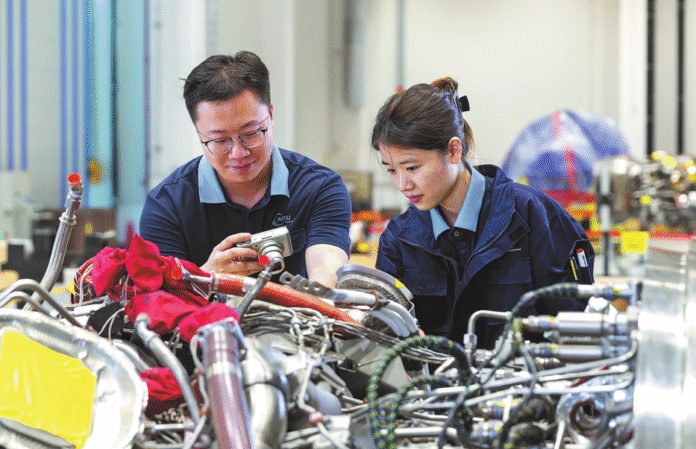
 MTU technicians repair engines. CHINA DAILY

Located in the heart of one of Asia’s most dynamic aviation clusters, MTU Maintenance Zhuhai has grown into China’s market leader for commercial aircraft engine maintenance, repair and overhaul, known as MRO.

 As a joint venture between MTU Aero Engines and China Southern Airlines, where each holds a 50 percent stake, the company represents more than two decades of close cooperation, technological progress and shared ambition.

 What started in 2001 with a vision to build a reliable MRO foothold in China has since evolved into one of the world’s fastest-growing centers for narrow-body aircraft engine maintenance.

 Today, the joint venture operates two advanced facilities in Zhuhai, a city in the Guangdong-Hong Kong-Macao Greater Bay Area, offering a combined technical capacity of more than 700 shop visits per year, making MTU Maintenance Zhuhai one of the largest MRO operations worldwide.

Shared vision

 The partnership between MTU and China Southern Airlines is one of the most successful collaborations in China’s aviation industry.

 China Southern Airlines, the country’s largest airline group, brings not only scale but an in-depth understanding of regional requirements, regulatory frameworks, and customer needs.

 MTU contributes more than 90 years of aero-engine experience, along with over 45 years of MRO specialization and a global team of over 13,000 engine experts.

 As a part of the MTU Aero Engines group, MTU Maintenance is the world leader in tailor-made MRO services, integrated leasing and asset management. It combines cutting-edge maintenance services with in-depth market understanding to provide customers with optimal aftermarket solutions for more than 30 engine models — the industry’s largest portfolio, according to the company.

 With locations in the Americas, Europe, Australia and Asia, as well as capabilities for on-site and near-wing services, MTU Maintenance and its more than 7,000 engine experts turn their passion for engines into top-quality performance and one-of-a-kind customer value, said a company statement.

 This complementary expertise of its shareholders has allowed MTU Maintenance Zhuhai to establish itself as a trusted, high-performance MRO provider serving airlines across China, Asia and beyond. The joint venture agreement was extended in 2018 through 2050, underscoring the long-term commitment of both partners to China’s growing aviation market.

 Gert Wagner, president and CEO of MTU Maintenance Zhuhai, emphasizes the significance of this partnership: “Our collaboration with China Southern Airlines is the foundation of our success. The trust and technical competence we share allow us to deliver world-class engine MRO services while supporting the long-term development of China’s aviation industry.”

Balanced portfolio

 MTU Maintenance Zhuhai focuses on the most widely used narrow-body engine types in global and regional fleets. Its portfolio covers CFM International engines — the CFM56-5B, CFM56-7B, LEAP-1A, and LEAP-1B — as well as the IAE V2500-A5 and the PW1100G-JM from Pratt & Whitney’s GTF engine family.

 This balanced mix supports both legacy fleets and next-generation aircraft, ensuring stable, long-term demand for MRO services.

 With over 5,000 completed shop visits since its inception, MTU Maintenance Zhuhai has achieved remarkable throughput improvements. The most recent 1,000-engine milestone was reached in under two years — faster than any previous period — a result made possible by targeted training initiatives, process optimization, and additional capacity provided by the new Jinwan facility, its second facility in Zhuhai.

 Advantageous location

 Both facilities located in Zhuhai benefit from efficient customs procedures, bonded goods policies and the absence of import restrictions. These special advantages help reduce turnaround times — one of the most critical key performance indicators for airline customers — and enable smooth logistics for international operations.

 Among all cities in the Greater Bay Area, Zhuhai’s geographic position strengthens its appeal. Located within Asia’s aviation industry hub, international airports such as Hong Kong, Shenzhen, Guangzhou and Macao are all within a two-hour radius, allowing rapid connections and efficient customer support.

 The region also offers a highly skilled workforce, supported by a fast-growing economy and government backing for high-technology industries.

 Jinwan facility

 To keep pace with market growth — especially among airlines expanding their Airbus A320neo fleets — the joint venture opened its second facility in March 2025 in Jinwan, just 20 kilometers from the original site. This new facility specializes in the PW1100G-JM, representing one of the aviation sector’s most advanced engines.

 The Jinwan site currently supports an annual capacity of up to 260 engine shop visits, employs around 300 highly trained specialists, and is expected to grow to 600 employees as demand increases.

 With more than 30,000 square meters of modern workspace — including disassembly and assembly lines, parts-cleaning areas, inspection zones, and a second state-of-the-art test cell — this facility significantly expands MTU Maintenance Zhuhai’s ability to serve modern fleets.

 “Building and ramping up a facility of this scale in such a short time was only possible through outstanding cooperation with our partner, China Southern Airlines. Their operational experience and strategic support were essential throughout the entire process,” Wagner said.

 Technology, capabilities

 The combined capabilities of both facilities cover the full spectrum of MRO services required for modern narrow-body engines — including CNC machining, grinding, milling and drilling; advanced inspection technologies such as immersion ultrasonic, eddy current and phased array ultrasonic tests; electrochemical stripping, heat treatment, plasma and high-velocity oxygen fuel coating, vacuum brazing, and other specialized repair processes — just to name a few.

 MTU Maintenance Zhuhai also operates one of the world’s largest and most advanced test cells, enabling full-thrust engine testing under controlled conditions with high precision and reliability.

 Talent development

 Highly qualified employees are the backbone of the company’s operational excellence.

 In 2023, MTU Maintenance Zhuhai opened a dedicated training center capable of educating up to 100 mechanics per year, combining classroom instruction with hands-on training inside the workshops and across the global MTU network. Its talent development model integrates international best practices with local educational partnerships, including cooperation with aviation universities.

 With its dual facility setup, expanding engine portfolio and long-term joint venture framework, MTU Maintenance Zhuhai is well-positioned to become the world’s largest MRO provider for narrow-body engines.

 To achieve this, the company is focused on delivering high-quality, safe and cost-efficient engine maintenance solutions while continuing to innovate and strengthen its workforce.

 The partnership between MTU and China Southern Airlines will continue to play a central role in this journey. As global fleet growth accelerates and next-generation engines become the new standard, MTU Maintenance Zhuhai said it is set to remain a pillar of Asia’s aviation infrastructure for decades to come.

Article inline ad