Wednesday, November 25, 2026

Home Blog Page 101

Financial Regulator Committed To Avoiding Major Risks And Ensuring Stability

0

By Jiang Xueqing | chinadaily.com.cn | Updated: 2026-01-16

China’s top financial regulator underscored the critical importance of strictly holding the bottom line of preventing major financial risks at the 2026 regulatory work conference of the National Financial Regulatory Administration on Thursday.

 The meeting called for strong, orderly, and effective efforts to advance the resolution of risks at small and medium-sized financial institutions, with a focus on addressing existing risks, resolutely curbing new risks, and avoiding the pitfalls of major financial risks. It also urged the steady promotion of the normalized operation of the city-level real estate financing coordination mechanism to help build a new model for real estate development, and the provision of lawful and compliant support for resolving debt risks at financing platforms.

 Additionally, the meeting stressed the need to enhance the financial industry’s capacity for high-quality development, steadily advance the reduction in number and improvement in quality of small and medium-sized financial institutions, rationally optimize the institutional layout, thoroughly address disorderly competition, and urge banking and insurance institutions to focus on their core businesses and pursue differentiated development, while advancing high-standard financial opening-up.

 The meeting also called for strengthening financial supply to promote consumption and expand investment, and for providing efficient support for the strategy of expanding domestic demand. Moreover, the meeting emphasized optimizing financial services for technological innovation, actively fostering patient capital to support the development of new quality productive forces, better leveraging the financing coordination mechanism for small and micro enterprises, and improving financial services for new forms of employment.

 The NFRA meeting reinforced the directives from the annual Central Economic Work Conference in December that highlighted the need for China to adopt a firm stance in 2026 on safeguarding against risks in key areas.

 Efforts should focus on stabilizing the real estate market by implementing city-specific measures to control new construction, reduce inventory, and optimize supply. Local government debt risks must be addressed proactively and orderly, the Central Economic Work Conference said.

 jiangxueqing@chinadaily.com.cn


Article inline ad

Insurance Funds Ramp Up Bets On Equities

0

Report: ’25 stake disclosures hit 10-year high; ’26 inflows may top 1 trillion yuan

By Jiang Xueqing | China Daily | Updated: 2026-01-16

Driven by both policy incentives and potential healthy returns, insurance funds have shown heightened activity in the equities market. In 2025, such funds triggered mandatory stake disclosures in listed companies at their highest frequency since 2016.

 Financial industry professionals expect insurance funds to further ramp up their equity exposure. Zhao Ran, an analyst at CSC Financial Co Ltd, said in a report that under pessimistic, neutral and optimistic scenarios, insurance funds’ equity allocations in 2026 are projected to rise by approximately 968.1 billion yuan ($139 billion), 1.07 trillion yuan and 1.18 trillion yuan, respectively.

 In recent years, financial regulators have stepped up efforts to support insurers’ participation in the equity market by introducing a series of measures, including promoting long-cycle performance evaluation mechanisms, raising the upper limit on the allocation ratio of equity assets in insurance funds, and expanding channels for medium and long-term capital to enter the market.

 Meanwhile, amid a low-interest-rate environment, increasing allocations to the equity market also reflect insurers’ pursuit of yield flexibility and risk mitigation against interest spread losses, analysts said.

 In terms of investment targets, bank-related shares have emerged as a key focus for insurance funds, as their low valuations and high dividend yields align well with insurers’ preference for stability.

 Ping An Life Insurance recently announced that Ping An Asset Management, acting on its behalf, invested in Hong Kong-listed shares (H shares) of Agricultural Bank of China. On Dec 30, its holdings exceeded 20 percent of the bank’s H-share capital, triggering a mandatory disclosure requirement under Hong Kong market regulations.

 In addition, Ping An Life increased its holdings of Postal Savings Bank of China’s H shares in 2025, lifting its stake above 16 percent. The company also triggered stake disclosures in China Merchants Bank’s H shares four times in 2025, with its shareholding exceeding 20 percent.

 Excluding repeated disclosures by the same entity, insurance funds triggered stake disclosures 31 times in 2025. Including repeated disclosures, the number reached at least 38, second only to 2015, said a report released by Hua Chuang Securities on Jan 5.

 Insurance funds showed a clear preference for H shares last year, triggering 26 disclosures in stocks characterized by low valuations and high dividend yields. Investments were mainly concentrated in the banking and utilities sectors, the report said.

 Chen Haiye, an analyst at Hua Chuang Securities, said insurers’ stakebuilding activities can generally be divided into two categories. One is dividend-driven, with a preference for counters offering relatively stable future dividend cash-flow expectations. The other is driven by return on equity considerations, favoring central and State-owned enterprises with mature profit models, which are incorporated as high-quality assets through long-term equity investments.

 Referring to the full-year 2026, Chen said demand from both categories is likely to persist, and the wave of stakebuilding by insurance funds may continue.

 Executives at Ping An Insurance (Group) Co of China said the company continues to focus on high-dividend, high-payout investment targets, while also actively seeking and deploying quality assets related to new quality productive forces.

 Michael Guo Xiaotao, co-CEO and senior vice-president of Ping An Group, said at the company’s 2025 interim results briefing that as borrowing costs continue to decline and asset allocation is further optimized, the company will dynamically balance high-dividend shares, value shares and growth shares to seize opportunities in the capital markets.

 Yang Xiaotian, a researcher at Hualong Securities, said in a report that by moderately increasing equity investment ratios, insurers can enhance the elasticity of their returns. Long-term investments in high-ROE, high-dividend listed companies can generate more predictable dividend income and strengthen the safety buffer of net investment returns.

 jiangxueqing@chinadaily.com.cn

Article inline ad

More Localities To Have Say In Bond-Funded Projects

0

By Wang Keju | China Daily | Updated: 2026-01-16

China is expected to allow more local governments to review and approve projects funded by special-purpose bonds this year, analysts said, as policymakers vow to “halt the decline in investment and promote its recovery” amid a complex external environment.

 The analysts’ comments came after a yearlong pilot program that granted 10 provincial-level regions greater say in fast-tracking their special-purpose bond projects showed initial progress, paving the way for a potential expansion of the initiative to more localities this year.

 The move also aligns with the decisions made at the Central Economic Work Conference in December, which called for optimizing the management of local government special-purpose bonds.

 In late 2024, the State Council, China’s Cabinet, said in a notice that it would give provincial-level regions, including Beijing, Shanghai, Guangdong, Fujian, Shandong, as well as Xiong’an New Area in Hebei province, the authority to approve such bond-funded projects locally.

 Prior to that, localities needed to seek approval from the National Development and Reform Commission, the country’s top economic regulator, and the Finance Ministry, before selling the bonds.

 Special-purpose bonds are issued to fund specific infrastructure projects, such as highways and industrial parks, that are expected to be market-operable and revenue-generating. Repayment is usually supported by the income generated after project completion.

 An official at the Office of the Central Commission for Financial and Economic Affairs said in December that the government needs to effectively drive investment by making good use of funding sources such as local government special bonds.

 An official from the debt management office of the Fujian provincial department of finance said, “We have streamlined the project review process. This shortens the application chain, simplifies management procedures, reduces communication costs and improves review efficiency.”

 “The progress of new special-purpose bond issuance in the aforementioned regions is notably faster than in non-pilot areas,” said Yuan Haixia, dean of the research institute at China Chengxin International Credit Rating.

 Yuan noted that in the first three quarters of 2025, the 10 provincial-level regions had issued an average of 94 percent of their annual special-purpose bond quotas, 25 percentage points higher than provinces outside the pilot program.

 The delegation of approval authority and the accelerated issuance timeline in no way indicate a relaxation of the review standards.

 An official from the Shandong provincial department of finance explained that compared to before the pilot, the province’s review criteria have actually become stricter and more rigorous. Projects that exceed fiscal capacity, lack balanced financing returns, or which do not align with required investment areas will not be approved.

 Additionally, various regions have driven down the interest rates for special-purpose bond issuance, reducing financing costs and alleviating interest burdens through measures such as assessing market conditions, optimizing issuance timing and adopting differentiated pricing strategies.

 Data show that the weighted average interest rate for special-purpose bonds in Hunan province stood at 1.99 percent last year, down 34 basis points from 2024.

 Special-purpose bonds have become a pivotal policy instrument for stabilizing investment.

 In light of their critical role, policymakers could consider granting more provincial regions greater autonomy and flexibility in project review and management this year, analysts said.

 The NDRC said in December that it planned to “research and adjust” the scope of the pilot program and refine the mechanism further.

 Local authorities are also expected to front-load the issuance of the special-purpose bonds to generate economic gains as quickly as possible, setting the stage for a sustained economic recovery, said Wen Bin, chief economist at China Minsheng Bank.

 In October, the Finance Ministry said it would move promptly to advance the issuance of the 2026 new local government debt quota. This will help local authorities to better support the funding needs of key projects in the first quarter of 2026.

 This year marks the start of the 15th Five-Year Plan period (2026-30), with a substantial pipeline of key projects in infrastructure and public welfare requiring urgent funding. The early allocation of debt quotas will ensure sufficient financial support for project launch in the first quarter, Wen added.

 wangkeju@chinadaily.com.cn

Article inline ad

PBOC Cuts Rates On Targeted Monetary Tools

0

By Zhou Lanxu | chinadaily.com.cn | Updated: 2026-01-16

China will cut interest rates on targeted monetary policy tools and expand related quotas to spur lending in key areas and improve market expectations, underscoring policymakers’ resolve to support a solid economic start to the 15th Five-Year Plan (2026-30) period, officials and experts said.

 Zou Lan, vice-governor of the People’s Bank of China, said on Thursday that the central bank will reduce interest rates of various structural monetary instruments by 0.25 percentage points as it implements a moderately accommodative monetary policy, with the one-year rate on central bank lending facilities to be lowered from 1.5 percent to 1.25 percent.

 Interest rates for other maturities will be adjusted accordingly, with effect from Monday.

 Speaking at a news conference, Zou said the quota of key structural monetary instruments will be expanded. This includes a central bank lending quota worth 1 trillion yuan ($143.4 billion) to support small and medium-sized private companies, and a 400 billion yuan increase in the central bank lending quota for technological innovation and upgrades, bringing the total to 1.2 trillion yuan.

 In terms of broad-based easing measures, Zou said there remains room this year for benchmark interest rate cuts and reductions in the reserve requirement ratio, or RRR — the proportion of deposits that banks must hold as reserves, which now stands at 6.3 percent on average.

 “Overall, the exchange rate does not pose a strong constraint (on interest rate cuts),” Zou said. Domestically, he said that net interest margins of banks started to stabilize in 2025, and that the latest reduction in rates on structural policy tools will further lower funding costs of banks, making room for broad-based rate cuts.

 Lou Feipeng, a researcher at the Postal Savings Bank of China, said the policy package has sent a clear signal of targeted easing, helping anchor market expectations while strengthening the precision and sustainability of financial support for the real economy.

 “With banks’ net interest margins stabilizing and about 50 trillion yuan of medium- to long-term deposits set to mature in 2026, expectations for a first-quarter RRR cut have strengthened. Heavy government bond issuance in January and related liquidity demand could further raise the odds of such a move,” Lou said.

 Zou, the central bank vice-governor, vowed to increase liquidity injections and flexibly conduct open market operations of buying and selling government bonds to create a supportive monetary and financial environment for the smooth issuance of government debt.

 Zou added that the minimum down payment ratio for loans to purchase commercial properties will be lowered to 30 percent to help reduce inventory in the commercial real estate market.

 Ming Ming, chief economist at CITIC Securities, said, “Given current capital market conditions, the new policies — cutting rates on structural tools while keeping an active tone on broad-based measures — will serve the dual goals of stabilizing market expectations and preventing asset bubbles.”

 According to Zou, the renminbi exchange rate is expected to continue “moving in both directions with flexibility”, with China’s vast market and complete industrial chain to help offset external uncertainties.

Article inline ad

China To Advance Multinationals’ Cross-Border Cash Management

0

By Zhou Lanxu | chinadaily.com.cn | Updated: 2026-01-15

China will roll out nationwide policies to facilitate centralized cross-border cash management by medium-sized multinational companies, while stepping up reforms on foreign exchange administration for both direct and securities investment, an official said, as part of efforts to deepen institutional opening-up under the capital account.

 Xiao Sheng, head of the Capital Account Management Department of the State Administration of Foreign Exchange, said China has recently expanded nationwide the integrated renminbi and foreign currency cash pooling program, which applies to large or mega multinationals.

 A separate set of policies for medium-sized multinationals on centralized cross-border fund operations will be rolled out nationwide this year, supporting more companies in managing cross-border funds flexibly and efficiently while boosting the development of the headquarters economy, Xiao said at a news conference on Thursday.

 On foreign direct investment, Xiao said SAFE will push ahead with forex management reforms by simplifying related registration procedures and facilitating the use of investment funds, better supporting foreign businesses’ expansion in China.

 SAFE will also revise rules on integrated renminbi and foreign currency management for domestic firms’ provision of funds to overseas affiliates to support companies going global, helping lower costs and improve efficiency, he added.

 On securities investment, Xiao said regulators will further study improvements to cross-border cash policies for qualified foreign institutional investors, continue to issue investment quotas in an orderly manner for qualified domestic institutional investors, and work with relevant departments to advance stock and bond connectivity programs, further enhancing two-way opening-up of China’s financial markets.

Article inline ad

Zhanjiang’s ‘Four Green Plus One Blue’ Strategy Boosts Economy

0

By Li Wenfang and Zheng Caixiong | chinadaily.com.cn | Updated: 2026-01-15

Zhanjiang, a coastal city in Guangdong province, has been promoting a development strategy focused on what local officials describe as “Four Green plus One Blue Industries”, covering green steel, petrochemicals, energy, food production, and the marine economy.

 At a news conference in Guangzhou on Thursday, Zhanjiang Mayor Li Yongyi said the city had made progress in building industrial clusters around green petrochemicals and modern agriculture and food processing. According to Li, the annual output value of each of these sectors exceeded 100 billion yuan ($14.3 billion) last year.

 Li said the city’s overall economic strength had improved, supported by several large-scale industrial projects that have either entered production or moved forward in construction.

 These included the BASF Zhanjiang Verbund project, Baosteel Zhanjiang, the Zhongke (Guangdong) Refinery and Petrochemical project, the Lianjiang nuclear power project, and the Xuwen offshore wind power plant.

 Zhanjiang’s gross regional product is expected to exceed 400 billion yuan in 2025, while industrial added value is projected to surpass 100 billion yuan. The growth rate of the industrial added value of enterprises above a designated size is expected to achieve double-digit growth.

 Zhanjiang currently ranks first in Guangdong in terms of the scale of grid-connected centralized onshore wind power and photovoltaic power, and places among the province’s top three cities for competitiveness in the marine economy.

 Located in the Leizhou Peninsula, Zhanjiang borders the South China Sea on three sides and has the longest coastline in Guangdong. The city is also adjacent to the Guangxi Zhuang autonomous region and faces Hainan Island, factors local officials say give it advantages in marine industries and potential for seaside tourism development.


Article inline ad

Agibot Gains Lead In World Humanoid Robot Uptrend

0

Shanghai-based firm rides generative AI tools to capture 39% of global mkt share

By MA SI and CHEN BOWEN in Haikou | China Daily | Updated: 2026-01-15

The global humanoid robot industry witnessed a remarkable surge in 2025, with Chinese manufacturers, led by Shanghai-based AgiBot — also known as Zhiyuan Robotics — surging to the forefront on both commercial deployment and technological prowess, according to a report by market research firm Omdia.

 The comprehensive analysis, which systematically evaluates market trends, key commercial metrics and overall technical capabilities, positions China at the helm of this transformative sector. AgiBot emerged as the global leader, clinching the top spot worldwide in both annual shipments and market share.

 Omdia’s report highlights that the global humanoid robot market entered a phase of rapid expansion in 2025, with total annual shipments estimated to reach 13,000 units. Chinese companies demonstrated exceptional performance in scaled manufacturing and delivery.

 AgiBot stood out with annual shipments exceeding 5,100 units, capturing over 39 percent of global market share. This dual achievement in volume and market penetration solidifies its number-one ranking globally, the report said.

 The company’s success is underpinned by a diversified product portfolio covering full-sized, semi-sized and wheeled variants. More importantly, AgiBot has successfully transitioned from technological validation to batch delivery, achieving commercial deployment across multiple core scenarios. These include commercial performances and entertainment, guided tours and retail, intelligent industrial manufacturing, scientific research and education, and data collection for AI training, AgiBot said.

 The report identifies the deep integration of generative artificial intelligence and robotics as a key catalyst, propelling robots beyond executing preset tasks toward becoming “general-purpose embodied intelligence” capable of autonomous learning and environmental adaptation.

 The long-term outlook is notably rosy. Omdia forecasts an exponential growth trajectory for the humanoid robot market over the next decade. By 2035, global annual shipments are expected to skyrocket to approximately 2.6 million units.

 The findings of the Omdia report signal a pivotal shift in the global high-tech manufacturing arena, highlighting China’s ascendant role in defining the future of intelligent robotics. With Chinese companies setting the pace in both innovation and market execution, the era of humanoid robots is moving decisively from laboratory prototypes to integral components of the global industrial and service sectors, experts said.

 Yao Maoqing, a partner at AgiBot and president of its embodied intelligence business unit, said the company began product deliveries to overseas customers in 2025, and it will ratchet up resources to explore markets such as North America, Europe, the Middle East, Japan, South Korea and Southeast Asia.

 AgiBot on Tuesday inaugurated its first overseas robot experience center in Malaysia, positioning it as a pivotal move in its globalization strategy and Asia-Pacific market entry.

 The facility is not only AgiBot’s inaugural experience center outside China, but also Malaysia’s first AI robot experience hub.

 Deng Feng, general manager of AgiBot’s Middle East and Asia-Pacific Region, highlighted the company’s products, solutions and competitive advantages for the brand in the region. He emphasized that the global AI industry is experiencing explosive growth, with the Asia-Pacific region serving as a key driver and primary growth engine for humanoid robotics.

 “To seize this opportunity, AgiBot will significantly lower the barrier to entry for partners by providing full-stack software and hardware technology along with support for mass production,” Deng said.

 The company adopts a dual-drive approach of “technology ecosystem plus business ecosystem” to precisely cater to diverse scenarios, including education, scientific research, manufacturing and services.

 Li Lecheng, minister of industry and information technology, said in an interview earlier this week that China’s industrial growth will increasingly rely on “value creation” and “winning through quality”, with key sectors — including AI — set to be the focus of policy support this year.

 Highlighting China’s competitive advantages, particularly in scaling technology applications, Li pointed to the country’s vast landscape for innovation.

 “Our talent advantage is very evident, especially our strength in scenario applications — there are so many innovative activities,” Li said.

 He singled out AI as a critical area for rapid advancement.

 “We must swiftly leverage our strengths in application scenarios, foundational resources, talent and even our institutional mechanisms to push AI development forward,” Li added.

 Local governments are also moving fast. The Hainan provincial government said it will focus on cultivating future industries and building new engines for development in 2026. In the field of embodied intelligence, Hainan will proactively plan for “brain-like models” tailored to unique application scenarios such as deep-sea exploration and tourism, and develop a variety of embodied intelligent robots, including underwater robots and cultural tourism consumer robots.

 Seeing the potential, Beijing Galbot Co Ltd recently established a unit in Hainan, with a business scope covering the manufacturing of service and consumer robots, the research and development of intelligent robots, and the production of industrial robots.

Article inline ad

Chinese Firms Showcase Tech Vitality, Innovation At 2026 CES

0

Annual event in Las Vegas attracts more than 4,500 exhibitors from over 150 countries, regions

By Fan Feifei | China Daily | Updated: 2026-01-15

Chinese technology companies demonstrated their latest technological achievements and innovative products, including artificial intelligence, robots, wearable devices and immersive entertainment products, at the 2026 Consumer Electronics Show, the world’s premier tech show in Las Vegas, the United States.

 The annual event, which concluded on Friday, drew more than 4,500 exhibitors from over 150 countries and regions, including about 1,400 startups. More than 1,000 Chinese enterprises participated in the show, accounting for about 32 percent of the total registered exhibitors.

 Industry experts said this robust participation underscores the growing strengths and independent innovation capabilities of Chinese companies in cutting-edge technologies and emerging fields, and competitiveness on the global stage, as well as their willingness to expand international cooperation.

 They added that the presence of Chinese companies at CES also demonstrates that they are not only playing an increasingly pivotal role in spearheading the revolution in the global consumer electronics sector, but also stepping up efforts to expand their presence in overseas markets.

 In addition, artificial intelligence technology has sped up its application in a wide range of hardware devices, ranging from smart home appliances, humanoid robots, smart glasses, smartphones, toys and electric vehicles, and attracted widespread attention during this year’s event.

Chinese tech company Dreame Technology presented a slew of new products covering intelligent household appliances, intelligent cleaning, smart kitchen appliances, personal care products, and smart gardening and intelligent audiovisual devices.

 With an exhibition area spanning more than 2,000 square meters, the company debuted several innovation achievements for the first time, including embodied intelligence robotic vacuums and robotic mowers.

 Yu Hao, founder and CEO of Dreame Technology, said the company aims to deliver an intelligent experience for users through its whole-home intelligent ecosystem, adding that with capabilities in scenario awareness and intelligent coordination, the products could provide around-the-clock proactive services with minimal user intervention, helping users save a lot of time and energy.

 As intelligent algorithm capabilities and ecosystem collaboration continue to evolve, AI will increasingly become a key driving force of the whole-home smart ecosystem, bringing a smarter and more efficient living experience for people, the company said.

 Looking ahead, it will step up research and development investment in core technologies and continue to advance the deep application of embodied intelligence in home scenarios, strengthen core capabilities in terms of perception, decision making and execution, and drive breakthroughs in robotic vacuum cleaners, washing machines and lawn mowers.

 Chinese consumer electronics maker TCL showcased various innovative intelligent gadgets, such as SQD-Mini LED TVs, the world’s first printed OLED vehicle-mounted displays, augmented reality glasses, AI-powered home appliances and companion robots.

 The company is accelerating steps to expand its footprint abroad. It has established R&D center in Silicon Valley and built manufacturing facilities in Mexico, providing strong support for its North American business. The TV shipments of TCL rank second in the North American market by depending on localized R&D, manufacturing and marketing.

 TCL said it will further increase capital input in R&D, with a focus on the application of AI and next-generation displays, while bolstering innovation of fundamental and cutting-edge technologies.

 Zhu Keli, founding director of the China Institute of New Economy, said by participating in the world’s biggest consumer electronics show, Chinese tech companies can not only boost brand awareness and influence globally and speed up integration into global innovation networks, but also let overseas consumers understand their technological prowess and innovation capabilities in emerging technologies.

 Meanwhile, these companies can learn about the latest industry trends and market demand, deepen international cooperation, break down overseas technological barriers and enhance their participation and influence in shaping global industrial rules.

 “AI technology has transitioned from conceptualization to practical application and been deeply integrated into core functions of products,” Zhu said, highlighting that leading Chinese tech companies are accelerating their global layouts through establishing R&D centers and manufacturing bases overseas and collaborating with international enterprises.

 BOE Technology Group, a major Chinese display panel manufacturer, displayed more than 60 cutting-edge display and internet of things solutions, including a smart cockpit, 17-inch OLED curved screens, vehicle-mounted displays and AI-powered products covering smart wearables, education and entertainment applications.

 Chinese home appliances manufacturer Hisense Group unveiled its latest RGB-Mini LED TVs equipped with self-developed imaging chips, laser projectors, household appliance products powered by its own Xinghai large language models, as well as humanoid robotics at the CES.

 According to the latest data released by market research company Omdia, Hisense has taken the top spot globally in the shipments of 100-inch-plus TV segments with a 56.6 percent market share in the third quarter of 2025, and in the laser TV segment, it accounted for a 68.9 percent share.

 Experts said the tech show is not only a demonstration of products, but also reflects the immense vitality and innovation resilience of China’s technology industry.

 Hong Yong, an associate researcher at the Chinese Academy of International Trade and Economic Cooperation, said Chinese companies are at the global forefront of technological innovation and have made remarkable progress in tech frontiers, such as AI, AR, robotics and smart home devices.

 The move will help boost their competitiveness globally and drive the transformation from “Made in China” to “Created in China”, Hong said, adding Chinese companies are promoting the application of AI in consumer electronics and intelligent terminal devices.

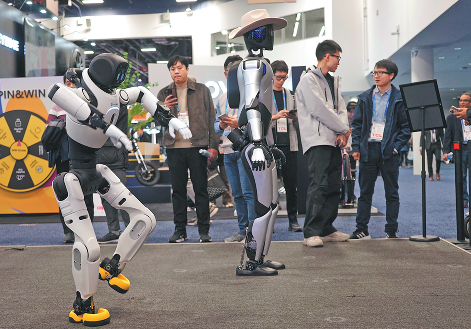
 Humanoid robots and AR glasses have also attracted a lot of attention this year. Chinese robotics company Unitree Robotics showcased its humanoid robot portfolios, such as the G1, which features high-speed martial arts and boxing-style movements, emphasizing balance, agility and motor control.

 Shanghai-based robotics firm AgiBot presented its full lineup of embodied robots for real-world deployment. The portfolio includes the A2 Series, full-sized humanoids enabling multimodal interaction and autonomous navigation for guided presentations and showroom spaces.

 Yao Maoqing, partner at the company and president of its embodied business unit, said: “Bringing our full robotics portfolio to CES marks a defining moment for AgiBot … It demonstrates how we are able to build an ecosystem of humanoid robots, not for a single task or setting, but for a future where embodied intelligence can serve people across industries, environments, and everyday life.”

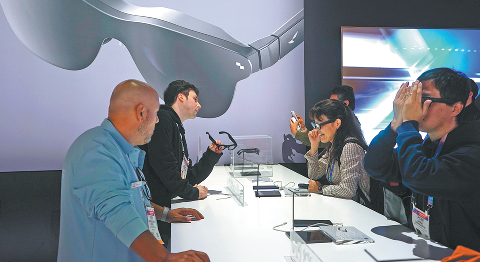
 RayNeo, a Chinese augmented reality technology company, unveiled its AR glasses Air 4 Pro at the CES. Combining cutting-edge optical technology with audio performance, it delivers a private cinema-like experience in a lightweight, wearable form, and is positioned as a “new form of head-mounted TV”, the company said.

 Pan Xuefei, research director at market consultancy IDC China, said AI models will bring about abundant application scenarios for smart glasses, while these AR glasses’ multimodal interaction functions covering text, images, audio and video will further improve.

 Pan said that advances in core components such as AR and VR chips, camera modules and display technologies will drive down costs significantly, accelerating the mass adoption of AI glasses among consumers.

 “Chinese firms are continuously enhancing their products and technologies to meet the increasingly diverse demands of global consumers and secure a larger share of the mid to high-end markets overseas,” said Pan Helin, a member of the Expert Committee for Information and Communication Economy, which is part of the Ministry of Industry and Information Technology.

 The application scenarios of AI are expanding to an array of intelligent terminals such as personal computers, smartphones, smart speakers, tablets and smart home devices, which will become a new growth driver for the global consumer electronics industry, he added.

Article inline ad

Foldables Set To Show Steady Growth

0

By Fan Feifei | China Daily | Updated: 2026-01-15

China’s foldable smartphone market is poised for steady growth this year, driven by the gradual improvement of flexible screens, design innovations and rollout of new products, experts said.

 Data from market consultancy Sigmaintell Consulting show that shipments of foldable screens in the Chinese market are likely to rise from about 10 million units in 2025 to 12 million units in 2026, given that Apple is expected to launch its long-awaited foldable iPhone.

 Chen Jun, executive deputy general manager and chief analyst at Sigmaintell, said the prices of foldable smartphones are relatively high currently due to the high supply chain costs, and that foldables produced by some domestic phone makers are priced at around 9,000 yuan ($1,300).

 Chen forecasted that the prices of foldables will not drop significantly in the short term and will continue to maintain an upward trajectory, as there is a noticeable increase in the prices of smartphones’ internal storage and chips.

 Shipments of global foldable panels are projected to grow from around 17 million units in 2025 to about 24 million units in 2026, Chen said, adding that book-type foldables have a higher acceptance among consumers compared to clamshell-style foldable handsets.

 Global foldable smartphone panel shipments are expected to grow 46 percent year-on-year in 2026, driven by Apple’s procurement for its first foldable, according to a report released by market consultancy Counterpoint Research.

 “Apple is the key driver as it starts to procure panels for its first foldable iPhone,” said Guillaume Chansin, associate director of Counterpoint Research. “We also think a foldable iPhone is going to reinvigorate the broader market, helping to massively grow panel shipments in 2026.”

 In terms of form factors, panel shipments will move in sync with smartphone trends, with book-type panels solidifying their dominant position in 2026, the report said.

 “We are moving into a new era where book-type foldables will be the main form factor for the segment,” Chansin said. “This is significant for the foldable panel sector on several levels. It means we will see a material bump in average selling prices next year, and it is also a huge boon for Samsung Display, which will see its market share rise past the 50 percent mark.”

 The consultancy expected global foldable smartphone shipments to grow 14 percent year-on-year in 2025 and to grow 38 percent in 2026, with the book-type form factor dominating.

 Book-type models have led the expansion of global foldable smartphone shipments, fueled by the launch of Samsung’s Galaxy Z Fold 7 and the continued strength of Huawei’s Mate X series.

 It noted that this shift is also happening in China, with book-type phones becoming the main foldable form factor despite higher price points. “Consumers want tablet-like productivity and all the other benefits big screens bring, and this is pushing buyers toward larger inner displays and the improved usability of book-type designs,” said Liz Lee, associate director at the consultancy.

 Moreover, artificial intelligence has quickly become part of the smartphone discussion, sparking new interest in next-generation AI experiences on handheld devices, industry insiders said.

 Among the many smartphone focus areas of the past decade, foldables stand out because they offer something highly tangible consumers can see and feel. In a market where it has become harder for consumers to perceive major upgrades, the display is one of the highly noticeable last frontiers, said market research company Omdia.

 Foldable smartphones are a proving ground for whether hardware research and development can still deliver meaningful differentiation in an industry where the gravitational pull is shifting toward software, AI and services as the core revenue drivers, Omdia added.

 It identified Apple’s potential entry into the foldable market, anticipated for 2026, as the primary catalyst for the next phase of significant growth.”Display suppliers are overcoming these challenges by systematically reducing the thickness of the entire foldable display module,” said Jerry Kang, practice leader at Omdia.

 “After more than six years of manufacturing experience, suppliers have optimized key components like ultrathin glass and supporting films. This not only enables sleeker device designs, but also improves durability, directly addressing key points of consumer resistance and paving the way for wider adoption.”

 An entry from Apple would fundamentally validate the foldable category and ignite demand far beyond the current Android ecosystem, Kang said. “The introduction of a foldable iPhone is expected to expand the entire market and it will be the key inflection point we are forecasting for post-2026 growth.”

Article inline ad

China’s Jiangsu Unveils AI Action Plan To Boost Smart Economy

0

Xinhua | Updated: 2026-01-15

NANJING – East China’s Jiangsu province plans to make the smart economy a key driver of its economic growth, according to a news conference held by the provincial government on Tuesday.

 The Jiangsu provincial government unveiled the “Jiangsu Province Artificial Intelligence (AI) Plus Action Plan” at the conference, outlining its goals for the next few years. By 2030, Jiangsu will achieve a 90 percent adoption rate for new-generation smart terminals and intelligent devices, with the AI industry exceeding a scale of 1 trillion yuan ($142.6 billion).

 Based on the six key actions outlined in the national “AI+” initiative, which focuses on scientific and technological advancements, industrial development, quality consumer goods, public welfare, governance capacity, and global cooperation, Jiangsu’s action plan introduces a new direction for emerging industries. It includes fostering new intelligent business models, supporting the “AI+OPC (one person, one company)” innovation and entrepreneurship model, and positively engaging in strategic emerging industries such as humanoid robots, the low-altitude economy, intelligent driving, biomedicine, and new energy.

 In addition to empowering industries with AI to accelerate the intelligent transformation of sectors such as manufacturing, agriculture and services, Jiangsu will also incorporate artificial intelligence across public services, including education, employment, healthcare, elderly care, transportation, and community services. Applications such as AI-assisted precision medicine and L4 autonomous driving have already been partially implemented, providing citizens with tangible improvements in quality of life and convenience enabled by digitalization and intelligence.

 By 2035, Jiangsu is expected to become a leading hub for AI innovation, industrial development, and integrated applications, marking a new stage in the province’s development into an intelligent economy and society, according to the action plan.

Article inline ad