Wednesday, November 25, 2026

Home Blog Page 121

‘Liquid Gold’, Health Drinks Heating Up Cold Weather

0

By Wang Zhuoqiong | China Daily | Updated: 2025-12-18

A sharp hit of ginger, a squeeze of lemon and a lingering warmth that runs from mouth to belly, turmeric drinks, dubbed “liquid gold” by young consumers, are emerging as hot winter hits in the country, a signal of the rise of health-focused beverages.

 Sales figures from Tmall show that during the Nov 11 shopping festival, which started on Oct 20, sales of turmeric-based “ginger shots” surged 14-fold from the beginning to the end of the buying frenzy. The momentum reflects a broader shift among younger consumers toward so-called “food-as-medicine” products, a category that blends traditional wellness concepts with modern convenience.

 Small-format turmeric drinks have been among the biggest beneficiaries. A 50-milliliter turmeric shot sold by Yololand has recorded more than 50,000 units in online sales, along with brands such as So Acai and Super Morning. Oatly has rolled out a turmeric-flavored oat milk that has also gained traction on e-commerce platforms.

 At stores operated by Hema Fresh, turmeric and ginger-based drinks have secured space alongside juices and functional beverages in refrigerated displays. A high-pressure processed turmeric-ginger-lemon is priced at 8.9 yuan ($1.25).

 Consumers on social media reviews frequently describe the first sip as “spicy”, “pungent” or even “hard to finish”, driven by the strong ginger heat and acidic lemon notes.

 The rise of turmeric drinks is closely tied to growing interest in “natural anti-inflammatory” claims and light wellness management among China’s urban youth, according to industry experts.

 “Turmeric drinks have become a hot topic on social media. But the actual benefits vary widely from person-to-person,” said Jason Yu, general manager of CTR Market Research. “What’s really driving the trend is the underlying demand for managing subhealth conditions, combined with a flavor profile that naturally generates discussion.”

 Yu added that the popularity of ginger shots in Western markets — often marketed as a “superfood” — has helped raise interest in the category in China.

 Still, sustaining growth will not be easy. Zhu Danpeng, a food industry analyst, said the rapid rise of turmeric drinks reflects how novelty-driven consumption shapes the behavior of younger shoppers. “At its core, a beverage still needs to taste good,” Zhu said.

 Turmeric drinks are only one slice of a fast-expanding wellness beverage segment. Industry data point to significant room for growth. According to a report by iiMedia Research, China’s health tea and wellness beverage market is expected to reach 64.27 billion this year, up 25.3 percent from a year earlier, and could surpass 100 billion yuan by 2028.

Article inline ad

Hudong-Zhonghua Achieves Annual Target After Delivering 100th Container Ship

0

By WANG YING | chinadaily.com.cn | Updated: 2025-12-18

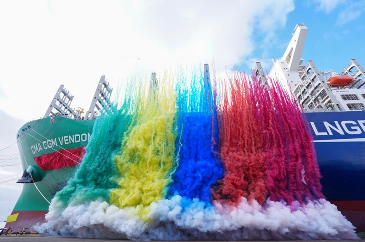
With the delivery of the world’s largest dual-fuel powered container ship to French shipping and logistics group CMA CGM Group, Hudong-Zhonghua Shipbuilding (Group) Co Ltd, a unit of the world’s largest shipbuilder China State Shipbuilding Corp, has announced that it has achieved the milestone of delivering 100 large-scale container ships.

Named CMA CGM Vendome, the ship, which was delivered on December 12, arrives eight and a half months ahead of schedule. It is also the third vessel of its kind that Hudong-Zhonghua has delivered to CMA CGM, each with a capacity of 24,000 TEU (twenty-foot equivalent units), according to the Shanghai-based shipyard.

 Measuring 399 meters in length and 61.3 meters in width, the dual-fuel powered container ship reduces emissions of sulphur and fine particles by 99 percent, nitrogen oxides by 85 percent, and carbon dioxide by about 20 percent compared with conventional vessels.

With the delivery of the world’s largest dual-fuel powered container ship to French shipping and logistics group CMA CGM Group, Hudong-Zhonghua Shipbuilding (Group) Co Ltd, a unit of the world’s largest shipbuilder China State Shipbuilding Corp, announces that it has achieved the milestone of delivering 100 large-scale container ships. [Photo provided to chinadaily.com.cn]

Over more than four decades, Hudong-Zhonghua has built container ships ranging from 1,714 TEUs to ultra-large vessels with a capacity of over 24,000 TEUs.

 Currently, the shipbuilder’s delivery schedule is fully booked through 2028, with 37 container ships planned for construction and delivery.


Article inline ad

Shanghai Waigaoqiao Shipbuilding Meets Annual Delivery Target Early

0

By WANG YING | chinadaily.com.cn | Updated: 2025-12-18

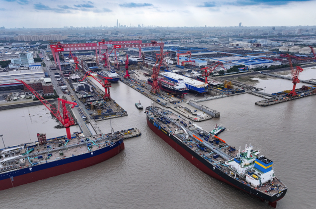
Having a PCTC (pure car and truck carrier) with 9,000 parking spaces and a container ship with a capacity of 7,000 TEUs (twenty-foot equivalent units) undocked on the same day on Tuesday, Shanghai Waigaoqiao Shipbuilding Co Ltd, a subsidiary of the China State Shipbuilding Corp, announced reaching its delivery target ahead of time.

 The achievement has underscored its strong production capacity and the continued success of its mixed-vessel construction model. During the 14th Five-Year Plan period (2021–25), the shipbuilder has focused on three core product lines — large cruise ships, commercial vessels, and offshore engineering equipment — achieving a marked improvement in operating performance and its capital base.

 Over the period, Shanghai Waigaoqiao Shipbuilding delivered 114 vessels and offshore engineering units across 15 different types, including China’s first domestically built large cruise ship, Adora Magic City, which was officially named and delivered on November 4, 2023.

 At the same time, the company has begun to build a cruise ship industrial ecosystem under a “1+100+1,500” framework, comprising one final assembly enterprise, around 100 main contractors, and 1,500 suppliers, in an effort to enhance its capabilities in leading and managing the cruise ship industry chain.

 Shanghai Waigaoqiao Shipbuilding is currently accelerating the construction of China’s second domestically built large cruise ship. The project is running ahead of schedule, with overall progress exceeding 88 percent.

 Compared with the first vessel, the overall construction efficiency of the second cruise ship has improved by about 20 percent, while steady advances have also been made in the localization of the supporting industrial supply chain.

Article inline ad

Canva To Spur Efforts For Digital Uptrend In Nation

0

By Zheng Xin | China Daily | Updated: 2025-12-18

Bolstered by the dynamism of China’s expanding digital economy and its flourishing user base of creative professionals, visual communication platform Canva has been ramping up its long-term commitment to the country, a senior executive of the Sydney-based company said.

 The firm will continue to channel investments into the country over the next three to five years, strategically deploying resources across technology, talent, and localized partnerships to establish an unassailable footing in the competitive market, said Wang Kexin, general manager of Canva China.

 Canva’s ambition is underpinned by the conviction that China represents one of its most critical growth vectors, she said.

 “The Chinese market is full of vitality and creativity, and it has always been one of the markets we value most,” Wang said.

 “China’s vast user base and unique application scenarios not only drive the rapid development of the local market, but also provide operational and product insights that have influenced, and been adopted by, Canva’s global platform.”

 “We aim to combine leading AI technologies with the real needs of Chinese users to make our product more attuned to the Chinese language and cultural context. Some product innovations originally developed to serve Chinese use cases, such as advanced Chinese font effects, have been incorporated into the global platform,” she said.

 According to Wang, the push into China is driven by technology, with artificial intelligence identified as the core weapon in its drive for “design equality”.

 Wang confirmed a collaborative approach with local tech leaders, actively forging alliances with Chinese AI platforms to refine its product functions rapidly for the distinct needs of the local user base.

 Since its entry into China in 2018, the company has witnessed fast adoption backed by the market’s huge user base. It has secured key strategic agreements, notably a technology partnership on the HarmonyOS system, and expanded its enterprise customer base across a range of industries, including catering, retail, the automotive sector and e-commerce businesses serving overseas markets.

 Industry experts believe China’s pledge to stabilize foreign trade and attract foreign investment also provides significant tailwinds, as the nation vows to further lower market entry barriers for foreign investment and expand market access for foreign businesses.

 Bai Ming, a researcher at the Chinese Academy of International Trade and Economic Cooperation, said allowing more foreign involvement in the services sector helps introduce cutting-edge technologies and advanced management methods, which, in turn, pressures domestic firms to modernize and boost their overall competitive edge.

 Further, as more Chinese companies take their brands overseas to tell their stories, Canva’s global resources can provide seasonal, on-trend services for brand premium, helping local Chinese enterprises go global, Wang said.

 “With the deepening application of AI, we provide customized generation services for enterprises. This ensures that employees can produce brand-aligned visual content through simple instructions, reducing repetitive tasks to focus more on strategy and innovation,” Wang said.

Article inline ad

German Firms Amplify Innovation-Focused Investments

0

China Daily | Updated: 2025-12-18

HEFEI — At BSH Home Appliances Group’s dishwasher factory in Chuzhou, Anhui province in East China, fully automated AGV (automated guided vehicle) robots shuttle components along precise routes, while AI-powered quality inspection systems detect microscopic flaws at high speed. A large screen displays real-time production status with colored dots — a vivid symbol of intelligence and innovation that defines this facility.

 Established in 1995, BSH Home Appliances has continuously expanded investments in China, with its Chuzhou base now the group’s largest global production site by area.

 “China is not only a big market, but also a showcase for innovations,” said Oliver Giersberg, senior vice-president and chief operating officer of BSH Home Appliances Greater China, in an exclusive interview with Xinhua News Agency.

 As one of the earliest foreign appliance manufacturers to enter China, BSH, owner of brands like Siemens and Bosch, has evolved over 30 years from pure production to integrated research, manufacturing and sales.

 Giersberg highlighted the synergy: “The advantages of China are definitely lying in digitization, while Germany’s strength is the topic of engineering. It is like two hands holding firm, and you have to take the best. That is the core of the collaboration.”

 This complementary approach drives BSH’s local upgrades, reflecting a broader shift among German multinationals.

 Similarly, Volkswagen Group recently inaugurated its first full-process R&D base outside Germany in Anhui, featuring comprehensive testing facilities. This center enables end-to-end development, from software to vehicle validation, slashing new model development cycles in China to 24-30 months.

 China’s experience is empowering Volkswagen’s global growth, said Ralf Brandstaetter, chairman and CEO of Volkswagen Group China, adding that European development cycles have accelerated from 48 to 30-36 months, driven by insights from China.

 Other German giants are amplifying innovation-focused investments. BMW China deepened its local AI ecosystem by integrating DeepSeek, while Porsche launched its first strategic overseas R&D center in Shanghai. The Sino-German Standardization Cooperation Innovation Center in Frankfurt has commenced operations, fostering standardized outcomes in smart manufacturing.

 These moves underscore China’s transition from a sales destination to a co-creation hub.

 A 2025/26 business confidence survey released by the German Chamber of Commerce in China shows that the proportion of respondent enterprises believing Chinese companies will take a leadership role in industry innovation has reached a record high of 60 percent. Additionally, 56 percent of respondent enterprises plan to deepen cooperation with Chinese partners further.

 From January to September, China-Germany trade hit 185.9 billion euros ($217.83 billion), up 0.6 percent year-on-year, reaffirming China as Germany’s top trading partner.

 China is evolving from a vast market to an innovation center and is now a global application field for innovation, experts said, adding that by leveraging complementary strengths, German firms and Chinese partners jointly enrich global supply chains, turning collaboration into a catalyst for upgrading.

 Xinhua


Article inline ad

China Becomes Key Strategic Market For CSL

0

By ZHOU WENTING in Shanghai | China Daily | Updated: 2025-12-18

Australian biopharmaceutical company CSL has designated China as one of its most important strategic markets worldwide, a milestone highlighted by a significant expansion of both its workforce and investment in the country, said a senior executive.

 Since 1986, CSL — a century-old firm — has supplied human albumin to Chinese patients, with a large proportion of the company’s albumin products supplied to the China market. According to data released by information consultancy IQVIA in September, CSL’s human albumin has maintained the largest market share in China.

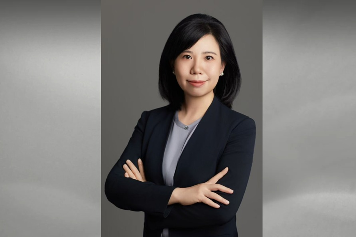
 Wang Yu, general manager of CSL China

“As the world’s second-largest pharmaceutical market, China, a market that we’ve been deeply involved with for 40 years, is a critical growth engine within CSL’s global blueprint,” said Wang Yu, general manager of CSL China, during a recent interview in Shanghai.

 “Looking ahead at the vast market potential and opportunities, CSL will focus on ‘new products, new collaborations, and new efficiency’, driving sustainable and high-quality growth,” she said.

 For four decades, CSL has been committed to addressing the needs of patients with rare and severe diseases in China.

 Human albumin, derived from human plasma, is used clinically for emergency treatment of hypovolemia, severe hypo-albuminemia, neonatal hyperbilirubinemia, and acute respiratory distress syndrome, among others.

 Since 2018, CSL has experienced significant growth in China, according to Wang. Within regulatory limits, the company has supported medical institutions and clinical experts, contributing to the publication of several treatment guidelines and consensus documents, thus advancing the standardization and rational use of human albumin in the country.

 In response to the Guangdong-Hong Kong-Macao Greater Bay Area’s special access policy for Hong Kong and Macao drugs and medical devices that allows designated hospitals in the bay area to use Hong Kong-approved drugs and medical devices, CSL has facilitated the introduction of anti-D immunoglobulin to three medical institutions on the Chinese mainland, benefiting over 3,000 pregnant women with rare Rh-negative blood.

 In March, Paul McKenzie, CEO and managing director of CSL, emphasized at the China Development Forum that China is a crucial strategic market for the company. He reiterated the company’s commitment to deepening its presence in China, and fostering innovation with upstream and downstream partners to support the development of China’s healthcare sector.

 “The strategic market designation of China together with other markets, such as the United States and Germany, means our investment in China will be larger, more sustained, and more committed. Our workforce has grown considerably this year and continues to grow,” said Wang.

 zhouwenting@chinadaily.com.cn

Article inline ad

Hainan FTP Opens Fast Lane

0

Businesses swiftly capitalize on latest move to boost growth, competitiveness

By WANG KEJU in Beijing,CHEN BOWEN and MA SI in Haikou | CHINA DAILY | Updated: 2025-12-19

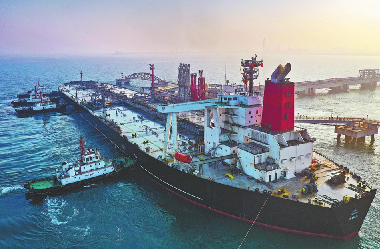
As a colossal bulk carrier ship laden with 179,000 metric tons of petrochemical raw materials eased alongside the dock on Thursday morning, a clear announcement echoed across the port: “The Yangpu Maritime Safety Administration welcomes your vessel to the Hainan Free Trade Port.”

 The vessel was delivering the first shipment of zero-tariff imported goods as China launched island-wide special customs operations at the Hainan FTP, the world’s largest by area.

 Around the same time, at Haikou Meilan International Airport’s cargo terminal, 3,300 boxes of locally produced chocolate, achieving at least 30 percent value-added processing on the island, began the journey north to Beijing and Hanzhong, Shaanxi province, as the first shipment of duty-exempt goods.

 The initiative on the island will promote freer entry of overseas goods, zero-tariff expansion and a pro-business climate.

It underscores the country’s determination to advance high-standard opening-up and turn China’s super-sized market into a stronger magnet for global trade and investment, despite rising protectionism worldwide, senior officials and business leaders said.

 Vice-Premier He Lifeng said that it is essential to seize the opportunity presented by the special customs operations to persistently deepen reforms in key areas, solidly promote high-quality development and continually improve the risk prevention and control framework.

 The goal is to shape the Hainan FTP into a pivotal gateway that leads China’s new round of opening-up in the new era, the vice-premier said at the launch ceremony in Haikou, Hainan province, on Thursday, which also marked the 47th anniversary of the initiation of China’s reform and opening-up policy.

 China released a master plan in June 2020 to build Hainan into a globally influential, high-level free trade port by the middle of the century, and it is a significant move by the country’s top leadership to support the construction of the Hainan FTP system with Chinese characteristics.

 The special customs operations are built on a framework of “freer access at the first line, regulated access at the second line, and free circulation within the island”.

The “first line” allows for freer access between Hainan and regions outside China’s customs territory. The proportion of zero-tariff product lines has now surged from 21 percent to 74 percent, covering about 6,600 items.

 The “second line” maintains regulated access with standard customs controls for goods entering China’s mainland from Hainan, while a key incentive allows goods produced in Hainan, or those using imported materials with at least 30 percent value-added processing on the island, to enter the mainland exempt from import tariffs.

 Businesses promptly acted to harness the new policy advantages, aiming to drive growth and enhance competitiveness.

 Siemens Energy became the first foreign-invested enterprise to register, receiving its business license in Danzhou, Hainan.

 “With the free trade port option, we have the chance to optimize our logistic processes and to reduce administration effort and make everything faster,” said Lars Voelker, general manager of Siemens Energy (Hainan).

 The company simultaneously broke ground on a new gas turbine assembly base and service center. The facility, scheduled for completion in 2027, is designed to create an integrated business system covering assembly, validation and maintenance for domestic and overseas markets.

 Zhang Xiangchen, deputy director-general of the World Trade Organization, said, “This initiative brings tangible policy dividends, but we place greater value on its role in driving systemic innovation.

 “These opening-up measures are not isolated adjustments, but interconnected measures spanning trade, taxation and financial services,” Zhang said. “The island serves as a testing ground. It allows us to identify potential issues and make adjustments, thereby reducing risks when scaling reforms nationwide.”

 More important, amid a wave of de-globalization around the world, China continues to advance its opening-up, optimizing the business environment for global investment and contributing to fostering an open world economy, he added.

 Analysts also noted that the island’s unique geographic and policy profile makes it a critical nexus designed to strengthen China’s role as a linchpin of regional trade and investment.

 Positioned at the geographic heart of the Regional Comprehensive Economic Partnership, the world’s largest trade group to date, Hainan is being groomed as a critical conduit for closer economic ties with participating economies, particularly the Association of Southeast Asian Nations, said Chi Fulin, president of the China Institute for Reform and Development.

 In the past five years, the RCEP contributed three times as much to global economic growth as the Comprehensive and Progressive Agreement for Trans-Pacific Partnership and the European Union combined, according to Chi.

 For ASEAN exporters, Hainan will be a low-tariff entry point into the vast Chinese consumer market. For manufacturers and service providers operating on the island, it is a potential springboard into RCEP markets, with supportive logistics and financial services, Chi said.

 Zhu Jianmin, chairman of Oxiranchem Group, highlighted the efficiency of Hainan’s business environment. Despite challenges, the company had completed and put into operation in Hainan its Yangpu International Container Port-based project by the end of 2023.

 “The Hainan FTP’s tax policies, unique geographic location and logistics advantages have enabled us to source raw materials globally and target ASEAN markets effectively,” Zhu said.

 Contact the writers at wangkeju@chinadaily.com.cn

Article inline ad

Businesses Begin Receiving Benefits As Hainan FTP Starts Customs Shift

0

By CHEN BOWEN in Danzhou, Hainan | chinadaily.com.cn | Updated: 2025-12-18

 Companies and institutions began receiving benefits on Thursday as the Hainan Free Trade Port began its island-wide special customs operations.

 Siemens Energy became the first foreign-invested enterprise to register, receiving its business license at the Yangpu administrative service center in Danzhou. The company simultaneously broke ground on a new gas turbine assembly base and service center, a project it calls its first of its kind in China. Siemens Energy began its partnership with Yangpu power plant in 1993.

 Joern Schmuecker, senior vice-president, Gas Services Central of Siemens Energy, said: “Establishing a gas turbine assembly base and service center in Hainan aligns perfectly with the Free Trade Port’s vision of becoming a new high ground for openness and international cooperation. Together with our partners, we will drive collaborative innovation across the industry value chain, continuously enhance equipment delivery and service capabilities, and build an industrial ecosystem that contributes to energy resilience in China and across the world.”

 “We’ve seen very fast that we will receive a lot of support,” said Lars Voelker, general manager of Siemens Energy (Hainan) Co Ltd, highlighting the efficient logistics and reduced administrative effort enabled by the FTP. He also highlighted the operational benefits. “With the free trade port option, we have the chance to optimize our logistic processes and to reduce administration effort and make everything faster.”

 Local officials emphasized the upgraded cooperation enabled by the new policies. “The start of construction on the day of island-wide special customs operations marks an upgrade in cooperation from a ‘technology provision model’ to an ‘industry co-construction model’,” said Danzhou Mayor Chen Yang. He pledged “full-scale, whole-cycle services” to support the project.

 Businesses producing goods on the island also began receiving practical benefits. Jia Green Chocolate Works (Hainan) completed the first shipment to China’s mainland to be eligible for a tariff exemption. A batch of chocolate, valued at 300,000 yuan ($42,600), cleared customs at Haikou Meilan International Airport bound for Shaanxi province and Beijing.

 Meng Xinli, chairman of the company, said the shipment qualified under rules allowing tariff-free domestic sale for goods with at least 30 percent value-added during processing in Hainan. “These measures have helped lower operating costs and enhance market competitiveness,” he added.

 In a separate import transaction, the Sanya Phoenix International Airport customs port processed its first batch of duty-free imports under the FTP’s zero-tariff policies. The Sanya Branch of Peking University Hospital of Stomatology received a spectrometer and an electron backscatter diffractor from Germany, with tax exemptions of about 128,000 yuan. China National Medical Device (Hainan) also imported two scientific research instruments from Hong Kong, receiving tax reductions of about 182,100 yuan.

 The cooperation between multinational corporations, local manufacturers, and institutions underscores the broad initial impact of Hainan’s policy milestone. The island-wide special customs operations are designed to facilitate trade, investment, and customs clearance to create a new environment for developing high-end manufacturing clusters and positioning the island as an open economy hub.

 Wu Weidi contributed to the story.

Article inline ad

Hainan Marks A New Phase In Opening-Up

0

By Jiang Xueqing | chinadaily.com.cn | Updated: 2025-12-18

The island-wide special customs operations of the Hainan Free Trade Port officially commenced on Thursday, marking a new phase in Hainan Island’s opening-up. Bank of China Hainan Branch is stepping up support to help the island build a high-level open financial system.

 The recommendations for China’s 15th Five-Year Plan (2026-30) explicitly call for developing the Hainan Free Trade Port to high standards. The free and convenient flow of cross-border capital is identified as a key driver of high-level opening-up.

 Against this backdrop, Bank of China Hainan Branch is focusing on core areas, including trade in goods and cross-border investment and financing, promoting more efficient cross-border settlement, greater foreign exchange facilitation, and integrated investment and financing services.

 At the same time, it is deepening innovative applications of the Hainan FTP’s multi-functional free trade accounts, also known as EF accounts, and enhancing the freedom and convenience of cross-border capital flows.

 In line with the timetable for the island-wide special customs operations, BOC has rolled out dedicated “cross-border finance plus industrial chain” service solutions. Particularly in the context of the Regional Comprehensive Economic Partnership and China’s cooperation with the Middle East, it is encouraging more local companies to engage in cross-border renminbi settlement, investment and financing.

 The bank has also continued to pursue institutional innovation in areas such as cross-border cash pooling, EF accounts and offshore financial services, actively seeking regulatory approval for pilot programs to help position Hainan Island as a new high ground for financial opening-up.

 Wang Fanghong, president of the Bank of China Hainan Financial Research Institute and a senior business manager at the BOC Hainan Branch, said, “Financial innovation in the Hainan FTP has produced a steady stream of highlights. In particular, the launch of the Hainan FTP’s multi-functional free trade accounts has provided entirely new infrastructure for a higher level of financial opening-up in Hainan. As a large State-owned bank, Bank of China will naturally place innovation at the core of its efforts to serve the development of the Hainan FTP.”

Article inline ad

From Beachfronts To Breakthroughs

0

Marine science, preferential policies and talent incentives are reshaping Sanya into a growing hub for high-tech startups

By Li You | China Daily | Updated: 2025-12-18

For many Chinese people, Sanya in South China’s Hainan province is the ideal destination for coastal tourism. However, for many business startups, the city is emerging as a prime choice for entrepreneurial success.

 Deep-sea innovation

 Xu Shupeng of Hainan Langyan Optoelectronics Technology has been running a company in the Sanya Yazhou Bay Science and Technology City for two years. As the deputy general manager of the company, he arrives at work every day to inspect equipment, collect and organize data, formulate research plans and promote products.

 “I came to Sanya to solidify our technology advantages and expand our product line, trying to transform the scientific research achievements from universities into marketable products,” he said.

 Since its launch in July 2023, Langyan has filed 14 patents in just two years. With an annual turnover exceeding 5 million yuan ($709,522) in 2025, it is securing a firm foothold in the field of ultrafast laser precision control.

 At present, the company has developed a high-energy femtosecond laser, YbFemto-HP, a device widely known as “the fastest knife” that can cut, drill holes and groove the surface of hard materials. In Hainan, however, this product has a more important role: applying superhydrophobic, anti-corrosion and rust-removal treatments to the hulls of ships engaged in deep-sea exploration.

 Access to nearby deep-sea resources was a key factor behind Langyan’s decision to set up in Sanya. Nanshan Port, located in Sanya’s Yazhou district, is the closest port in China to sea areas with a water depth of 1,000 meters. It takes only half a day to sail from here to the area. “This geographical convenience allows our equipment to complete testing quickly,” Xu said.

 Apart from the tax incentives and trade facilitation policies of the YZBSTC, the city’s focus on deep-sea technology and high-end equipment is aligned with the application scenarios of the company’s core businesses such as marine laser equipment, Xu said.

 In the initial stage of entrepreneurship, the company was confronted with a series of challenges, including difficulties in recruiting high-end technical talent, weak connections with the local supply chain and heavy financial pressure.

 The targeted incubation services provided by the YZBSTC played a crucial role — they not only offered key support such as talent apartments, settlement subsidies and shared laboratories, but also organized industry-university-research collaborations and matched industry chain resources, helping Langyan establish operations and achieve market expansion.

 Recalling the differences between working in Sanya and Shanghai, where Xu used to work as a researcher, he said that while the fast-paced work environment in Shanghai can drive rapid personal growth, excessive pressure may instead restrict performance. In Sanya, the more balanced work rhythm enables people to focus more energy on work and pursue their aspirations wholeheartedly.

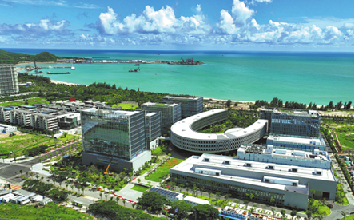
 Nanshan Port, facing the South China Sea and backed by Yazhou Bay, is Sanya’s sole seaport for foreign-oriented maritime transportation, serving both scientific research and cargo transportation.

 Backed by industries in the YZBSTC, the policy dividends of the Hainan Free Trade Port — including zero tariffs, low tax rates and a simplified tax system — will be fully realized after the island-wide special customs operations. This is expected to significantly reduce institutional costs for key industries.

 As a key industrial park for the construction of the Hainan FTP, the YZBSTC is developing two major sectors: breeding science and deep-sea technology.

 Focusing on industries such as deep-sea equipment, marine pastures, marine energy, marine biomedicine and marine public services, it has attracted high-profile research institutes and leading enterprises, including Shanghai Jiao Tong University, Zhejiang University, Ocean University of China, the Institute of Deep-sea Science and Engineering of the Chinese Academy of Sciences and China State Shipbuilding Corporation.

Free trade dividends

 Wang Xiao, one of the founders of SensingX Technologies (Hainan) located in the YZBSTC, also recognized the advantages of the Hainan FTP. As early as 2021, he began participating in research and commercialization related to brain-computer interfaces here.

 “Based on the policies of the Hainan FTP covering tariffs, talent and services, as well as the industry’s development prospects, I concluded back then that the Hainan FTP was bound to achieve rapid growth in the future,” Wang said. “Moreover, most of the preferential policies I learned about at that time have now been implemented.”

 Earlier this year, the Ministry of Finance and the State Taxation Administration issued a notice stating that by Dec 31, 2027, for high-end and in-demand talent working in the Hainan FTP, the portion of personal income tax exceeding 15 percent will be exempted.

 “For high-end talent, the percentage of personal income tax rises as income increases. The 15 percent tax relief is therefore very attractive,” Wang added.

 To meet the high-throughput, low-power consumption and wireless transmission needs when developing brain-computer interfaces, SensingX has broken through multiple technical bottlenecks. At present, chips designed by the company are being tested by more than 30 downstream enterprises and more than a dozen have completed testing and placed orders.

 Guo Zheshan, another co-founder of the company, said that the research, development and production of its brain-computer interface chips and equipment require importing large quantities of raw materials and high-end equipment from overseas.

Currently, the Hainan FTP exempts tariffs on the entry of these raw materials and equipment. In addition, goods processed in the Hainan FTP that achieve or exceed a 30-percent value-added rate are exempt from tariffs when entering the mainland from the port. This gives Hainan-based enterprises a significant cost advantage in domestic sales, Guo explained.

 After the island-wide special customs operations of Hainan FTP, various shipping procedures will be simplified. Zero-tariff goods will be able to circulate freely among eligible entities, greatly reducing cooperation costs between upstream and downstream enterprises, Guo noted.

 The island-wide special customs operations launched on Thursday mark a “critical leap”, said Cui Fan, a professor at the University of International Business and Economics. After the special customs operations, the proportion of zero-tariff commodity tax items will rise sharply from 21 percent to 74 percent. This represents a substantive change and can be regarded as a milestone in the initial establishment of the policy and institutional system of the Hainan FTP.

 Hainan’s continued efforts to raise its level of opening-up not only position it at the forefront of higher-level opening-up nationwide, but also create more opportunities for neighboring countries and regions, especially ASEAN members, Cui added.

 To attract foreign talent to settle in the YZBSTC, Bob Dejkam, a talent manager at YZBSTC, said they are working to simplify the entire application process for international professionals. For tax incentives and entrepreneurship support, YZBSTC provides one-on-one guidance, helps applicants prepare documents and connects them directly with government departments.

 “We also offer different levels of support based on talent type. For example, top scientists can receive project funding and customized research platforms, while others receive fast-track work permits and targeted services. This helps us match each professional with the most suitable resources,” Dejkam said.

Article inline ad