Wednesday, November 25, 2026

Home Blog Page 167

Shanghai’s Role Key As Supplier Of Institutional Innovation

0

City’s international reinsurance exchange, which became operational in December, is latest success story

By Shi Jing in Shanghai | China Daily | Updated: 2025-09-23

As Chinese companies expand their reach amid the advancement of strategies like the Belt and Road Initiative, demand for new financial services has risen, including reinsurance, or, insurance provided to insurers.

 According to Chang Ming, assistant to the general manager of the Shanghai International Reinsurance Exchange, reinsurance is the risk buffer for companies’ overseas operations. When enterprises face higher risks such as natural disasters and legal risks in overseas markets, the policy limits are often large, making it difficult for a single insurer to bear all the risks alone. In that case, reinsurance is important to diversify risk, he said.

 Against that backdrop, the Shanghai International Reinsurance Exchange went operational in eastern Shanghai’s Lin-gang Special Area in late December 2024.

 Prior to the establishment of the exchange, Chinese insurance companies could only deal with reinsurance businesses via the international reinsurance centers based in London, Bermuda or Singapore. But now, direct trading can be done in the Chinese market, where premiums can often be lower and security higher.

 “One transaction, which would have taken three days in the past, can now be completed in just a few hours here, as we can achieve automatic identification and speed confirmation via a unified billing template, a digital platform and standardized trading rules,” said Chang.

 “When Chinese companies build new factories or undertake infrastructure projects, many countries require companies to purchase local insurance. However, many local insurers either have insufficient underwriting capacity or set excessively high premium pricing. Chinese domestic insurance companies are more capable in these aspects,” he added.

 Feng Xiao, deputy general manager of the reinsurance department of PICC Property and Casualty Co Ltd, said such reinsurance capacity can facilitate the export of Chinese new energy vehicles.

 Local insurance companies are less willing to serve outbound Chinese NEV companies, as the former have not formed a good understanding of the battery and electric control unit technologies grasped by Chinese companies, Feng said.

 “Reinsurance companies can play a crucial role under such circumstances. While the local insurer comes up with a policy, 50 to 90 percent of the risks can be transferred to the Chinese reinsurance company. Local insurance companies are thus willing to make the move, which is conducive to Chinese NEVs’ expansion in overseas markets,” he said.

 The establishment of the exchange has also addressed the great potential of the Chinese market.

 According to the National Financial Regulatory Administration, China accounted for 11 percent of the world’s direct insurance premium value in 2024, while that for reinsurance premiums was only 3.5 percent.

 The size of the Chinese reinsurance market is not on par with China’s economic size or that of the direct insurance market, said Yin Jiang’ao, director-general of NFRA’s property and casualty insurance supervision department.

 To look on the bright side, quick progress has been made at the Shanghai International Reinsurance Exchange.

 In the first eight months of the year, the exchange traded nearly 4.4 billion yuan ($618.52 million) of insurance premiums. The exchange has so far seen 118 institutions registered with trading rights, among which 90 are domestic and the rest from overseas.

 Such rapid development in less than a year can be largely attributed to the institutional innovation first attempted there, with the trading seats introduced at the exchange being one of them.

 According to Chang, overseas institutions are allowed to provide offshore reinsurance services to Chinese clients even if they have not acquired official operational approval from the Chinese central regulators. Under such circumstances, the overseas reinsurance companies cannot set up fixed operation venues in China.

 The trading seats at the exchange can help those institutions reach their Chinese clients more conveniently, while significantly reducing the costs of conducting China-related business, he said.

 Currently, six overseas institutions from the United Kingdom, Barbados and the Democratic Republic of the Congo, among others, have obtained trading seats at the exchange.

 The exchange has also jointly explored an overseas fleet insurance service mechanism with Commercial Aircraft Corp of China, PICC and Air Union Insurance Brokers, which is aimed at facilitating the export of domestically produced commercial aircraft while securing Chinese companies’ interests in overseas markets, Chang said.

 The exchange has helped to attract 26 domestic and international reinsurance institutions to settle down in Lin-gang, including operation centers of 21 reinsurance companies, one branch of a reinsurance company, and branches of four insurance brokerages.

 France’s AXA Global Reinsurance officially opened its reinsurance operation center in Lin-gang in January, the first foreign firm of its kind to make such a move.

 According to Xue Fei, general manager of AXA International Reinsurance (Shanghai) Co Ltd, the collective financial infrastructure and policies introduced at the exchange — as well as the gathering of registration, clearance and information disclosure functions there — can largely improve trading efficiency and lower costs. This is conducive to improving companies’ operational efficiency and competitiveness, he said.

 The fact that more and more industry players are gathering in Lin-gang helps AXA talk to its peers more conveniently about the most up-to-date trends regarding health insurance, travel insurance and even businesses related to new energy vehicles, he said.

 Shanghai has always served as the first stop for foreign financial service providers to enter the Chinese market.

 By the end of June, Shanghai was home to 1,796 licensed financial institutions, among which 556 were foreign-invested. About 80 percent of China’s foreign asset management companies are based in Shanghai, while the ratio for foreign banks is 40 percent.

 China’s first wholly foreign-owned securities firm and the first wholly foreign-owned mutual fund companies are based in Lujiazui of Pudong New Area.

 Lujiazui is home to 70 percent of the country’s foreign asset managers, 40 percent of foreign-owned banks, and 40 percent of foreign securities brokerages.

 The various financial infrastructures built in Shanghai have better linked the Chinese and overseas markets. The Shanghai-based China Foreign Exchange Trade System is one of them.

 The Bond Connect program launched by the CFETS has served as a flexible channel for overseas institutions’ access to the Chinese interbank market. The Swap Connect program and offshore buyback services have met overseas institutions’ needs for liquidity management and risk hedging, said Dong Yiwei, vice-president of the CFETS.

 To date, over 1,100 overseas legal entities have been participating in the Chinese interbank market, holding about 4 trillion yuan of Chinese onshore bonds.

 “The Chinese interbank market has a complete product system and high liquidity. The appeal of the yuan-denominated financial assets has continued to grow,” she said.

 All these are inseparable from various policy support. During this year’s Lujiazui Forum — the annually held industry event gathering officials, experts and top executives in Shanghai — an action plan to consolidate Shanghai’s role as an international financial center was released.

 The action plan stated that more financial institutions, international financial organizations and commercial banks’ headquarters should be attracted to the city. Institutional opening-up should be expanded, among which the Shanghai International Reinsurance Exchange should play a bigger role.

 Another eight financial opening-up measures for the country were announced at the same forum. Financial infrastructure such as an interbank market trading report database and a personal credit institution will be set up in Shanghai.

 “These are not isolated reforms, but rather building a new system connecting finance, trade and supervision. Almost all the eight measures have set Shanghai as the pioneering zone, reflecting the city’s core function as a supplier of institutional innovation. New rules are first experimented here and promoted nationwide,” said Liu Dian, an associate researcher at the China Institute of Fudan University.


Article inline ad

Nation’s Monetary Policy To Remain Independent Of US Fed Rate Cuts

0

PBOC: Multiple tools in place to ensure ample liquidity, facilitate financing

By Zhou Lanxu | China Daily | Updated: 2025-09-23

China will maintain an independent and accommodative monetary policy amid the unfolding global rate cut cycle, with future adjustments to be determined by domestic priorities and incoming data, officials and analysts said on Monday.

 Pan Gongsheng, governor of the People’s Bank of China, the country’s central bank, said on Monday that China’s monetary policy will remain independent and data-driven, following the US Federal Reserve cutting the federal funds rate by 25 basis points last week.

 “China’s monetary policy adheres to the principle of staying oriented to domestic needs while balancing internal and external factors,” Pan said at a news conference, adding that future decisions will be based on macroeconomic conditions and evolving circumstances.

 Citing international central banking practice, Pan said the PBOC will follow a data-based approach to policy adjustment, and make comprehensive use of multiple tools to ensure ample liquidity and guide financing costs lower.

 Such efforts are aimed at bolstering consumption, expanding investment and consolidating economic recovery, Pan said, stressing that “China’s current monetary policy stance is supportive.”

 Also on Monday, the PBOC released the latest loan prime rates — the market-based lending benchmarks — which remained unchanged for the fourth consecutive month. The one-year LPR stood at 3 percent, while the over-five-year LPR came in at 3.5 percent.

 The steady rates were in line with expectations, as the policy rate of seven-day reverse repos has also held stable. Analysts said the third quarter has been a period of observing monetary policy effects, even as the US Fed rate cut provides more policy room for China by potentially ushering in a global rate cut cycle.

 Looking ahead, Ming Ming, chief economist at CITIC Securities, said credit growth remained subdued and property sales became weaker in the third quarter, underscoring the need for interest rate cuts to lower financing costs.

 Ming said that the narrowing net interest margin of commercial banks suggests that deposit rates may need to decline before a cut in LPRs can take place, adding that rate cut decisionmakers should also pay attention to the impact on investor sentiment in the stock market.

 During Monday’s news conference, heads from China’s top financial regulators also reported the achievements made by the country’s financial sector over the 14th Five-Year Plan period (2021-25).

 Pan said total assets of China’s banking sector reached nearly 470 trillion yuan ($66 trillion) by the end of June, the largest in the world, while the country’s stock and bond markets ranked second globally in size.

 Wu Qing, chairman of the China Securities Regulatory Commission, said at the conference that equity and bond financing on the exchange markets totaled 57.5 trillion yuan in the past five years, raising the share of direct financing to 31.6 percent, up by 2.8 percentage points from the end of the 13th Five-Year Plan period (2016-20).

 Technology-related stocks now account for over one-fourth of the market capitalization of the A-share market, far surpassing the combined weight of financial and real estate sectors, while dividends and share buybacks reached 10.6 trillion yuan in the past five-year period, more than twice the combined proceeds from IPOs and refinancing, Wu said.

 Looking ahead, Wu said the commission will advance reforms of the STAR Market and ChiNext regarding IPOs, mergers and acquisitions, and corporate restructurings to amplify support for innovation, improve listed companies’ disclosure quality, foster a culture that values and rewards investors, and enhance market regulation and risk-prevention frameworks.

 Wu added that long-horizon assessments of funds will be reinforced, while cross-border investment and financing will be made more convenient to attract more capital inflow.

 Zhu Hexin, administrator of the State Administration of Foreign Exchange, said that overseas institutions and individuals held over 10 trillion yuan worth of onshore stocks, bonds, deposits and loans by the end of July.

 Official data showed that foreign investors now hold about 3.4 trillion yuan of A shares, while 269 Chinese companies are listed overseas.

Article inline ad

PBOC Vows Data-Driven, Independent Monetary Policy Amid US Fed Cut

0

By Zhou Lanxu | chinadaily.com.cn | Updated: 2025-09-22 18:00

Pan Gongsheng, governor of the People’s Bank of China, said on Monday that China’s monetary policy will remain independent and data-driven, following the US Federal Reserve’s interest rate cut last week.

 China’s monetary policy adheres to the principle of staying oriented to domestic needs while balancing internal and external factors, Pan said at a news conference, adding that future decisions will be based on economic conditions and evolving circumstances.

 Citing international central banking practices, Pan said PBOC will also follow a data-dependent approach in policy adjustment and comprehensively use multiple tools to ensure ample liquidity and lower financing costs.

Article inline ad

China’s Monetary Policy Stance Is Supportive: Central Bank

0

Xinhua | Updated: 2025-09-22 16:42

BEIJING — China’s monetary policy is currently supportive, with an emphasis on domestic imperatives while balancing both domestic and external situations, central bank governor Pan Gongsheng said on Monday.

 Responding to a question about the latest rate cut from the US Fed at a press conference, Pan said that China’s major financial markets, including stock, bond and foreign exchange markets, have maintained stable operations.

 In accordance with macroeconomic performance and changes in the overall situation, the People’s Bank of China will use a variety of monetary policy tools to ensure ample liquidity, lower overall financing costs, support efforts to stimulate consumption and effective investment, consolidate and strengthen economic recovery momentum, maintain financial markets’ stable operations, and keep the exchange rate of the yuan generally stable at an adaptive, balanced level, Pan said.

Article inline ad

Life Sciences Shine In MIT Technology Review’s 2025 ’50 Smartest Companies’ List

0

By Li Jing | chinadaily.com.cn | Updated: 2025-09-19 17:02

The MIT Technology Review has unveiled its annual “50 Smartest Companies” list, known as the TR50, with life sciences emerging as one of the standout sectors. Companies including Jinbo Bio-Pharmaceutical Co Ltd, Insilico Medicine, METiS TechBio, BEIJING PINS MEDICAL Co Ltd and DP Technology grabbed spots on the list.

 The four leading sectors in this year’s TR50 are artificial intelligence and computing, robotics and smart manufacturing, semiconductors, and life sciences, reflecting both the growth of digital technologies and the surging momentum of biotech innovation.

 According to the MIT Technology Review, the world’s “smartest companies” share two defining traits: the intelligent application of new technologies, and the strategic acumen to grasp market opportunities. Armed with innovation and sustainable business models, these firms are extending their influence on a global scale.

 Importantly, the MIT Technology Review emphasizes that the innovations highlighted by TR50 are not the achievement of any single country or region. Instead, they represent the outcome of global collaboration and the cross-pollination of ideas, a testament to how science and business transcends borders.

 Twenty-eight Chinese companies made the 2025 list, representing 56 percent of the total list, highlighting China’s prominence on the world stage in both technology and business.

Article inline ad

Unmanned Cargo Aircraft Completes Landmark Farm-To-City Flight

0

By Lin Shujuan in Shanghai | chinadaily.com.cn | Updated: 2025-09-19 16:01

A Chinese-developed unmanned electric vertical take-off and landing (eVTOL) aircraft successfully completed its first inter-city cargo flight on Wednesday, transporting fresh agricultural products to the city of Hefei.

 The 2-ton CarryAll V2000CG cargo aircraft, developed by Shanghai-based AutoFlight, is the world’s first ton-class eVTOL certified for commercial operation by the Civil Aviation Administration of China.

 The aircraft embarked on its pioneering journey from the National Blueberry Industrial Park in Huaining county in Anqing, Anhui province, carrying approximately 200 kilograms of blueberry juice and SF Express parcels and, after a smooth 161-kilometer flight lasting one hour, it landed near the Hefei Baida Zhougudui Agricultural Products Logistics Park in the provincial capital of Hefei. It was the world’s first inter-city transport of agricultural products using a 2-ton class eVTOL for low-altitude unmanned logistics and represents a breakthrough in long-range, cross-city low-altitude logistics applications within China.

 Huaining is the largest county-level blueberry cultivation area in the Yangtze River Delta, while the Zhougudui market is a major agricultural wholesale hub in Hefei. This new low-altitude unmanned transport method offers a 50 percent efficiency increase over traditional road transport, enabling direct and rapid delivery from rural areas to distribution centers.

 The successful flight has effectively opened a main aerial logistics channel between the two cities and multiple surrounding counties. According to operators, it serves not only as a critical technological validation but also as an innovative practice in the collaborative management of inter-city low-altitude unmanned cargo transport.


Article inline ad

Hainan Making Big Strides With Satellite Tech

0

Wenchang aerospace facility eyes 10 billion yuan in revenue by 2027

By MA SI and CHEN BOWEN in Haikou | China Daily | Updated: 2025-09-18 

Hainan province is intensifying efforts to build a comprehensive aerospace industrial cluster at Wenchang international aerospace city, focusing on satellite launches, satellite manufacturing and data chain development, with an ambitious goal to generate 10 billion yuan ($1.4 billion) in revenue from the facility by 2027.

 The move is part of China’s broader efforts to accelerate the development of satellite communications technology. The Ministry of Industry and Information Technology recently launched a guideline which outlines goals to achieve large-scale application of new models and formats such as direct smartphone-satellite connectivity by 2030, with satellite communication users exceeding 10 million.

 Cao Shuyu, mayor of Wenchang, said the city will accelerate the development of a full commercial aerospace chain. Major projects, including a space-themed park, are being planned to position Wenchang as the “Capital of Aerospace Tourism”.

 As of Wednesday, the satellite super factory, a key supporting project of the aerospace city, was nearing completion. Construction has reached 90 percent of its planned progress and is expected to be delivered by the end of October. Once operational, the facility will provide significant momentum for Hainan’s space sector and national space internet infrastructure development, experts said.

 At the construction site, the main structure of the factory is already visible. Machinery and engineering vehicles are operating efficiently, with workers diligently advancing the project according to schedule.

 In August, the Hainan provincial government issued a three-year plan (2025-27) to develop a modern industrial system with local characteristics and advantages. The plan highlights aerospace as a key sector, outlining measures to foster a full commercial aerospace industry chain and establish Wenchang as a major scientific innovation base for aerospace.

 To enhance launch capabilities, Hainan is upgrading its launch site for commercial aerospace and accelerating second-phase construction and supporting facilities. The second phase of the Hainan commercial aerospace launch site began construction in January of this year.

 Minsheng Securities said Launch Pads 1 and 2 at the Wenchang launch site will have a combined annual launch capacity of 32 liquid-propellant rocket missions, marking a significant improvement over traditional launch facilities. The analysis also suggests that 2025 and 2026 will be critical years for the debut and validation of new-generation reusable rockets, both from private and State-owned enterprises, potentially marking a true turning point for commercial rocket development.

 In satellite manufacturing, the action plan promotes the construction of satellite super factories such as the one in Wenchang. A survey by Orient Securities indicated that major private aerospace companies currently have an annual satellite production capacity of about 300 units, which is expected to expand to 500-600 units in the near future.

 In August, the MIIT released a guideline on optimizing market access to promote the development of the satellite communications industry.

 Liu Xingliang, a member of the Expert Committee for Information and Communication Economy, which is part of the MIIT, said that the guideline has two standout features — setting clear development targets and top-level design up to 2030, and allowing private enterprises to lease satellite resources to develop value-added services, thereby promoting market openness and innovation.

Article inline ad

China, UK Executives Explore New Business Opportunities At London Roundtable

0

By Xing Yi in London | chinadaily.com.cn | Updated: 2025-09-19 23:15

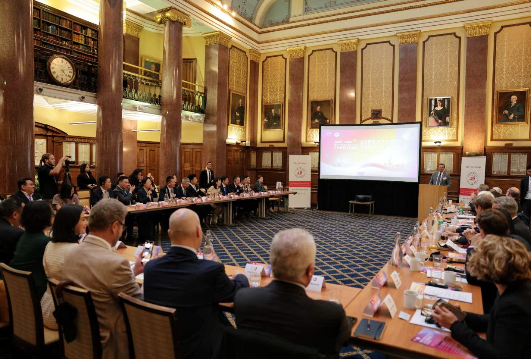
Business executives from China and the United Kingdom gathered in London on Wednesday to explore cooperation opportunities at an industry and investment roundtable hosted by the UK’s 48 Group and the Chaoyang District of Beijing.

 The event spotlighted Chaoyang district — Beijing’s central business hub and main diplomatic area — as an attractive destination for foreign investors.

Wu Xiaojie, Party chief of Chaoyang district, said in his opening speech that the district hosts more than 90 percent of embassies in Beijing, 80 percent of international organizations’ offices, and 65 percent of foreign financial institutions.

 “With a world-class business environment and comprehensive policies, Chaoyang welcomes British businesses to come and grow,” Wu said, noting that 172 multinational companies have already set up their regional headquarters in the distric

Jack Perry, chairman of the 48 Group, a London-based organization that is dedicated to promoting trade and business between the UK and China, said: “We have an extraordinary group of leaders from finance, energy, healthcare, consumer brands, professional services, academia, and advanced technology represented in this room. They are here not for ceremony but to create partnerships and deliver results.”

 Wang Qi, minister and charge d’affaires of the Chinese Embassy in the UK, said bilateral trade reached $130 billion in 2024, highlighting strong potential for further cooperation. He urged companies from both sides to seize opportunities in global industrial transformation and green development to improve trade quality and support economic recovery.

 The roundtable drew CEOs and senior representatives from about two dozen companies, including Octopus, Barclays, The Store WPP, and Circle Health Group from the UK, as well as Alibaba,Fosun Group, SIGIA and Weibo Corporation from China.

Timothy Hailes, alderman of the City of London Corporation, chaired the discussions, while Douglas Flint, chairman of Aberdeen Group, delivered a keynote speech.

 Flint said emerging markets such as China, India, the Middle East, and Africa will generate exceptional demand for goods and services in the coming decades. He also emphasized the need for collective investment to address global challenges.

“China recognized this back in 2013 with the launch of the Belt and Road Initiative, which is really a huge contribution, in my view, to development activity around the world,” he said.

 Business exchanges between China and the UK have been on the rise in recent months.

 In early September, the UK was named the guest country of honor at the 25th China International Fair for Investment & Trade. The largest-ever British business delegation — more than 100 companies — attended the event in Xiamen, Fujian province.

 Hugh de Lusignan, head of Financial Services at the UK’s Department for Business and Trade, said the fair sent a strong signal that China welcomes more trade with the UK, stressing the mutual benefits of economic and financial cooperation.


Article inline ad

Biotech Firm Unveils AI-Powered Delivery Tech

0

By LI JING | China Daily | Updated: 2025-09-19 09:09

Beijing-based biotech unicorn METiS TechBio has rolled out what it calls the world’s first AI-powered nano-delivery platform, NanoForge, which could reshape the way medicines are developed and delivered, paving the way for reprogrammable drugs.

 At the launch event in Beijing on Tuesday, cofounder and CEO Chris Lai compared the breakthrough to aerospace engineering. “NanoForge is like the SpaceX of drug delivery. It is both the rocket that delivers drugs precisely and the satellite that speeds up new drug development. This could solve one of the toughest problems in medicine, which is to get treatments exactly where they need to go, without harming healthy tissue,” Lai said.

 Drug delivery has long been one of the industry’s hardest puzzles. The rollout of mRNA COVID-19 vaccines in 2020 showed the promise of lipid nanoparticle systems. These microscopic fat droplets can shield fragile molecules like mRNA and ferry them through the body. But applying them across multiple organs and scaling them for broader drug innovation have remained elusive.

 Lai explained that traditional drug delivery research relies heavily on trial and error, a slow and costly process with low success rates. For example, scientists may have to sift through tens of thousands of lipid combinations to identify a single viable LNP formula.

 NanoForge uses a generative AI model called PhatGPT, which designs new lipid molecules atom by atom, much like ChatGPT generates text word by word. It evaluates multiple parameters at once to optimize performance, then validates results through automated lab experiments. “For nucleic acid drugs, NanoForge significantly improves mRNA encapsulation and targeting. What once required screening tens of thousands of formulas can now be achieved in weeks,” said Zhang Xiaoju, head of RNA innovation at METiS.

 METiS has developed three core solutions: AiLNP for nucleic acid delivery, AiRNA for mRNA sequence design and AiTEM for small-molecule drug formulation.

 So far, the company says Nano-Forge has produced more than 10 million lipid structures and collected around 100,000 data points to train its models. The platform has already shown targeted delivery in eight types of human organs and tissues, including the liver, lungs, tumors and the central nervous system.

 To secure its edge, METiS has filed or obtained more than 100 patents.

 Its drug pipeline includes more than 10 advanced programs. Seven have been validated in preclinical studies, while four are already in clinical trials. The lead candidate, an oncology therapy, has reached the pre-NDA stage, that is the final step before applying for regulatory approval.

 Drug development usually drags on for more than a decade and can cost upward of $1 billion. Founded in 2020, METiS seems to have broken that cycle, moving more than 10 programs into advanced stages within five years by combining AI with nanotechnology.

 Still, experts urge caution. “The ultimate goal of innovative drug development is to address unmet clinical needs, deliver strong efficacy and safety data in trials, and secure regulatory approval,” said Fang Yang, executive director for healthcare and biotech at CEC Capital. “From that perspective, AI-driven drug platforms still need time and clinical validation.”

 Lai acknowledged that METiS is in a “critical stage, moving from pre-commercial to commercial”, with the focus now on ensuring both the platform and its pipeline generate sustained value.

 The business case appears compelling. According to consulting company Frost & Sullivan, the global market for intelligent drug-delivery solutions exceeded $18 billion in 2023 and will reach $52 billion by 2030, growing at a compound annual rate of 17.2 percent. Nano-delivery technologies are expected to make up 42 percent of that market by 2025, or roughly $7.8 billion, underscoring its growing importance in the field.

 Investor interest has followed. In August, METiS closed a 400 million yuan ($55.6 million) Series D financing round. The fresh capital will support upgrades for NanoForge, pipeline expansion, global partnerships and new talent recruitment.

 lijing2009@chinadaily.com.cn

Article inline ad

Banks Find Natural Ally In AI Models

0

Lenders use cutting-edge tech to boost efficiency and customer experience

By JIANG XUEQING | China Daily | Updated: 2025-09-19 

China’s listed banks are ramping up the adoption of artificial intelligence, accelerating deployments in the first half as they seek to boost efficiency, enhance customer experience and unlock new growth, with experts saying large AI models are shifting from tools of productivity to engines of value creation.

 During its 2025 interim results briefing on Aug 29, Han Jing, executive vice-president of China Construction Bank, said: “We use technology and data-driven approaches, especially AI, to empower precise customer identification, targeted marketing and accurate profiling. This is reflected in both our corporate and retail business segments. By gaining insights into customer characteristics, we can precisely tailor our products and services.”

 In corporate banking, CCB managed long-tail clients through robotic tools, adding over 130 billion yuan ($18.3 billion) in new corporate deposits in the first half. In retail banking, its intelligent management helped achieve a nearly 95 percent renewal rate for maturing deposits, said Han.

 Industrial and Commercial Bank of China introduced over 100 new AI-powered application scenarios across key business areas such as personal finance, financial markets and corporate lending, including an AI wealth assistant and an intelligent investment research assistant.

 Postal Savings Bank of China has developed more than 230 large-model application scenarios. Its interbank ecosystem platform has deployed bill-transaction robots, achieving full-process intelligent management across all bill types. Its investment banking transaction robots enable intelligent inquiry and response for bond underwriting, boosting inquiry efficiency by more than 95 percent. The lender’s intelligent loan review assistants support over 30,000 loan approval cases daily by effectively identifying, extracting and classifying more than 10 types of images, thereby further improving loan review efficiency.

 While large State-owned banks maintain leadership in applying digital technologies, joint-stock commercial lenders are also striving to catch up.

 In the first half, China Everbright Bank launched a large-model intelligent policy assistant, building a knowledge base of over 1,700 policy documents and an intelligent policy search and analysis agent. By linking policy documents with business scenarios, it has improved compliance execution and built end-to-end policy service capabilities.

 Bank of Beijing, embracing an “All in AI” strategy, is accelerating its transformation into an AI-driven commercial bank. It has established an AI system built on an integrated computing power infrastructure and developed two major model development and operating platforms.

 Huo Xuewen, chairman at Bank of Beijing, said the integrated computing power base allows unified management of enterprise-level AI resources, significantly improving operational efficiency and enhancing data linkage and analytical capabilities. The two platforms, driven by both large and small models, empower product innovation, customer service and risk management. The bank has developed a core AI capability system with over 100 AI functions, rolled out a suite of practical AI tools and built more than 300 application scenarios.

 Ping An Bank’s interim report showed that in the first half, the lender built a large-model capability system, refining models through supervised fine-tuning, autonomous large-model planning and intelligent agents to enhance application capabilities in key scenarios. As of the end of June, it had deployed over 330 large-model application scenarios.

 Beyond business applications, digital finance is also playing an increasingly important role in risk management and compliance. For example, in corporate risk management, Ping An Bank has deepened its exploration of intelligent risk control protocols powered by large models, building a knowledge base of risk experts and leveraging intelligent systems to improve the efficiency of risk-control processes and broaden the applicability of large models.

 In retail loan approvals and collections, the bank relies on large-model capabilities to extract and identify risk characteristics from unstructured data and other elements.

 Industry experts point out that the use of large AI models in risk management remains at an exploratory stage. Looking ahead, in order to better ensure security, AI large models are expected to gradually unlock greater value in forward-looking risk identification, accuracy of risk assessment, speed of risk monitoring and breadth of risk management.

 jiangxueqing@chinadaily.com.cn

Article inline ad