Tuesday, November 24, 2026

Home Blog Page 19

The Quiet Shift Away from Dollar Dominance

0

Why Global Capital Is Slowly Repricing the RMB

For decades, the global financial system has revolved around a single anchor.

But that anchor is starting to move.

On Friday, China’s largest commercial bank, the Industrial and Commercial Bank of China (ICBC), launched a comprehensive suite of cross-border renminbi (RMB) financial solutions. On the surface, it looks like a routine financial product rollout.

It is not.

What ICBC is really signaling is something much larger:
the acceleration of a multi-currency world.

Amid rising geopolitical tensions and increasing fragmentation of global trade, policymakers and investors are no longer comfortable relying on a single dominant currency.

According to Liu Jun, president of ICBC, global capital is actively shifting toward more diversified currency allocations — not just across currencies, but also across regions, instruments, and financial platforms.

This is not theory anymore.

It is already happening:

  • In 2025, RMB accounted for over 50% of China’s cross-border receipts and payments
  • Nearly 30% of goods trade is now settled in RMB
  • Total cross-border RMB flows reached 71 trillion yuan ($10.3 trillion)

Meanwhile, China is accelerating efforts to:

  • Expand RMB use in trade and investment
  • Grow offshore RMB markets
  • Increase RMB-denominated assets
  • Deepen bilateral currency cooperation (notably in Africa)

A newly signed agreement between ICBC and Standard Bank — Africa’s largest bank — further underscores this shift, pointing toward a future where China-Africa financial flows become more RMB-based, more digital, and more integrated.

This is not just about China.
This is about the early stages of a structural shift in the global monetary system.


this is pro content, view need get membership

Article inline ad

China Is Building Robotic Wolves for the Battlefield

0

The next phase of artificial intelligence isn’t happening on screens.

It’s happening on the ground.

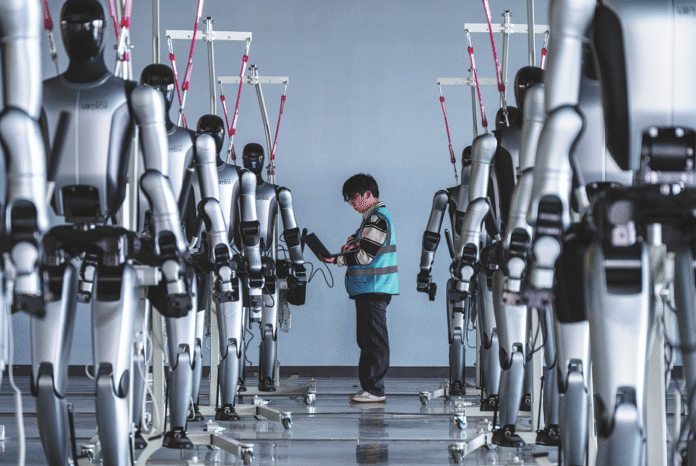
China has developed a new generation of quadruped combat robots — described by engineers as “robotic wolves” — capable of navigating complex terrain, carrying weapons, and operating in coordinated teams.

Developed by China North Industries Group Corp, the machines are designed for real-world combat environments — from urban battlefields to high-altitude terrain.

⚙️ What these robots can do

The robots are built for mobility and adaptability:

  • Climb stairs and traverse uneven terrain
  • Operate at altitudes up to 5,000 meters
  • Run at speeds of up to 15 km/h
  • Carry loads of up to 25 kg

They can also:

  • Map battlefield environments
  • Plan routes autonomously
  • Avoid obstacles in real time

And when deployed in groups:

👉 They can share data and coordinate actions as a unit

🎯 From sensing to striking

These machines are not just mobile platforms.

They can be equipped with:

  • Automatic rifles
  • Micro-missiles
  • Grenade launchers

Once a target is identified:

  • The system locks on
  • Sends data to human operators
  • Waits for final authorization

👉 Humans remain in control — but the machines do the work

At first glance, this may look like another military hardware story.

It’s not.

👉 It represents a major shift in how AI is entering the physical world.

👉 Continue reading to understand why embodied AI — not chatbots — may define the next phase of technological competition.

From Code to Combat: China’s Leap Into Embodied AI

What these “robotic wolves” represent goes far beyond military hardware.

this is standard content, view need get membership


Article inline ad

China Technology|Digital Infrastructure & AI

0

Cisco bullish on China growth amid AI transformation

Global networking giant Cisco has reaffirmed its long-term commitment to China, citing the country’s clear policy direction, technological innovation, and expanding digital infrastructure as key drivers for growth.

Ming Wong, Cisco’s vice-president, told China Daily that China’s stable policy framework and demand from both domestic and foreign enterprises create opportunities in connectivity, cybersecurity, and cross-border operations.

“China is not only an important market for Cisco but also a hub for research, development, and supply chain operations,” Wong said, highlighting the company’s confidence in medium- and long-term prospects.

With artificial intelligence (AI) reshaping enterprise demand for digital infrastructure, Cisco sees China as a prime environment for implementing AI-ready foundations, particularly across healthcare, logistics, manufacturing, and finance sectors.

Key points for free readers:

  • Cisco views China as a critical hub for R&D, digital infrastructure, and AI deployment.
  • The company is increasing investment to support AI-ready foundations and secure, scalable enterprise networks.
  • China’s clear policy and regulatory environment provides stability amid global uncertainties.

Unlock the full story to explore Cisco’s detailed China strategy, AI deployment plans, and how multinational corporations are leveraging China’s 15th Five-Year Plan.

this is standard content, view membership

Article inline ad

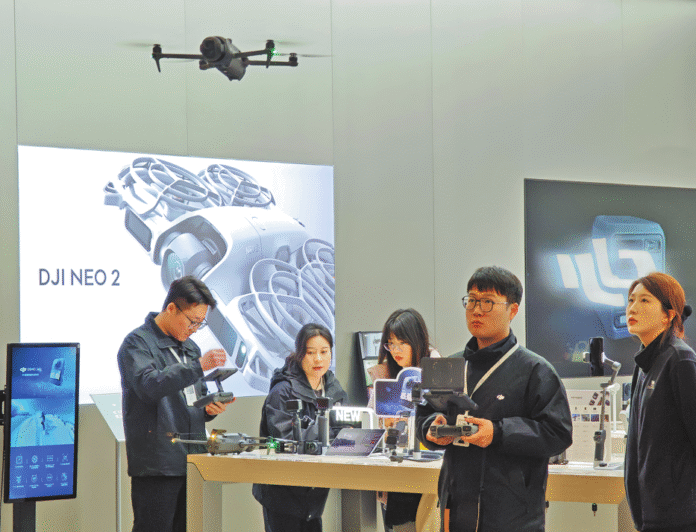
Insta360, DJI lock horns in patent case

0
By Li Jiaying | CHINA DAILY | Updated: 2026-04-03 

China’s leading consumer drone maker and top panoramic camera company are entering a new phase of direct competition, with DJI filing its first domestic patent ownership lawsuit against Insta360 that has escalated tensions between the two technology rivals.

DJI filed the lawsuit on March 23 in Shenzhen, Guangdong province, citing disputes over the ownership of six patents.

The company alleged that several former core R&D employees were involved and that the disputed patents — covering flight control, structural design and imaging technologies — were closely related to their previous roles and developed within one year of the employees leaving DJI.

In response, Insta360 founder and CEO Liu Jingkang said on social media that the company had conducted a thorough review and that existing evidence shows that the patents were based on ideas generated internally at Insta360 and are the result of independent innovation.

Liu added that the company typically withholds the names of inventors in domestic filings to protect employees from headhunting, while disclosing them in international applications.

Liu also noted that some DJI technologies may fall within Insta360’s patent protection scope, but the company has not initiated legal action.

Echoing the statement, Yuan Yue, head of Insta360’s China operations, said in a post that according to an internal assessment, the technologies involved are covered by 28 patents held by Insta360, including 11 related to hardware and structural design, eight to software methods, six to control systems and three to accessories.

The dispute comes as the areas of expertise of the two Shenzhen-based consumer electronics firms, once operating in distinct segments — DJI in consumer drones and Insta360 in panoramic cameras — increasingly overlap.

According to market consultancy International Data Corp, DJI and Insta360 ranked first and second globally in the hand-held camera market in 2025, with market shares of 62.4 percent and 20.4 percent, respectively, accounting for more than 80 percent combined.

In the panoramic camera segment, Insta360 maintained its global lead, with shipments rising nearly 60 percent year-on-year and market share reaching 66 percent.

Competition intensified in July 2025, when Insta360 launched its first drone, the Antigravity A1, leveraging panoramic imaging as a differentiating feature. DJI responded within days by introducing its Osmo 360 panoramic camera, adopting a lower pricing strategy than its counterpart and marking a shift to direct rivalry.

Tensions had already surfaced late last year, when Insta360 accused DJI of enforcing supply chain exclusivity, claiming that more than 30 core component suppliers faced “either-or” choices, with distributors and retail channels also facing similar dilemmas.

In this regard, industry analysts said that in segments where both companies have established competitive advantages, each side is seeking to consolidate its position and safeguard proprietary technologies.

“This kind of exclusivity is not uncommon in the consumer electronics sector, and is a typical competitive strategy once the industry reaches a certain stage,” said Liu Dayong, a senior semiconductor analyst at market research company Sigmaintell.

Liu noted that key components such as flight control chips, stabilization modules and imaging sensors often require joint development between brands and suppliers, leading to deep technological integration that can, to a certain extent, justify exclusive arrangements.

In return, key suppliers that have engaged in customized development with one company also tend to maintain existing partnerships, therefore often declining collaboration requests from competing firms, he explained.

For its part, Insta360 stressed a different perspective. “We believe that in the tech industry, replication and suppression will not lead to leadership — innovation and openness will,” Yuan of Insta360’s China business said.

Against this backdrop of intensifying competition, the company has also claimed a more open stance on intellectual property. Following a favorable outcome in a US Section 337 investigation involving US camera company GoPro, Liu, the founder and CEO, said Insta360 would not proactively initiate lawsuits if peers make “good-faith use” of certain patented technologies from its Insta360 Ace series.

Article inline ad

ByteDance’s Volcano Engine Sees Explosive Growth in AI Token Usage

0

China’s ByteDance-backed AI platform, Volcano Engine, reported that its flagship large language model, Doubao, now consumes over 120 trillion tokens daily — a clear signal of the surging demand for generative AI among Chinese enterprises.

The platform is rapidly expanding its ecosystem for developers. Volcano Engine recently partnered with Peter Steinberger, founder of the open-source OpenClaw project, to launch a China-based mirror site for ClawHub, aimed at improving access for domestic developers and broadening adoption of AI agent frameworks.

Doubao’s growth has been meteoric. Daily token consumption has doubled in the past three months and increased nearly 1,000-fold since its debut in May 2024. Meanwhile, the number of corporate clients using over one trillion tokens cumulatively has grown to 140, up from 100 at the end of last year.


Paid Content (70%) — Subscriber-Only Insights

Doubao 2.0: Driving AI Commercialization and Enterprise Adoption

this is standard content, view need get membership

Article inline ad

Tokens Emerge as Strategic Commodity in China’s AI Era

0

Tokens as the new AI “currency” are reshaping how companies budget, strategize, and compete. Experts now urge firms to treat token consumption as a core cost metric, much like electricity in the industrial era, integrating it into operations and financial planning.

At Nvidia’s recent GTC conference, CEO Jensen Huang described tokens as “the new commodity” — units that underpin recruitment, budgeting, and productivity in the AI era. Each token represents the smallest chunk of data processed by AI models, with a single Chinese character costing roughly 0.7 tokens, high-resolution images requiring thousands, and 15-second videos consuming around 300,000 tokens.

China is leading the global surge in token use. The National Data Administration reported that daily token consumption exceeded 140 trillion as of March 2026 — a 1,000-fold jump since early 2024. Chinese AI models now dominate global token usage, outperforming U.S. counterparts, driven by both technological innovation and lower operating costs.

Why it matters to overseas investors and enterprises:

  • Chinese AI companies enjoy unit costs 6–10x lower than overseas peers.
  • Firms that manage token usage efficiently gain strategic leverage in both domestic and global markets.
  • Forward-looking businesses are beginning to create “token budgets” and departmental quotas to optimize AI ROI.

Up next in the paid section: In-depth corporate strategies, token management frameworks, and how leading Chinese tech giants are operationalizing token economics to dominate AI markets.


this is standard content, view need get membership

Article inline ad

Role of humans in teaching stressed as AI evolves

0
By CHEN BOWEN in Sanya | CHINA DAILY | Updated: 2026-04-01 

As artificial intelligence reshapes classrooms worldwide, the technology should be used only as a learning tool to optimize teaching methods and not as a substitute for teachers, global education leaders said on Tuesday.

They made the remarks at the 2026 UNESCO Associated Schools Network Global Conference, which opened on the same day in Sanya, Hainan province.

The three-day conference has brought together representatives from more than 50 countries and regions to reflect on the growing global consensus that education reform in the digital age must remain human-centered, even as schools accelerate the adoption of AI and other technologies.

Kim Min-jeong, director of UNESCO’s Division for Education 2030, noted that well-trained teachers form the core of quality education.

“We need to make sure that we have good, well-trained teachers to provide quality education for all the young people around the world,” she said, adding that in-person exchanges offer great value that no digital connection can replace.

The participants emphasized that a human-centered approach requires addressing inequalities in terms of access to technology.

Lamin Jarjou, ASPnet national coordinator for Gambia, said the uneven pace of digitalization remains a challenge. “We don’t have equal access to digitalization globally. Countries like mine are still catching up,” he added.

The conference, themed “Transformative Education in Action”, focuses on advancing mutual understanding, sharing best practices and promoting innovative approaches that equip young people to build a more sustainable and peaceful future.

The educators highlighted how human-centered principles are shaping the use of AI in classrooms.

In China, for example, an AI-powered classroom analysis system developed by East China Normal University has been put into regular use in more than 500 schools across 15 provincial-level regions. It analyzes recorded classroom sessions and generates diagnostic reports within 15 minutes.

To date, the system has processed over 19,000 classroom videos, and the results have been used to support teaching research, classroom reflection and continuous teacher training.

Zhang Wei, executive director of the International Center for UNESCO ASPnet, said that such tools are designed to enhance teachers’ capacity, not to replace them.

In China, technologies such as virtual reality and extended reality are enabling students to develop AI-based solutions for environmental protection and cultural conservation, Zhang said.

In some countries, AI is also being used to promote gender equality and support the preservation of intangible cultural heritage, she added.

China has placed education at the center of its broader modernization efforts. Ren Youqun, vice-minister of education and chairperson of the Chinese National Commission for UNESCO, said the country will continue to explore new models in science, technology, engineering and mathematics education while advancing digital transformation.

A key platform supporting these efforts is the “Education for Tomorrow” digital education initiative, which provides global resources for teachers in STEM and education for sustainable development. Future plans include integrating AI-powered learning support and enabling real-time international collaboration among educators.

Established in 1953, ASPnet now connects nearly 10,000 schools in around 170 countries and regions, engaging hundreds of thousands of teachers and millions of learners. Stefania Giannini, assistant director-general for education at UNESCO, described the network as “a real vehicle” for promoting the organization’s core values.

For many participants, the conference reflects those values in action. Yousriya Al Harthi, ASPnet national coordinator for Oman, said that such gatherings offer a key opportunity for peer learning. “It’s a chance to exchange cultures, learn from our colleagues and share best practices,” she said, adding that peer learning is one of the most effective methods of learning.

Zheng Jinran contributed to this story.

Article inline ad

Integrated Market Expands Consumer Horizons in China

0

As China launches its 15th Five-Year Plan (2026–30), multinational corporations are stepping up their presence to capture opportunities in a rapidly evolving consumer market. Executives from global firms including Forvia, Goodyear, Coach, and FedEx shared insights on how China’s growth trajectory and integrated market are reshaping their strategies.

Key takeaways for global business:

  • Stable growth amid global uncertainty: China’s GDP reached 140.19 trillion yuan ($20.29 trillion) in 2025, with a 5% growth target for 2026. Proactive fiscal policies and accommodative monetary measures reinforce confidence among global investors.
  • Market expansion and consumer engagement: Companies are deepening their China operations, leveraging e-commerce, short video platforms, and new retail formats to engage consumers more effectively.
  • China as a strategic hub: Beyond being a large market, China increasingly functions as a production base, innovation center, and global supply chain anchor, supporting regional and international operations.

“China remains one of our most promising long-term markets,” said Brian Niccol, CEO of Starbucks. “Partnering with local firms accelerates growth in a purposeful and disciplined manner.”

These trends signal that China’s domestic demand, digital ecosystem, and unified market are creating unique opportunities for companies to optimize their product portfolios, expand distribution channels, and deepen localization strategies.


this is pro content, view need get membership

Article inline ad

China Emerges as a Global Hub for High-Growth Tech Startups

0

China has solidified its position as a leading destination for high-growth startups, ranking second globally in terms of unicorn companies—private firms valued at $1 billion or more.

According to the newly released 2026 China Unicorn Companies Development Report, the country is home to 416 unicorns, representing nearly 30% of the global total. The United States continues to lead the list, holding just under half of the world’s unicorns.

The average valuation of Chinese unicorns has reached $3.87 billion, with both the number of companies and their valuations hitting a three-year high.

Hard technologies, particularly artificial intelligence (AI), are driving this surge. In 2025, the AI sector led all industry tracks with 69 companies valued at a combined $638 billion.

this is standard content, view need get membership

Article inline ad

Gap sets sights on 50 new stores in China amid booming apparel market

0


According to a report by China Daily on April 3…

Clothing brand Gap is ramping up its presence in China, planning around 50 new stores this year as its local operator, Baozun Inc, pushes to maintain double-digit growth in the world’s second-largest apparel market.

The expansion follows a strong 2025, when Gap China opened 29 new stores, bringing the total store count to 164 by year-end. Baozun is using a hybrid model of directly operated and partner stores to accelerate growth while keeping an asset-light strategy.

“China remains a standout market,” said Ken Huang, Baozun’s president of brand management. “We are building on our momentum, aiming for strong growth this year and beyond.”

The brand’s revival in China has been impressive: sales rose more than 20% last year, reflecting a combination of new store openings and strong same-store performance.

this is standard content, view get membership

Article inline ad