Tuesday, November 24, 2026

Home Blog Page 24

Why China May Actually Want More Inflation

0

ZH edited based on a March 30 report from China Daily.

A counterintuitive policy shift is emerging — and it could redefine how China manages its economy


1. The Problem Isn’t Inflation — It’s the Lack of It

For most economies, inflation is the enemy.

For China today, the situation is the opposite.

  • consumer prices: subdued
  • producer prices: weak
  • nominal GDP growth: at times below real GDP

This points to a deeper issue:

Demand in the economy is not strong enough

And in that context, a moderate rise in inflation is not a risk.

It is a signal of normalization.


2. Why Inflation Suddenly Matters More Than Growth

Traditional thinking focuses on real GDP growth.

But policymakers are increasingly concerned with something else:

Nominal growth — the combination of real growth + inflation

Why?

Because nominal growth directly affects:

  • corporate revenues
  • debt sustainability
  • asset prices (especially property)

When inflation is too low:

  • debt becomes harder to service
  • asset prices stagnate
  • expectations weaken

In other words:

Low inflation quietly tightens the entire economy


3. The Real Shift: “Stimulus” Is Being Redefined

China has long relied on a familiar stimulus model:

infrastructure + construction + credit expansion

But its effectiveness is fading.

  • diminishing returns on infrastructure
  • rising local government debt
  • weaker transmission to consumption

So policymakers are exploring something different:

using reform itself as a form of stimulus


4. “Investing in Reform” — The Hidden Strategy

This is the most important idea in the article.

Instead of separating:

  • short-term stimulus
  • long-term reform

China may combine them.

The logic:

  • reforms (e.g., social security, fiscal system) are expensive upfront
  • those costs suppress near-term growth
  • but they improve long-term efficiency

So the policy innovation is:

Use fiscal expansion + monetary support to finance reform costs

In effect:

Reform becomes the stimulus


5. Why This Works — But Only Under One Condition

This strategy only works in a very specific environment:

  • weak demand
  • low inflation

Because:

  • fiscal expansion won’t overheat the economy
  • monetary easing won’t trigger runaway inflation

That creates a rare window:

China can spend aggressively — without the usual macro risks


6. Two Key Battlegrounds

1) Local Government Debt

Problem:

  • high debt burden
  • constrained local spending
  • systemic risk concerns

Possible solution:

  • central government debt swap
  • lower financing costs

But here’s the catch:

Without reform, debt relief = future debt cycle

So the real objective is:

  • fix fiscal structure
  • reduce land finance dependence
  • redefine local-central responsibilities

2) Social Security (Especially Healthcare)

Problem:

  • fragmented system
  • unequal coverage
  • suppressed consumption

Reform potential:

  • expand coverage
  • reduce inequality
  • unlock demand

But:

these reforms are expensive — especially during transition

Which is exactly why:

they need to be financed as part of macro policy


7. This Isn’t MMT — And It Isn’t Abenomics

It may sound similar to aggressive fiscal-monetary coordination.

But there is a crucial difference:

  • MMT → spending without hard constraints
  • Abenomics → stimulus without deep structural reform

China’s approach (if executed properly):

targeted expansion tied directly to reform outcomes

That constraint is everything.


8. The Inflation Trade-Off

A moderate rise in inflation (~2%) effectively acts as:

a soft redistribution mechanism (“inflation tax”)

It reduces real purchasing power — slightly.

But the outcome depends on how funds are used.

If directed toward:

  • healthcare
  • social services
  • employment

Then:

lower- and middle-income groups may benefit more than they lose


9. The Bigger Picture: A New Policy Paradigm

What’s emerging is a different way of thinking about macro policy:

Short-term stabilization and long-term reform are no longer separate

Instead:

  • fiscal policy → supports reform transition
  • monetary policy → stabilizes macro conditions
  • reform → improves long-term growth

This is a more integrated model of economic management.


10. Why This Matters for Investors

If this framework takes hold, several implications follow:

1) Inflation may rise — but in a controlled way

Not a policy mistake, but a deliberate outcome


2) Fiscal expansion will become more targeted

Less infrastructure, more system reform


3) New winners will emerge

  • healthcare
  • public services
  • consumption-related sectors

4) Old growth drivers will fade further

  • property-led expansion
  • debt-driven infrastructure

Final Thought

China is facing two challenges at once:

  • cyclical weakness (low demand)
  • structural transition (economic upgrade)

Most economies struggle to solve even one.

China is attempting to solve both — with a single framework:

Use macro policy not just to stabilize growth, but to finance transformation

If successful, this would mark a quiet but profound shift:

from managing the economy
to engineering its evolution

Article inline ad

Why Global Capital Is Repricing China

0

ZH edited based on a March 30 report from China Daily.

The 15th Five-Year Plan is doing more than guiding policy — it’s resetting expectations


1. A Plan That Markets Can Actually Read

China’s newly outlined 15th Five-Year Plan (2026–2030) is not just another policy document.

For global investors, it is something far more valuable:

A rare source of long-term visibility in an increasingly uncertain world

At a time when many major economies are struggling with policy inconsistency, China is doubling down on:

  • clear industrial priorities
  • structured policy sequencing
  • long-term strategic direction

That combination is beginning to reshape how global capital views China.


2. From “Optional Allocation” to “Strategic Necessity”

One of the most telling shifts is coming from global financial institutions.

Executives at firms like UBS and Deloitte are no longer framing China as just another emerging market exposure.

Instead, the narrative is changing:

China is moving from a “portfolio option” → to a “strategic allocation”

This distinction matters.

  • “Option” = tactical, short-term
  • “Strategic” = structural, long-term

And that shift alone can drive multi-year capital reallocation.


3. What Exactly Is Driving the Confidence?

The answer is not just growth — it’s directional clarity.

The plan highlights several sectors where China is not only investing, but systematically building dominance:

  • artificial intelligence
  • semiconductors
  • high-end manufacturing
  • new energy

For investors, this creates something critical:

Predictability of where policy support — and opportunity — will concentrate


4. Multinationals Are Already Moving

This is not theoretical.

Foreign companies on the ground are adjusting in real time.

  • Logistics players are converting assets into AI data infrastructure
  • Consumer brands are doubling down on experience-driven consumption
  • Financial institutions are expanding cross-border product capabilities

What ties these moves together is simple:

They are aligning with China’s policy direction — not just market demand


5. Stability Is Becoming a Competitive Advantage

In today’s global environment, one word keeps coming up:

uncertainty

Against that backdrop, China is positioning itself differently:

  • stable policy framework
  • long-term planning cycles
  • clear industrial roadmap

As Standard Chartered’s CEO put it:

“In a world full of uncertainty, stability is a very good thing.”

That stability is increasingly being priced into Chinese assets.


6. But Here’s What Most Are Missing

Many observers still interpret China through an old lens:

  • growth rate
  • property sector
  • short-term cycles

But that misses the bigger shift.

What the 15th Five-Year Plan really signals is this:

China is transitioning from a cyclical story → to a structural one

And structural stories are where long-term capital flows.


Article inline ad

China’s Next Growth Engine Isn’t Bigger — It’s Smarter

0

Edited by ZH on March 30th

Inside the structural shift reshaping the world’s second-largest economy


1. This Is Not Another Industrial Upgrade

For decades, China’s growth model followed a familiar formula:

capital + labor + infrastructure = expansion

That model built the world’s largest manufacturing base.

But today, Beijing is signaling something fundamentally different:

China is no longer trying to grow bigger. It is trying to grow smarter.

At the recently concluded “Two Sessions,” policymakers placed technological innovation at the absolute center of the next development phase.

This is not a cyclical adjustment.

This is a structural reset of the growth model.


2. The Real Shift: From Inputs to Productivity

China’s 2026 growth target (4.5%–5%) looks modest on paper.

But what matters is how that growth is generated.

The key transition underway:

  • From factor-driven growth (investment, land, labor)
  • To productivity-driven growth (technology, efficiency, innovation)

In economic terms, this is a shift toward:

Total Factor Productivity (TFP) as the primary driver

That’s a big deal.

Because historically:

  • Emerging economies grow by adding more inputs
  • Advanced economies grow by using inputs better

China is now attempting to cross that divide — at scale.


3. The Policy Architecture Behind It

This shift is not rhetorical. It is being engineered.

The 2026 Government Work Report outlines three critical mechanisms:

1) State-led demand creation for innovation

  • State-owned enterprises are being pushed to:
    • open real-world application scenarios
    • accelerate commercialization of new technologies

👉 Translation:
China is reducing the biggest bottleneck in innovation — lack of deployment


2) Risk-sharing in emerging industries

  • Government-backed funding mechanisms
  • Capital support for early-stage technologies

👉 Translation:
Beijing is socializing part of the innovation risk — to accelerate breakthroughs


3) Strategic sector prioritization

Six industries elevated to “pillar” status, including:

  • semiconductors
  • aerospace
  • biomedicine
  • low-altitude economy

👉 Translation:
This is not market-led evolution.
This is directed industrial transformation


4. The Numbers Already Tell the Story

This is not early-stage anymore.

Key signals:

  • R&D intensity: 2.8% of GDP
    • now above OECD average
  • Total R&D spending: ~¥3.9 trillion
  • Global innovation clusters: #1 in the world
  • Patent filings: global leader for years

This places China in a new category:

Not just a manufacturing power — but a system-scale innovation economy


5. Where the Shift Is Happening First

Healthcare: From Generics to Global Innovation

China’s pharma sector is undergoing a quiet transformation:

  • Out-licensing deals surged to $135.7B (2025)
  • Chinese drug pipelines ≈ 30% of global total

This is critical:

China is moving from selling products → exporting technology


Energy: The World’s Largest Real-World Lab

China is no longer just producing green tech.

It is deploying it at unmatched scale:

  • EVs >50% of new car sales
  • Massive rollout of solar, wind, batteries

Impact:

China is shaping the global cost curve of clean energy


Low-Altitude Economy: The Next Frontier

Think:

  • drones
  • flying cars
  • aerial logistics

With new regulatory support (e.g., airspace below 300m), China is:

attempting to commercialize an industry most countries are still testing


6. The Global Implication: A Different Kind of Competitor

This transformation changes how the world interacts with China.

Multinationals are adjusting:

  • Airbus expanding R&D collaboration
  • Agilent deepening supply chain integration

Why?

Because China is no longer just:

  • a market
  • or a factory

It is becoming:

a core node in global innovation systems


7. The Constraint: Innovation Is Hard

Despite progress, structural challenges remain:

  • gaps in core technologies (e.g., chips)
  • weak original innovation in some sectors
  • supply chain vulnerabilities

This matters.

Because:

Investment-led growth is predictable
Innovation-led growth is not


8. The Big Picture: A High-Stakes Transition

China is attempting something historically rare:

Upgrading an entire large-scale economy while still growing

Most countries:

  • either stagnate during transition
  • or never complete it

China is trying to:

  • maintain ~5% growth
  • while rewriting its growth engine

9. What Investors and Businesses Should Watch

Three signals will define whether this transition succeeds:

1) Commercialization speed

Can innovation move from lab → market fast enough?

2) Private sector confidence

Will companies invest alongside the state?

3) Global integration

Can China stay embedded in global tech and supply chains?


Final Thought

A useful analogy from economist Justin Yifu Lin:

“A small boat rises and falls in rough seas. A large ship can still move forward.”

China is that large ship.

But the direction has changed.

Not toward faster expansion —
but toward higher-quality growth powered by innovation.

And if that transition succeeds:

It won’t just reshape China’s economy.
It will reshape the global economic landscape.

Article inline ad

Chengdu High-Tech Zone Emerges as Western China’s Innovation Powerhouse

0

By China Daily | Adapted for ZH Sailing

Once a modest 2.5-square-kilometer stretch of farmland on Chengdu’s southern outskirts, the Chengdu Hi-Tech Industrial Development Zone in Sichuan province has, over nearly four decades, transformed into a premier hub for emerging and future industries. Leveraging technological innovation, advanced manufacturing, and the digital economy, the zone now serves as a model for innovation-driven growth in western China.

Founded in 1988, Chengdu Hi-Tech Zone was among China’s first State-level high-tech zones and the first national independent innovation demonstration zone in western China. During the 14th Five-Year Plan (2021–25), the zone recorded robust economic performance, with annual GDP growth averaging around 22 billion yuan ($3.19 billion). By 2025, its GDP had risen to 366.15 billion yuan, up 6.1 percent year-on-year, reflecting steady industrial upgrading and a shift toward high-value sectors.

Strategic Industries Driving Growth

The zone’s value-added output in the electronic information sector increased by 10 percent in 2025, while strategic emerging industries reached a scale of 247.83 billion yuan. Future industries contributed 8.13 billion yuan, demonstrating that innovation and next-generation technologies are central to its growth model.

A flagship example is BOE Technology Group’s 8.6th generation AMOLED production line, recently activated in the western area of the zone. The project, the first of its kind in China, reduces OLED screen power consumption, extends product lifespan, and improves manufacturing efficiency. BOE CEO Feng Qiang emphasized that this line reinforces Chengdu’s industrial ecosystem and underlines the city’s commitment to high-quality growth.

AI and Robotics Lead the Next Frontier

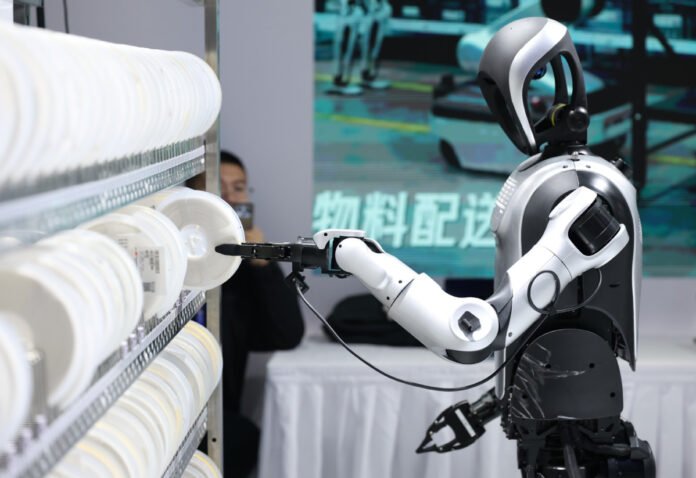
Emerging industries, particularly artificial intelligence applications, are gaining traction. At the Zhuge AI Center — an AI-focused industrial park within the zone — Chengdu Yuefan Innovation Technology has deployed the Sendbot Space system, a commercial embodied-intelligence sorting-and-delivery solution.

Unlike conventional logistics robots, this system operates as an autonomous intelligent agent, integrating sorting, dispatching, and delivery across multiple floors in office buildings. Employees place orders from their desks, while robots complete the entire chain with human-like perception, reflecting a leap in AI-enabled industrial automation.

These developments align with China’s “AI Plus” initiative, which accelerates the adoption of intelligent terminals, AI agents, and large-scale commercial AI applications, fostering new AI-native business models.

Investment and Innovation Outlook

For foreign investors and multinational corporations, Chengdu Hi-Tech Zone represents a strategic gateway into western China’s innovation ecosystem. With its robust technology-driven industrial base, the zone exemplifies China’s dual focus on manufacturing excellence and innovation-led growth, offering opportunities in electronics, AI, automation, and strategic emerging sectors.

Bai Wenxi, vice-chairman of the China Enterprise Capital Union, highlighted the zone’s achievements: “Chengdu Hi-Tech Zone illustrates how technology-driven development can create a sustainable, innovation-led growth model. For investors, the integration of AI, advanced manufacturing, and future industries provides a compelling landscape for long-term engagement.”

As China enters the 15th Five-Year Plan (2026–30), the Chengdu Hi-Tech Industrial Development Zone is poised to remain a cornerstone of western China’s industrial modernization, bridging high-tech innovation with market opportunities and demonstrating the potential of next-generation industries to drive regional and national growth.

Article inline ad

Advanced humanoid robot training marches ahead

0
By WANG SONGSONG and GUO YANQI | China Daily | Updated: 2026-03-28 

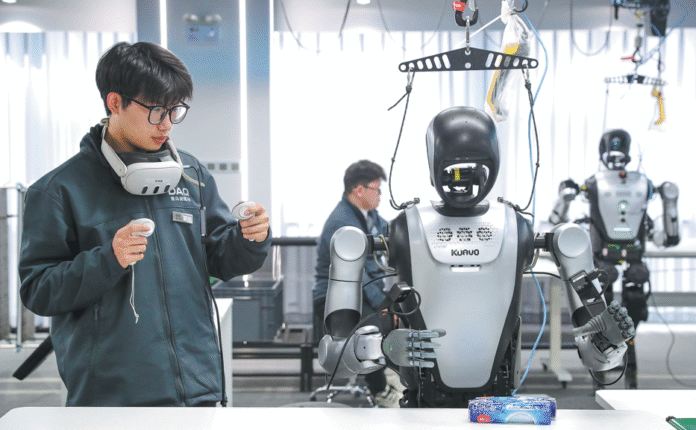
Shijingshan district in Beijing, on Friday, opened the third phase of its humanoid robot training center, combining advanced simulation and tactile technologies to create China’s largest robotics database.

The project, led by Beijing Shijingshan Science and Technology Innovation Co and Beijing Tashan Technology Co, provides simulated environments such as homes, hotels, supermarkets and factories, where more than 100 robots can train and collect essential data.

Dong Jianqiang, head of Tashan’s training platform, said robots first learn tasks in a controlled simulation scenario, then conduct real machine training for about a week before being deployed in real-world applications. The data collected serves three main purposes: supplying datasets to companies developing advanced AI models, training robots for specific applications, and supporting larger projects that include building scenarios, generating data and scaling up deployments.

What sets the project apart is its combination of vision, movement and tactile sensing. While visual systems alone can struggle with blind spots or capturing fine details, the addition of touch sensors allows robots to handle delicate tasks, such as gripping eggs without cracking them or manipulating fragile items like potato chips and tofu. A robot has to sense how an object changes shape when touched and how it returns to normal when released. “Physical contact data is essential for large-scale deployment in the future,” Dong said.

The third phase has introduced dozens of robot models from multiple manufacturers, allowing cross-platform training that was not possible in earlier phases, which relied on a few models from a single brand. Dong said this flexibility is key to developing more versatile robotic systems.

According to Fu Hang, director of the Zhongguancun Shijingshan Park integrated service center, the first two phases laid the groundwork for large-scale data collection. Phase one, completed in March 2025, deployed 100 wheeled robotic arms, creating Beijing’s first specialized data training facility. Phase two added 100 humanoid robots across multiple scenarios, generating millions of high-quality data points per year, Beijing News reported.

The project plans a fourth phase to introduce “data collection gloves”, offering a simpler and more agile way to gather training data, it added.

The push for such projects is fueled by strong market demand. A report released by Zheshang Securities on March 22 estimated that by 2030, China and the United States will need about 2.1 million humanoid robots for manufacturing and household services, representing a potential market of around 314.6 billion yuan ($45.6 billion).

The report added that humanoid robots are expected to see large-scale adoption first in industrial settings before gradually moving into household applications over the medium to long term.

The pace of adoption differs mainly because of environmental complexity. Dong explained that industrial sites are relatively controlled, with standardized components and predictable conditions, making it easier to deploy robots efficiently.

“Household environments, on the other hand, compress the full complexity of the real world into a small space,” he said. “This makes operations less predictable and more challenging, so widespread use of robots in homes is likely to take longer — perhaps five to 10 years — before we see meaningful progress.”

Yang Cheng contributed to this story.

Article inline ad

China’s Sci-Fi Industry Hits $18 Billion, Drives High-Tech Creative Economy

0

China’s science fiction sector is entering a new era of high-quality development, with total revenue reaching 126.1 billion yuan ($18.25 billion) in 2025, a 15.7% year-on-year increase, according to the 2026 China Science Fiction Industry Report released in Beijing. The milestone marks the third consecutive year that the sector has surpassed 100 billion yuan in annual revenue.

Multi-Sector Growth: Books, Games, Film, Derivatives, and Tourism

The report, published by the China Research Institute for Science Popularization, analyzes China’s sci-fi ecosystem across five pillars: reading, film and television, gaming, derivatives, and cultural tourism.

  • Publications: Sci-fi books, magazines, and online literature achieved 5.19 billion yuan, driven by eight consecutive years of growth, with online literature emerging as the key engine at 3.73 billion yuan.
  • Film and TV: Domestic sci-fi films, series, and animations posted 8.16 billion yuan, a 21.6% year-on-year rise, while AI-generated short and medium-form content (AIGC) gains rapid traction.
  • Gaming: The sector dominates with 77.91 billion yuan, with strong overseas performance from domestic IP.
  • Derivatives: Revenue soared 179.4% year-on-year to 7.07 billion yuan, highlighting opportunities in AI-powered toys and other tech-enhanced products.
  • Cultural Tourism: Generated 27.77 billion yuan, led by sci-fi-themed attractions, reflecting the growing link between immersive entertainment and local tourism economies.

Sci-Fi as a Bridge Between Culture and Technology

Renowned writer Liu Cixin emphasized the strategic role of science fiction in shaping China’s technological and cultural future:

“Science fiction goes beyond depicting technology. It compels us to consider why we embark on a journey and where we aim to go. Its development mirrors China’s modernization journey and sense of the future.”

The report introduced two new metrics: science fiction technology & equipment and search popularity. Sci-fi tech revenue reached 24.74 billion yuan, fueled by AI-driven digital content production and immersive experiences. Online search interest in Chinese sci-fi surged 203% year-on-year, underscoring growing domestic and international curiosity for homegrown IP.

Strategic Significance Amid the 15th Five-Year Plan

With the launch of China’s 15th Five-Year Plan (2026-30), experts see the sci-fi sector as a strategic lever for high-quality economic development:

  • Technological integration: AI, AIGC, and immersive technologies are fostering innovation in both content and production.
  • Cultural export: Overseas audiences for Chinese sci-fi IP continue to expand, creating commercial opportunities for publishers, gaming companies, and tech innovators.
  • New productive forces: Sci-fi is a tool for stimulating creativity, nurturing talent, and driving the convergence of cultural and industrial innovation.

Yu Junqing, executive secretary of the China Association for Science and Technology, noted:

“Science fiction can ignite scientific dreams, stimulate creativity, and drive integration between technology and industry. This is essential for cultivating new quality productive forces and supporting China’s vision for a strong nation in science and culture.”

Hans d’Orville, UNESCO adviser, highlighted China’s position in the global creative economy:

“Through cross-border collaboration and AI-driven innovation, China is well-placed to lead in sustainable development of cultural and technological sectors.”

Investment and Market Potential

For investors and creative enterprises, China’s sci-fi market signals opportunities across multiple dimensions:

  • Digital IP monetization: From gaming exports to AIGC-generated content, the sector demonstrates rapid revenue scalability.
  • Derivative products: AI-powered toys, merchandise, and immersive theme parks present untapped revenue streams.
  • Global expansion: Rising overseas interest in Chinese IP suggests potential for licensing deals, co-productions, and international tech partnerships.

As the sci-fi industry matures, it is increasingly seen not only as entertainment but as a strategic pillar of China’s tech-driven creative economy, blending culture, innovation, and international market potential.

Article inline ad

China records historic green power shift

0

Renewable capacity overtakes coal amid stronger clean energy push

By Zheng Xin | China Daily | Updated: 2026-03-27

China’s total electricity consumption more than doubled that of the United States in 2025, surging to a record 10.4 trillion kilowatt-hours, underscoring China’s role as the engine of global industrial output and the primary driver of the world’s energy transition.

The world’s second-largest economy further solidified its position as the top global power consumer last year, with its annual consumption now roughly exceeding the combined power usage of the US, Russia, India, Japan, Brazil and Canada, a massive scale that highlights the robust vitality of the nation’s economy, said Yang Kun, executive vice-chairman of the China Electricity Council (CEC).

“The industry achieved historic breakthroughs in power security and infrastructure reliability over the past year,” he said during a conference on the economic situation and power development analysis and forecast held in Beijing on Thursday.

CEC data reveal that China’s total installed power generation capacity reached 3.89 billion kilowatts by the end of 2025, representing a year-on-year increase of 16.1 percent.

A critical component of this success was the enhanced west-to-east power transmission project, which saw its capacity rise to 340 million kW, it said.

“This massive infrastructure artery proved vital in balancing energy resources, supporting an average annual increase of 80 million kW in load demand within the country’s high-growth eastern and coastal economic hubs,” said Yang.

The structure of China’s electricity consumption underwent a fundamental transformation in 2025, reflecting the rise of “new quality productive forces” and a shift toward high-tech manufacturing, he said.

While the secondary industry remains a foundational consumer, the tertiary industry emerged as a primary engine of growth, with power consumption rising by 8.2 percent to reach 1.99 trillion kWh.

Driven by the massive rollout of electric vehicles, charging piles and next-generation telecommunications infrastructure, power demand in the information technology and software services sector jumped 17 percent year-on-year. This surge vividly illustrates the nation’s rapid transition toward a digital economy and intelligent computing.

Notably, electricity consumed by the EV charging and battery-swapping service industry skyrocketed 48.8 percent in 2025. This exceptional growth is supported by the world’s largest and most comprehensive charging network, which now comprises over 20 million individual facilities deployed nationwide.

The robust external demand for China’s “new three” high-tech exports — EVs, lithium-ion batteries and advanced photovoltaic products — also fueled this energy appetite. Export volumes for these cutting-edge products approached 1.3 trillion yuan ($188.2 billion), driving electricity use in the high-tech and equipment manufacturing sectors up 6.4 percent.

On the sustainability front, the year 2025 marked a pivotal turning point for the country’s energy structure as renewable energy capacity broke 1.8 billion kW. This achievement meant that renewable power officially surpassed traditional coal-fired power capacity for the very first time in the nation’s history.

Nonfossil energy sources now account for an impressive 61.7 percent of China’s total installed capacity. With these renewables generating 4 trillion kWh of electricity over the year, green power has become the absolute backbone of new electricity generation across the entire country.

According to Ye Xiaoning, a senior engineer at the new energy department of the State Grid Energy Research Institute, China’s consistent efforts in grid and transmission infrastructure updates are drastically improving the nationwide optimization of renewable resources.

A widespread ultra-high-voltage transmission network, which allows electricity to be transmitted efficiently across vast distances, is at the heart of this transition, significantly altering the nation’s overall energy infrastructure, Ye said.

According to the council, the terminal energy electrification in China reached approximately 30 percent by the end of 2025, a figure that far exceeds the global average of 21 percent.

This high rate of electrification provides a solid foundation for nationwide energy conservation and deep carbon emission reductions, it said.

Article inline ad

AI Music Monetization Accelerates in China’s Digital Economy

0

China is emerging as a global leader in the commercialization of AI-generated music, demonstrating how artificial intelligence is reshaping the creative economy. In a striking example, 28-year-old programmer Yang Ping from Chengdu sold the rights to a fully AI-composed track in just two hours for 50,000 yuan ($7,238), illustrating the unprecedented speed at which AI content is being produced, monetized, and scaled in China.

Yang’s track, Seven-Day Lover, was created using AI models that emulate the musical style of popular artists, capturing existing aesthetic preferences and quickly racking up millions of views. Over nine months, Yang reported earning more than 200,000 yuan simply by leveraging AI music creation, highlighting the low barrier to entry and rapid revenue potential in this emerging field.

China Leads in AI Music Development

At the Zhongguancun Forum in Beijing, Kunlun Tech unveiled its latest Mureka AI music model, building on a prior version that topped global rankings in both vocal and instrumental categories. Fang Han, CEO of Kunlun, emphasized that the model is updated every three months, reflecting both China’s engineering capabilities and its expansive application scenarios.

Commercial applications are proliferating. AI singer Yuri, who garnered millions of views with her debut video, has since been appointed Digital Exploration Creative Officer by The North Face, securing cross-industry partnerships in tech, gaming, and automotive sectors.

According to market consultancy Grand View Research, the global generative AI music market is projected to reach $2.8 billion by 2030, with the Asia-Pacific region—led by China—emerging as the fastest-growing segment. QYResearch projects that China’s AI music software market alone could approach $600 million by 2032.

Legal and Ethical Challenges

Despite rapid growth, AI music faces significant legal and ethical hurdles. The key issues include the copyright status of AI-generated tracks, the legality of using copyrighted works for AI model training, and potential infringement risks. Liu Zhijun, a lawyer at Beijing Bairui Law Firm, noted that current regulations do not clearly define who owns the rights to AI-created content, creating uncertainties for both creators and investors.

“Questions about fair use in AI training and copyright ownership for AI outputs remain unresolved,” Liu said, underscoring the need for updated frameworks as AI continues to scale.

Implications for the Global Music Industry

Experts suggest that AI is not replacing human creativity but driving the next phase of the music industry. By automating composition, production, and distribution, AI expands creative possibilities, introduces new business models, and accelerates time-to-market for musical content.

For investors and international players, China’s AI music sector represents a fast-moving, high-potential opportunity. The combination of technical innovation, market scale, and monetization pathways makes the Chinese AI music ecosystem a key indicator of the future global digital economy.

Huang Zongquan, a professor at the Central Conservatory of Music, summarized the trend: “AI enriches both the form and content of music while opening up new business models. It is a driver of growth, not the end of creativity.”

Article inline ad

China’s Hydrogen Ambitions: From Policy Niche to Global Market Leader

0

According to a report by China Daily on March 27…

China is rapidly transforming hydrogen from a policy-driven niche into a strategic pillar of its energy and industrial economy, signaling a major opportunity for global investors, technology providers, and industrial players. As the country embarks on its 15th Five-Year Plan (2026-30), hydrogen is positioned at the center of China’s broader push toward low-carbon growth, industrial upgrading, and sustainable urbanization.

Scaling Up Hydrogen: From Pilot to Industrial Backbone

The fifth China International Hydrogen Congress and Expo in Beijing convened top government officials, energy experts, and corporate leaders to outline a national blueprint for industrial-scale hydrogen deployment. According to Bian Guangqi, deputy director-general of the National Energy Administration’s science and technology department, China aims to transition hydrogen from policy-driven growth to a market-driven, commercially sustainable industry.

“Hydrogen is a vital tool for decarbonizing hard-to-abate sectors such as steelmaking, chemicals, and heavy transport,” Bian said. “Our focus in the 15th Five-Year Plan is to integrate hydrogen into large-scale ‘wind-solar-hydrogen-ammonia-alcohol’ bases, accelerate technological innovation, and expand international collaboration.”

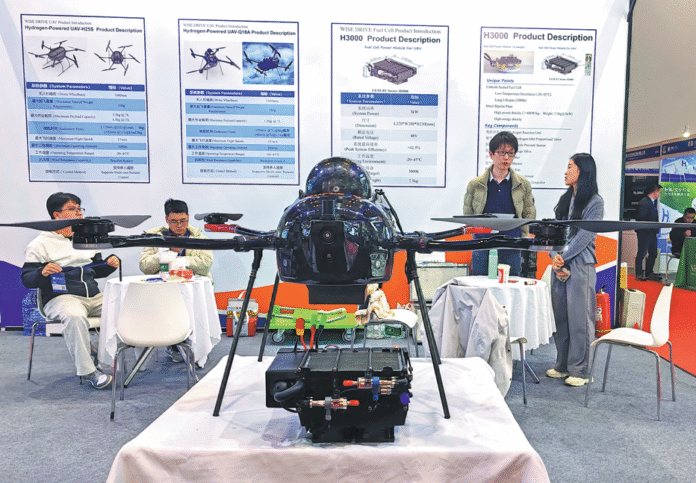
Building on the 14th Five-Year Plan (2021-25), which saw hydrogen move from pilot projects to industrial breakthroughs, China has now achieved notable scale: renewable hydrogen production capacity has jumped from 23,000 metric tons to 250,000 tons per year, supported by mega-projects in regions like Xinjiang. Over 30,000 fuel cell vehicles are already on the road, backed by a network of 590 hydrogen refueling stations, while Chinese firms export electrolyzers and other core technologies to more than 30 countries.

Strategic Opportunities for Global Stakeholders

Despite China’s domestic growth, green hydrogen — produced with renewable electricity — accounted for less than 1% of global hydrogen production in 2025, highlighting enormous untapped potential. Vineet Bhatia, senior advisor to UNDP China, emphasized that the Ordos UNDP green hydrogen demonstration project in Inner Mongolia could serve as a model for integrating hydrogen into energy, transport, and industrial systems both domestically and internationally.

For multinational corporations, this presents multiple entry points:

  1. Technology Partnerships – Advanced electrolyzers, fuel cells, and storage solutions are in high demand as China expands industrial hydrogen production.
  2. Industrial Collaboration – Steel, chemical, and heavy-duty transport companies can leverage hydrogen to decarbonize operations while accessing preferential policies.
  3. Investment and Infrastructure – Green hydrogen facilities and refueling networks offer opportunities for joint ventures, project finance, and public-private collaboration.

Policy and Market Synergy

The inclusion of hydrogen in China’s Energy Law and its recognition as a new growth driver in the 2026 Government Work Report reflect a robust policy framework. Officials stressed the integration of renewable energy, regulatory standardization, and global cooperation as critical enablers.

Bian highlighted that the development of hydrogen as a future industry is a strategic move to harness opportunities from the new scientific and technological revolution. As China continues scaling both production and consumption, international stakeholders stand to benefit from aligning with the country’s industrial and green energy policies.

The Road Ahead

China’s hydrogen ambitions are not just a domestic energy story; they signal a global shift. The country is leveraging scale, innovation, and international partnerships to position itself as a leader in the emerging hydrogen economy. For investors and technology providers, understanding this evolving landscape will be crucial to capturing early-mover advantages and integrating into China’s industrial supply chains.

Key Metrics to Watch:

  • Renewable hydrogen capacity: 250,000 tons/year (2026)
  • Fuel cell vehicles: 30,000+ deployed
  • Hydrogen refueling stations: 590+ nationwide
  • Global technology exports: electrolyzers to 30+ countries
Article inline ad

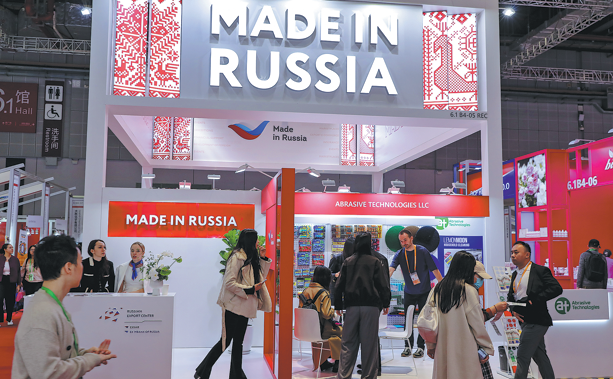
China-Russia Strategic Dialogue Signals Deepening Economic Ties

0

According to a report by China Daily on March 27…

Amid a rapidly shifting global economy, China and Russia are accelerating efforts to align macroeconomic strategies, financial innovation, and technological collaboration, aiming to reinforce a stable and multipolar world order.

This vision was highlighted at the inaugural China-Russia Education and Economic Dialogue, held in Moscow on March 17. Co-hosted by the Free Economic Society of Russia and Renmin University of China, the high-level forum convened policymakers, scholars, and business leaders to discuss the transition from traditional economic models toward sustainable, innovation-driven growth.

Strategic Coordination for a New Era

Zhang Donggang, Party secretary of Renmin University, emphasized the strategic importance of the China-Russia comprehensive partnership, noting that both nations are central to Eurasia’s economic vitality. He stressed that shared challenges—from technological competition to global supply chain volatility—require coordinated, forward-looking strategies.

“New opportunities are transforming international relations,” Zhang said. “Addressing these challenges shoulder-to-shoulder allows us to craft unified action plans that strengthen regional and global stability.”

Zhang also highlighted China’s ongoing economic modernization, guided by the 15th Five-Year Plan (2026-30). Central priorities include high-quality growth, technological self-reliance, and green, low-carbon industrial development—elements Russia views as reference points for its own modernization trajectory.

Modernizing the Global Financial System

A key focus of the dialogue was international financial architecture reform. Sergey Glazyev, academician of the Russian Academy of Sciences, proposed a “world settlement digital currency” pegged to a basket of national currencies and exchange-traded commodities, potentially within the BRICS framework. Such a mechanism, Glazyev suggested, could enhance transparency, mutual trust, and global financial stability.

Glazyev further advocated for the creation of an independent international credit rating agency, providing unbiased assessments to support a fairer and more resilient global economic system.

Education, Innovation, and AI as Growth Drivers

The forum underscored the critical role of education and technology in sustaining long-term economic resilience. Oleg Smolin, first deputy chairman of Russia’s State Duma Committee on Science and Higher Education, emphasized that artificial intelligence is pivotal to global competitiveness, yet “the natural intelligence of youth” remains the foundation for innovation.

Sergey Bodrunov, president of the Free Economic Society of Russia, reinforced this point: “National economic development relies on cultivating skilled professionals and modern specialists. There is no modern industry without education.”

Rising Bilateral Trade and Investment Opportunities

The dialogue took place against a backdrop of strong China-Russia economic performance, with bilateral trade reaching historic highs in 2025 and continuing its upward trajectory in early 2026. Experts highlighted that deeper academic, technological, and financial ties will provide the intellectual and structural infrastructure needed to navigate global economic uncertainty.

For multinational corporations and investors, the implications are clear: China and Russia’s coordinated strategy opens pathways for joint innovation, supply chain resilience, and participation in emerging markets. As these two major economies integrate policy, technology, and education, the potential to shape global economic norms and investment flows will grow significantly.

Article inline ad