Tuesday, November 24, 2026

Home Blog Page 35

China’s AI Integration Drives New Smart Economy Paradigm

0

Compiled from a report by China Daily on March 13.

China is accelerating the integration of artificial intelligence (AI) into core industrial and business processes, creating new opportunities for enterprises and investors as the country transitions into a smart economy. Industry leaders and scholars emphasize that AI is no longer just a supportive tool—it is becoming a strategic driver of process innovation, efficiency gains, and industrial competitiveness.

Recent guidance in China’s 2026 Government Work Report encourages the deep application of AI to “create new forms of smart economy,” signaling policy support for technology-driven modernization. Experts stress that successful AI adoption requires more than deploying isolated systems; it necessitates system-wide digital transformation.

Jiang Qiping, deputy director of the academic committee of the China Management Science Society, explained that enterprises must embed AI into core operational flows to unlock its full potential. “Integrating AI into business processes enables companies to convert technological potential into real industrial momentum,” he said.

International observers also see China’s AI-driven transformation as a major economic lever. Muhammad Hamayun, a scholar from Multimedia University in Malaysia, noted that AI is enabling enterprise-level process restructuring, with implications for productivity, competitiveness, and regional economic modernization.

Industry-Scale Impact and Market Growth

China’s core AI sector surpassed 1.2 trillion yuan ($174.5 billion) by the end of 2025, with projections indicating AI-related industries could reach over 10 trillion yuan by 2030 under the 15th Five-Year Plan. This massive scale has captured international attention, as investors seek exposure to AI-enabled industrial upgrades and digital transformation initiatives.

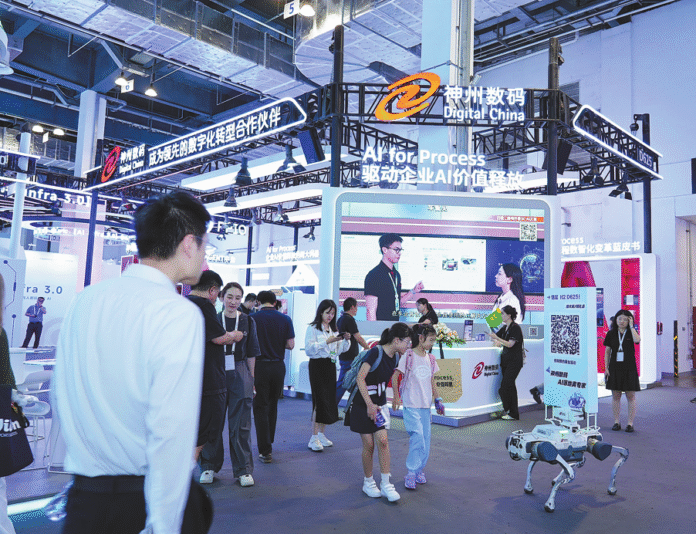
Guo Wei, chairman of Digital China, highlighted the company’s “AI for Process” mechanism, which integrates AI across production, sales, and service functions to enhance efficiency, coordination, and decision-making. Li Gang, Digital China’s CTO, added that this approach shifts AI from a support function to a core operational driver, allowing enterprises to move from traditional information architectures to intelligence-centric development models.

Case in Point: Voyah’s Digital Transformation

Digital China’s process-driven AI model has produced tangible outcomes for Voyah, a high-end smart new energy brand under Dongfeng Motor Corporation. By integrating large AI models into cross-functional operations and knowledge governance, Voyah has achieved end-to-end operational efficiency, supporting both strategic growth and customer delivery excellence.

Xu Yuance, head of digital large model applications at Voyah, commented, “Embedding AI across production, sales, and service processes generates far greater value than simple efficiency gains. This systematic approach underpins high-quality delivery and strengthens inter-team collaboration.”

Implications for International Investors

For global investors, China’s AI integration presents multi-layered opportunities:

  • Industrial leaders adopting AI are likely to outperform peers in efficiency and innovation.

  • AI infrastructure and service providers stand to benefit from the growing demand for process-centric solutions.

  • Cross-border partnerships leveraging AI for production, logistics, and energy optimization are increasingly strategic.

As AI evolves from concept to a practical engine of smart economy growth, China’s enterprises are setting benchmarks for both domestic competitiveness and global industrial standards.

Investor takeaway: Focus on companies leading in process-driven AI adoption, as they are positioned to capture efficiency gains, expand market share, and drive industrial innovation in China’s rapidly modernizing economy.

Article inline ad

China’s “Token Exports”: China Turns Energy and AI Into Global Competitive Edge

0

Compiled from a report by China Daily on March 13.

China is quietly transforming its abundant electricity and computing capacity into a new form of global trade: AI “tokens.” These tiny digital units — the currency of large AI models — are emerging as one of the most efficient value-added exports from the world’s second-largest economy, creating both opportunities and strategic advantages for international investors.

In February 2026, Chinese AI models processed 4.12 trillion tokens on the global aggregator platform Open-Router, surpassing the US total of 2.94 trillion. Leading Chinese developers, including MiniMax and DeepSeek, now occupy four of the platform’s top five positions, largely driven by US users.

This rapid rise is not merely a function of low electricity costs. Experts highlight a triad of advantages:

  1. Energy Cost Efficiency – China’s surplus green energy, particularly from the ultrahigh-voltage western grid, allows large-scale AI computation at fraction-of-global-market prices.

  2. Advanced AI Technical Capabilities – Chinese models increasingly adopt Mixture-of-Experts (MoE) architectures, which activate only the necessary neural pathways for each query, drastically reducing computational power and electricity per token.

  3. Integrated Supply Chain and Infrastructure – National coordination of electricity and AI computing ensures seamless energy-to-computation synergy, positioning China as a leader in large-scale, low-cost AI output.

According to Qiu Zeyu, deputy partner at Roland Berger, the alignment of computing power and electricity into national policy demonstrates that China is deliberately building a strategic moat for its digital economy, turning what was once a domestic advantage into a globally exportable asset.

Industry observers note that the economic impact is profound: converting electricity into AI tokens yields an estimated 22-fold increase in value compared to exporting raw power. For investors, this signals a new layer of digital value creation, where energy-intensive industries intersect with high-tech AI deployment.

However, analysts also caution about risks. While China’s token exports give it a structural cost advantage, geopolitical tensions and data security considerations could affect market access abroad. Morgan Stanley’s chief China economist, Xing Ziqiang, points to the experience of Chinese 5G equipment makers, which faced international restrictions despite competitive technology.

From an investor’s perspective, China’s token economy represents emerging opportunities in digital infrastructure, AI services, and cross-border cloud computing markets. Companies integrating Chinese AI services can achieve lower costs and faster computation times, while investors can consider exposure to AI compute hardware, energy-optimized data centers, and token-based service platforms.

Looking ahead, China’s government has explicitly included computing-electricity synergy as a national priority in the 2026 Government Work Report. As the global AI industry expands, Chinese “token exports” are likely to remain a key driver of international competitiveness and a model for value-added digital trade.

Investment Takeaways:

  • Strategic edge: Chinese AI token exports convert low-cost electricity into globally valuable computation.

  • Sector focus: Data center operators, AI platforms, cloud infrastructure, and GPU suppliers stand to benefit.

  • Risks: Geopolitical barriers and data security issues could limit international market penetration.

  • Outlook: With continued government support, token-driven digital trade will likely expand, underpinning China’s role in the global AI ecosystem.

Article inline ad

Critical Minerals Become a Strategic Growth Frontier in China’s AI-Driven Mining Revolution

0

Compiled from a report by China Daily on March 13.

Shanghai, China — As global demand for critical minerals surges, China is leveraging artificial intelligence (AI) to transform its mining sector, creating a high-value market poised for both industrial modernization and strategic competition. International investors and industry observers are taking note, as new AI-driven exploration models promise to dramatically increase efficiency, reduce costs, and accelerate discovery cycles in this previously low-yield sector.

Feng Yunduan, chairman of DeepVein Holdings, highlighted at the 2026 Appliance and Electronics World Expo in Shanghai that the integration of AI with traditional mining is unlocking a previously untapped trillion-yuan ($144 billion) market. “By combining Mixture-of-Experts AI models with decades of geological data, we’ve increased exploration success rates from less than 1 percent to nearly 50 percent in our projects, while reducing exploration cycles from five years to six months,” Feng said.

This AI-driven approach uses unmanned aerial vehicles equipped with multispectral and magnetic sensors, alongside robotic dogs capable of autonomous sampling, to navigate complex terrains and abandoned sites. On the beneficiation side, AI-enhanced technologies integrate dual energy XRT, XRF, and advanced sorting algorithms to recover high-value ore fractions that traditional processes often lose, generating substantial cost savings. In one Southeast Asia project, these innovations saved an estimated 50 million yuan annually in grinding costs.

The urgency for technological modernization is underpinned by a global strategic imperative: critical minerals such as rare earths, lithium, cobalt, tungsten, tantalum, and antimony are essential to clean energy, AI hardware, aerospace, and defense sectors. According to the International Energy Agency, global demand for these minerals is projected to nearly double by 2030 and quadruple by 2050.

“Amid the global energy transition and ongoing technological revolution, control and access to strategic mineral resources have become central to national competitiveness,” said Li Jinfa, former director of the China Geological Survey. China’s 15th Five-Year Plan (2026–2030) emphasizes AI-enabled, high-precision mining as a core driver of industrial growth, signaling policy support for both domestic development and international investment opportunities.

For international investors, these developments indicate multiple avenues for engagement:

  • AI-driven Mining Solutions: Companies like DeepVein are creating scalable AI platforms that can be licensed or co-developed internationally, offering exposure to high-growth segments of the mining technology market.

  • Strategic Minerals Supply Chains: Securing upstream exposure to rare earths, cobalt, lithium, and tungsten aligns with global demand for renewable energy, electric vehicles, and advanced electronics.

  • Industrial AI Partnerships: Collaboration opportunities exist with Chinese firms integrating AI into mining operations, offering knowledge transfer, joint ventures, and access to high-efficiency processes.

By embedding AI into the entire mining lifecycle—from exploration to beneficiation—China is not only modernizing an industrially strategic sector but also generating a blueprint for investors to access a frontier market where technology and natural resources intersect.

Investment Takeaways:

  1. High Growth Potential: The AI-driven mining market in China could exceed $144 billion, with global spillovers expected through tech partnerships and equipment exports.

  2. Strategic Asset Class: Critical minerals will remain a focal point for energy transition, defense, and high-tech industries.

  3. Policy-Backed Opportunities: National support ensures accelerated adoption of intelligent mining, reducing operational risks for foreign collaborators and investors.

China’s fusion of AI and strategic mineral exploration marks a new era where technology not only optimizes efficiency but also shapes global industrial competition—presenting opportunities for both industrial partners and long-term investors seeking exposure to high-value, future-critical resources.

Article inline ad

Zeiss Positions China as a Global Innovation Hub and Market Engine

0

Compiled from a report by China Daily on March 13.

German optical giant Zeiss Vision has reaffirmed China as both a key market and a global innovation engine, underscoring the country’s role in driving the company’s worldwide R&D and smart manufacturing strategy. The move signals China’s growing importance not just as a consumption market, but as a center of technological advancement that attracts international investment.

Strategic Investment and Innovation Hub
Over the next five years, Zeiss plans to expand its footprint in China, integrating global resources to accelerate smart manufacturing, localize research and development, and foster collaborative innovation ecosystems. “Our China innovation hub is designed not only for local needs but for the world,” said Sven Hermann, executive board member of the 180-year-old Zeiss Group and CEO of Zeiss Consumer Markets.

At the recent China (Shanghai) International Optics Fair, Zeiss showcased a dedicated exhibition house with five thematic zones highlighting the latest breakthroughs, emphasizing strategic co-creation, immersive experiences, and global product launches. A centerpiece was the debut of the Zeiss MyoActive Lens, powered by Zeiss M.O.V.E. technology, which clinically controls myopia progression and represents the company’s commitment to precision eye health.

Robust Local Ecosystem
Zeiss has developed an extensive innovation ecosystem in China, partnering with leading universities and hospitals, including Zhongshan Ophthalmic Center of Sun Yat-sen University, and collaborating with Tencent Health on AI-powered eye care solutions. These initiatives enable Zeiss to tailor products for Chinese consumers while simultaneously exporting innovations globally.

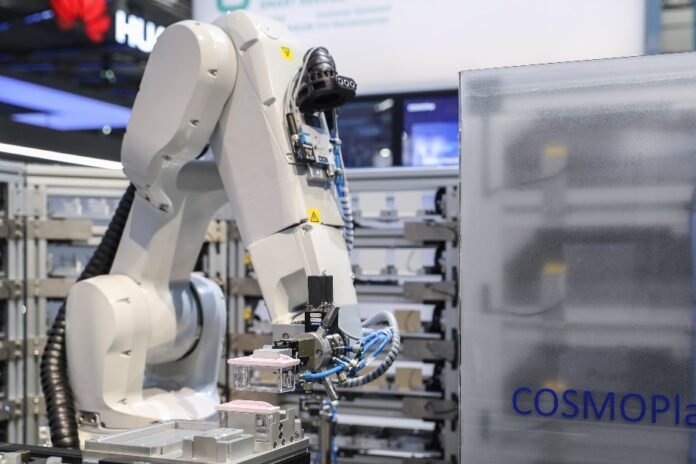
The company has also invested over 4.2 billion yuan ($608 million) across six legal entities in Guangzhou, transforming its operations from a local manufacturing base into a comprehensive eye health ecosystem. The Guangzhou Manufacturing Base has been recognized as a “lighthouse factory” by the World Economic Forum, reflecting end-to-end digital transformation in optical precision manufacturing. Technologies such as machine learning, digital twins, and AI agents have reduced delivery times by 29%, while enhancing product personalization for age, vision needs, and lifestyle.

Expanding Technology Frontiers
Zeiss is accelerating its entry into AR, VR, mixed reality, and smart glasses, signaling new avenues for growth in China’s technology-driven healthcare and consumer markets. The company has actively engaged with local governments to facilitate market expansion and innovation support, ensuring alignment with regional strategies and policy incentives.

Investment Takeaways for Global Investors

  • China as a dual-market and innovation hub: Multinational companies are increasingly using China not only for sales but as a base for global R&D.

  • Smart manufacturing and digital transformation: Investment in AI, digital twins, and precision manufacturing creates competitive advantages and efficiency gains.

  • High-value consumer and healthcare opportunities: Aging populations and rising healthcare awareness drive demand for personalized and technologically advanced optical solutions.

  • Policy alignment and collaboration potential: Companies actively engaging with local governments and research institutions gain strategic advantages in regulatory navigation and innovation support.

For international investors, Zeiss’ China strategy underscores the country’s evolving role as a global innovation engine, offering both market growth and R&D synergies that can shape multinational corporate strategy for the next decade.

Article inline ad

Asian Firms Eye Strategic Partnerships Amid China’s Tech Surge

0

Compiled from a report by China Daily on March 13.

Asian businesses are actively seeking partnerships with Chinese tech companies as China accelerates its drive toward a smart economy, offering fresh opportunities for international investors and regional enterprises.

At the recent Technology for Change Asia 2026 forum in Hong Kong, organized by Economist Impact, senior executives from across Southeast Asia and South Asia highlighted China’s rapidly evolving technological landscape as a catalyst for collaboration and market expansion.

Thailand’s CP Axtra has leveraged Chinese tech partnerships to transform its digital operations. Tanit Chearavanont, Group Chief Commercial Officer, noted that cooperation with Cainiao, the logistics arm of Alibaba, enabled the company to handle 2 million parcels daily and increase its e-commerce penetration from 3% to 30%. “China’s tech evolution is incredibly fast, and partnering with Chinese innovators allows us to scale efficiently,” he said. CP Axtra is also exploring partnerships with Chinese large language model providers to strengthen its digital infrastructure and plans to enter Chinese e-commerce platforms, creating a two-way exchange of products between China and Thailand.

Malaysia is taking a strategic approach to tech collaboration with China. Norman Matthieu Vanhaecke, CEO of Cradle Fund, an agency under Malaysia’s Ministry of Science, Technology and Innovation, emphasized that partnerships with Chinese tech firms complement ASEAN’s youthful digital talent and rapidly growing markets. “Strengthening ties with Chinese AI companies is key to building Malaysia’s startup ecosystem and achieving our goal of ranking among the world’s top 20 ecosystems by 2030,” he said. Vanhaecke also highlighted China’s support for open-source AI communities, which could accelerate innovation across Southeast Asia by making AI tools widely accessible.

In India, healthcare enterprises see similar opportunities. Madhu Sasidhar, CEO of Apollo Hospitals, stressed that AI-driven precision medicine will depend on open platforms that reduce costs and expand accessibility. “China’s efforts to open certain AI technologies globally empower innovators who might never have had access to advanced tools, particularly in healthcare,” he said.

Analysts at Economist Impact underscore that China’s combination of policy support, AI innovation, and smart economy initiatives positions it strongly in global competition. Charles Ross, Head of Policy and Insights for Asia-Pacific, noted that Chinese companies have demonstrated resilience and energy-efficient innovation even under restrictive conditions, and further policy encouragement will strengthen their global competitiveness.

Across ASEAN and South Asia, international investors are closely monitoring China’s tech landscape for opportunities to co-develop AI applications, integrate supply chains, and tap into expanding digital markets. Executives emphasize that collaboration with Chinese firms not only accelerates technology adoption but also unlocks new revenue streams in e-commerce, logistics, healthcare, and AI-powered services.

Investment Takeaways:

  • China’s AI and digital ecosystem provides fertile ground for cross-border partnerships, particularly in logistics, e-commerce, healthcare, and enterprise AI applications.

  • Open-source AI initiatives in China could lower entry barriers for regional startups and foster scalable solutions across ASEAN markets.

  • Strategic alliances with Chinese tech leaders offer international firms faster market access and operational efficiency gains.

  • Investors should monitor policies supporting AI, smart economy growth, and international collaboration as signals for long-term partnership opportunities.

Article inline ad

How AI Is Reshaping the Structure of China’s Chip Companies

0

Compiled from a report by China Daily on March 13.

Artificial intelligence is beginning to transform the way semiconductor companies operate, from product design and engineering workflows to management structures and decision-making processes.

Industry executives say the integration of AI tools could significantly improve efficiency across chip development while accelerating broader changes in how semiconductor firms organize their workforces and corporate structures.

AI Entering the Semiconductor Design Process

According to executives at Silergy, AI technologies are increasingly capable of automating tasks traditionally performed by integrated circuit (IC) designers.

These include:

  • Circuit layout design

  • Optimization of chip architectures

  • Large-scale data analysis in development processes

By automating repetitive and data-intensive tasks, AI can reduce engineering workloads, improve development efficiency and lower management costs across semiconductor firms.

The technology also enables companies to process large volumes of technical and operational data more effectively, allowing design teams to focus on higher-value innovation.

Data-Driven Decision-Making

Beyond engineering applications, AI is also expected to influence corporate decision-making within chip companies.

By analyzing sales data, supply chain dynamics and market trends, AI systems can help semiconductor firms:

  • Forecast demand more accurately

  • Optimize inventory levels

  • Improve supply-chain coordination

  • Manage operational risks

Executives say the main advantages of AI-driven decision-making lie in its speed, analytical scope and objectivity, enabling management teams to react faster to rapidly changing technology markets.

Organizational Structures May Become Flatter

The widespread adoption of AI tools could also reshape how semiconductor companies are structured internally.

Industry observers expect AI to gradually replace certain routine administrative and operational functions, potentially reducing layers of management and leading to flatter organizational structures.

Such structural changes may encourage faster communication and decision-making across engineering teams and departments — an important advantage in the fast-moving semiconductor industry.

Engineers Will Remain Essential

Despite the growing role of AI in chip development, experts emphasize that the technology is unlikely to replace skilled semiconductor engineers.

Instead, the role of engineers is expected to evolve.

Professionals will still be needed to:

  • Validate AI-generated design solutions

  • Train and refine algorithms

  • Integrate AI tools into complex chip development processes

In many cases, demand for highly skilled chip designers and engineers may actually increase, particularly those capable of combining semiconductor expertise with data science and AI capabilities.

A New Talent Model for the Semiconductor Industry

As AI becomes more deeply integrated into semiconductor operations, companies will likely need to rethink their internal talent structures.

Industry leaders suggest several key priorities for chip companies moving forward:

  • Strengthening employees’ digital and data-analysis skills

  • Improving cross-department collaboration

  • Building more flexible organizational frameworks

  • Encouraging a culture of innovation and technological experimentation

These adjustments could help semiconductor firms adapt to a future where AI-assisted engineering and data-driven management become standard industry practices.

Implications for the Global Semiconductor Industry

The integration of AI into semiconductor companies reflects a broader trend across the global technology sector, where AI is increasingly used to accelerate research, optimize production and enhance operational decision-making.

For China’s chip industry — which is investing heavily in technological upgrading and supply chain resilience — AI-driven transformation may play a key role in improving productivity and strengthening competitiveness in the global semiconductor landscape.

Article inline ad

Insurance Capital Set to Increase Equity Exposure in China

0

Compiled from a report by China Daily on March 13.

China’s insurance industry — one of the country’s largest pools of long-term capital — is expected to increase its allocation to equities, a trend that could bring substantial institutional funding into the country’s stock market in the coming years.

The shift comes as policymakers continue pushing reforms aimed at expanding direct financing and strengthening capital markets, while encouraging long-term investors to play a larger role in supporting economic and technological development.

A Growing Source of Institutional Capital

China’s insurance sector has rapidly expanded in scale, creating a significant reservoir of investable capital.

According to the National Financial Regulatory Administration, the balance of funds under management by Chinese insurers reached 38.48 trillion yuan ($5.57 trillion) by the end of 2025, representing a 15.7 percent increase from the previous year.

Within these portfolios, equity exposure has already risen notably. Holdings of stocks and securities investment funds by property and life insurers reached 5.7 trillion yuan, accounting for 15.38 percent of total insurance assets, the highest level on record.

Market analysts expect the upward trend to continue in 2026 as insurers gradually diversify away from low-yield fixed-income assets.

Interest Rate Environment Driving Portfolio Shifts

With interest rates trending lower, insurers are increasingly seeking higher-yielding investments.

Analysts note that insurance companies are reducing allocations to low-return assets and gradually shifting capital toward equities and bond markets, reflecting broader changes in the domestic financial landscape.

Securities firms estimate that the growth of equity investments by insurers could continue at around the trillion-yuan level annually, supported by strong premium growth and improving expectations for China’s capital markets.

Under a neutral scenario, additional funds flowing into equity markets from insurers could reach over 700 billion yuan in 2026, according to market estimates.

Bullish Outlook for China’s A-Share Market

Survey data from the Banking and Insurance Asset Management Association of China suggests that institutional investors remain broadly optimistic about China’s equity market outlook.

Among insurance institutions surveyed:

  • More than 60 percent plan to moderately increase stock investments

  • Around 30 percent expect to maintain current allocations

Many insurers are focusing on sectors aligned with China’s industrial and technological transformation, including:

  • Electronics and semiconductors

  • Power equipment and energy technologies

  • Telecommunications and computing

  • Pharmaceuticals and biotechnology

  • Advanced manufacturing and robotics

Investment themes attracting particular attention include AI computing power, commercial aerospace, energy metals and innovative drug development, as well as companies pursuing global expansion strategies.

Hong Kong Market Remains Key Overseas Destination

Outside mainland markets, Hong Kong equities remain the most favored overseas investment destination for Chinese insurers.

Roughly half of insurance asset management firms plan to increase allocations to Hong Kong stocks, while about 40 percent expect to maintain their current positions.

The trend reflects the role of Hong Kong as an important international capital market gateway linking Chinese institutional investors with global markets.

Long-Term Capital Supporting Technology Innovation

China is also seeking to leverage insurance capital to support technological innovation.

New policy guidelines aim to accelerate the development of technology insurance, encouraging insurers to direct long-term funding toward companies engaged in major national research initiatives and emerging industries.

Authorities are promoting the use of insurance funds as “patient capital” — long-term investment capital capable of supporting innovation cycles in sectors such as advanced technology, frontier science and future industries.

Policymakers are also encouraging insurers to increase financial support for venture capital funds investing in frontier technologies, reinforcing the link between capital markets and China’s innovation ecosystem.

Implications for Investors

For global investors, the growing presence of insurance capital in China’s equity market signals a broader structural shift.

As one of the largest sources of long-term institutional capital, insurance funds can help stabilize markets, improve liquidity and support financing for high-growth sectors.

If the trend continues, insurers may become an increasingly influential force in shaping the structure and performance of China’s capital markets — particularly in sectors tied to technology upgrading and industrial transformation.

Article inline ad

China Places Domestic Demand at the Center of Its Economic Strategy

0

Compiled from a report by China Daily on March 13.

China is placing domestic demand at the core of its economic strategy, signaling a structural shift toward a more consumption-driven growth model that could reshape the country’s role in the global economy.

Policies outlined in the latest Government Work Report highlight expanding domestic demand as the top policy priority for the second consecutive year, reflecting Beijing’s long-term goal of transforming China from the “world’s factory” into one of the world’s largest consumer markets.

Consumption as a New Growth Engine

China’s consumer market has already reached significant scale. According to the National Bureau of Statistics of China, total retail sales of consumer goods exceeded 50 trillion yuan ($7.23 trillion) in 2025 for the first time. Final consumption expenditure contributed 52 percent of economic growth, underscoring the growing importance of household spending.

Policymakers view domestic demand not only as a short-term growth stabilizer but also as a long-term strategic pillar for economic security and sustainable development.

By strengthening household purchasing power and encouraging consumption upgrades, China aims to create a more resilient economy that is less dependent on external demand.

Policy Measures to Boost Household Spending

To stimulate consumer demand, authorities are rolling out a series of policy measures designed to strengthen income growth and improve social welfare.

Key initiatives include:

  • A comprehensive income growth plan for urban and rural residents

  • Measures to increase earnings among low-income groups

  • Efforts to expand property income opportunities

  • Continued improvements to the social security system

These policies are intended to raise household confidence and spending capacity, creating a stronger foundation for long-term consumption growth.

Trade-In Programs and New Consumption Scenarios

The government is also expanding programs to upgrade consumer goods and services.

According to the Government Work Report, about 250 billion yuan in ultra-long special treasury bonds will be allocated to support consumer goods trade-in programs, encouraging households to replace older products with green and intelligent alternatives.

The initiative will also provide additional support for brick-and-mortar retailers, helping them adapt to evolving consumption patterns.

Meanwhile, policymakers plan to accelerate the development of new consumption scenarios, particularly in services such as tourism, cultural entertainment and lifestyle experiences.

Shift Toward Service Consumption

Economists say China’s consumption structure is gradually shifting from durable goods — such as automobiles and home appliances — toward service-based spending.

Data from the National Bureau of Statistics of China shows that per capita service consumption expenditure grew at an average annual rate of 8.5 percent between 2020 and 2025.

This trend reflects several structural factors:

  • Rising household incomes

  • Demographic shifts

  • Increasing demand for lifestyle and experience-driven consumption

Analysts believe the next stage of growth will depend on improving service quality, diversity and supply capacity.

Opportunities for Global Companies

China’s expanding consumer market is also creating opportunities for international companies.

Authorities have pledged to broaden market access for foreign investors in key service sectors, including value-added telecommunications, biotechnology and wholly foreign-owned hospitals.

Foreign businesses are already positioning themselves to benefit from rising consumption.

Executives from global brands say China remains a critical pillar of their global strategy. Companies such as Coach and McDonald’s are continuing to expand their presence in the country’s rapidly evolving consumer market.

McDonald’s China plans to open more than 1,000 new restaurants in 2026, aiming to capture growing demand for dining and lifestyle consumption.

Global Growth Implications

Economists note that a stronger Chinese consumer market could reinforce the country’s role as a major driver of global economic growth.

As China expands imports and opens new channels for international products and services, the country’s domestic market is expected to play a larger role in supporting global businesses.

For international investors and multinational companies, the message is clear: China’s long-term economic trajectory is increasingly tied to the strength and expansion of its consumer market.

Article inline ad

China Pushes Mutual Funds Toward Long-Term Performance Disclosure

0

Compiled from a report by China Daily on March 13.

China is strengthening regulatory oversight of its mutual fund industry by shifting disclosure requirements toward long-term investment performance, a move designed to encourage value-oriented investing and enhance investor protection.

New rules released by the China Securities Regulatory Commission will require fund management companies to report seven- and ten-year investment performance in periodic disclosures, replacing short-term metrics that have traditionally dominated industry reporting.

The revised disclosure framework, which will take effect on May 1, marks another step in China’s broader effort to promote the high-quality development of its asset management sector.

Moving Away from Short-Term Returns

Under the new rules, mutual fund managers will no longer be required to disclose one-month performance figures in their reports. Instead, annual, semiannual and quarterly disclosures will focus on longer investment horizons.

The updated reporting templates were also issued by the Asset Management Association of China, using standardized XBRL-based disclosure formats designed to improve transparency and data comparability.

Regulators say the shift aims to discourage short-term speculation and guide the industry toward more sustainable, value-driven investment strategies.

Greater Focus on Investor Outcomes

Another key feature of the reform is a new requirement for actively managed equity and hybrid funds to disclose the proportion of profitable investors over the past year.

This metric is intended to highlight actual investor returns, rather than focusing solely on fund-level performance benchmarks.

Annual and semiannual reports will also need to disclose stock turnover ratios, a measure that indicates how frequently a fund trades its holdings. By bringing greater attention to portfolio turnover, regulators hope to encourage more prudent and disciplined portfolio management.

Aligning With Global Practices

China’s securities regulator said the updated disclosure rules draw on practices used in mature international markets, while also streamlining repetitive reporting requirements across different disclosure periods.

By refining the structure of annual, semiannual and quarterly reports, regulators aim to improve information quality, transparency and investor accessibility.

Implications for Investors

For global asset managers and institutional investors monitoring China’s financial markets, the new disclosure regime signals a policy shift toward long-term capital formation and healthier market behavior.

The reform is expected to:

  • Encourage longer investment horizons among retail and institutional investors

  • Reduce excessive focus on short-term performance rankings

  • Strengthen investor protection and transparency in the mutual fund sector

As China continues to expand its asset management industry, regulators appear increasingly focused on building a more stable and sustainable investment ecosystem, aligning market practices with international standards while guiding capital toward long-term economic growth.

Article inline ad

China’s Financial Activity Gains Momentum as M1 Growth Accelerates

0

Compiled from a report by China Daily on March 13.

China’s financial system is showing renewed vigor at the start of 2026, with key indicators pointing to rising liquidity and stronger spending appetites among market participants. International investors and industry observers see this as a signal of robust underlying economic momentum.

Rising Aggregate Social Financing

Data from the People’s Bank of China (PBOC) indicate that the country’s aggregate social financing (ASF) — the total capital channeled into the real economy — reached 9.6 trillion yuan ($1.39 trillion) in January and February, up 316.2 billion yuan from the same period last year. This steady growth underscores that Chinese businesses and households are increasingly tapping credit to fund investment and consumption.

M1 Expansion Reflects Higher Spending Appetite

China’s M1 money supply, representing cash in circulation and short-term deposits actively used in the economy, rose 5.9% year-on-year by the end of February, accelerating from 4.9% in January. Analysts interpret this as a clear signal that businesses and consumers are more willing to deploy liquidity, supporting economic activity and demand growth.

Meanwhile, the broad money supply (M2) reached 349.22 trillion yuan, reflecting a 9% year-on-year increase, consistent with January levels. The PBOC noted that outstanding ASF stood at 451.4 trillion yuan, up 8.2% year-on-year, suggesting steady financial system expansion without overheating.

Loan and Deposit Trends

New renminbi-denominated loans totaled 5.61 trillion yuan in the first two months of 2026, while RMB deposits surged by 9.26 trillion yuan, highlighting ample funding available for consumption, corporate investment, and policy-driven projects.

Implications for Investors

For international investors, these trends suggest a favorable liquidity environment and a supportive backdrop for China’s equity, bond, and fintech markets. Rising M1 and ASF growth point to accelerating business activity and consumption, which could underpin corporate earnings growth in the coming quarters.

“China’s early-2026 financial indicators signal that policy measures to stabilize growth and support domestic demand are taking effect,” said a Shanghai-based macro strategist. “For global investors, monitoring liquidity conditions and credit expansion is critical to anticipating sectoral performance, especially in financials, real estate, and industrials.”

Bottom line: China’s expanding financial aggregates, robust lending, and rising M1 indicate that liquidity is supporting both consumption and investment. International investors should view these developments as part of a broader signal that the Chinese economy is maintaining stable momentum while transitioning toward higher-quality growth.

Article inline ad